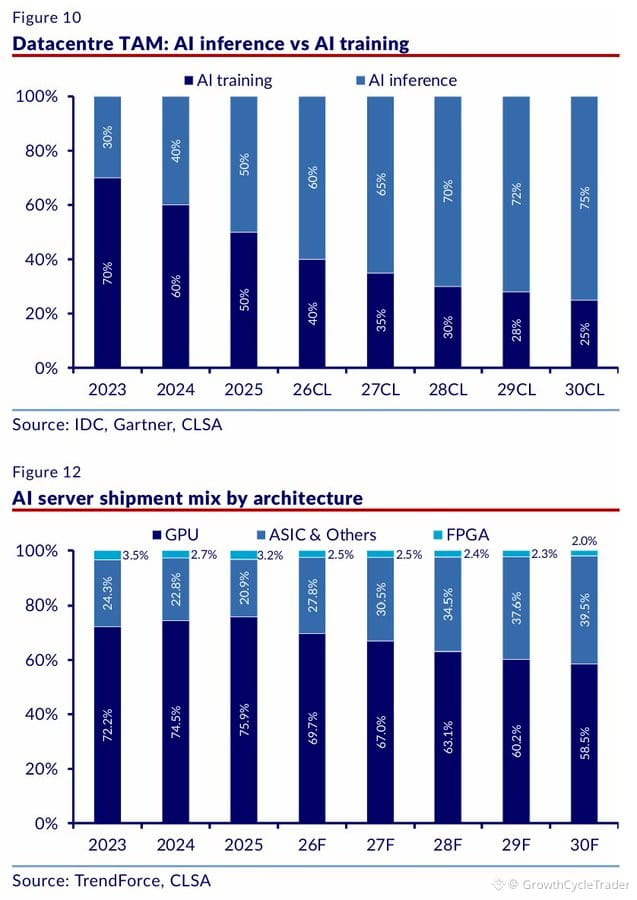
Inference is quietly becoming the next trillion-dollar supply chain story. In 2023, inference was roughly 30% of AI compute demand. By 2030, it's expected to hit 75%. Every chatbot, coding assistant, search engine, and agent will need constant compute power to respond in real time.
That shift changes the entire infrastructure stack.
$AVGO benefits because custom AI chips are projected to grow from 24% of AI server shipments in 2023 to nearly 40% by 2030. Marvell plays the networking side — AI clusters need high-speed optical connections to move data between thousands of chips.
Coherent and Lumentum supply the transceivers and lasers that push data through fiber at higher speeds. Celestica builds the actual servers, racks, and networking systems for cloud and AI customers.
Vertiv handles the heat problem. As AI racks get more powerful, air cooling stops working, which drives demand for liquid cooling and thermal management.
Eaton and Schneider Electric supply the electrical infrastructure — switchgear, power distribution, transformers, backup systems. Quanta Services builds the transmission lines that connect AI campuses to the grid.
Memory is another bottleneck. Inference requires models to stay loaded and respond instantly, which supports demand for high-bandwidth memory from $MU, SanDisk, SK Hynix, and Samsung.
Inference isn't just a software story. It's creating a second wave of physical infrastructure demand, and the supply chain is already pricing it in.
That shift changes the entire infrastructure stack.
$AVGO benefits because custom AI chips are projected to grow from 24% of AI server shipments in 2023 to nearly 40% by 2030. Marvell plays the networking side — AI clusters need high-speed optical connections to move data between thousands of chips.
Coherent and Lumentum supply the transceivers and lasers that push data through fiber at higher speeds. Celestica builds the actual servers, racks, and networking systems for cloud and AI customers.
Vertiv handles the heat problem. As AI racks get more powerful, air cooling stops working, which drives demand for liquid cooling and thermal management.
Eaton and Schneider Electric supply the electrical infrastructure — switchgear, power distribution, transformers, backup systems. Quanta Services builds the transmission lines that connect AI campuses to the grid.
Memory is another bottleneck. Inference requires models to stay loaded and respond instantly, which supports demand for high-bandwidth memory from $MU, SanDisk, SK Hynix, and Samsung.
Inference isn't just a software story. It's creating a second wave of physical infrastructure demand, and the supply chain is already pricing it in.