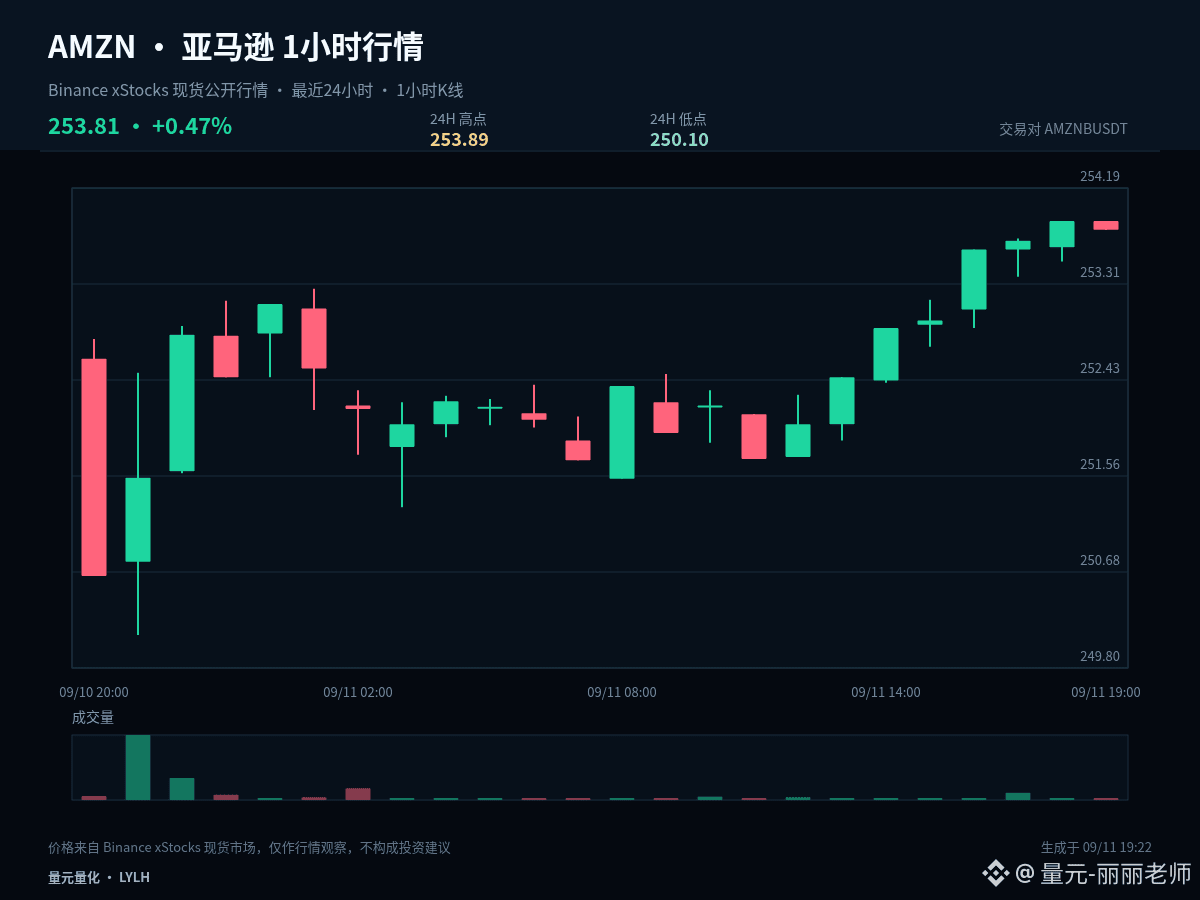
$AMZNB #AMZN In the past 24 hours, the high-low amplitude is about 1.5%, and the current price is 253.81. This is not a calm market suitable for opening a trade on a whim—when volatility expands, you should first adjust your position size, and only then discuss direction.
$AMZNB #AMZN has already moved to the upper edge of the last 24-hour range. At this point, the most important thing to confirm is whether there is a valid breakout, or just a push up followed by a pullback.
The current price is near the upper bound of the 24-hour volatility range: 1-hour -0.03%, 24-hour +0.45%. In the high area, what matters most is confirming the market’s acceptance after a breakout. If price can stay above the upper band, it shows the market recognizes the higher range; if it only briefly pierces and then quickly retreats, you need to guard against a false breakout.
For the short term, first watch whether 250.1 can form continuous support, then whether 251.995 can be reclaimed. The former determines whether the decline will slow down; the latter determines whether the rebound can strengthen. Without confirmation of both, it’s not advisable to judge opportunities based solely on the size of the drop.
In a high-volatility phase, the execution principles are to reduce single-trade exposure, avoid chasing prices back and forth in the middle of the range, and write the invalidation conditions before entering. If the price does not provide confirmation, it’s better to do one fewer trade than to use a larger position size to compensate for uncertainty.
My scenario analysis is not betting on only one direction. If price breaks above 253.89 and can hold, it means the upside space has been reopened; if it breaks below 250.1 and cannot reclaim on the retest, it means the structure is further weakening. If it’s operating between the two, then continue observing the closing conditions on both sides around 251.995.
Risk control is still placed before any conclusion: only execute when conditions are met, and re-evaluate promptly if price invalidates your thesis. The greater the volatility, the more restrained you should be with single-position sizing. The above is a market scenario projection based on the current 1-hour and 24-hour data, and it does not constitute any promise of returns.
#USToSanctionBigBankMonday
$AMZNB #AMZN has already moved to the upper edge of the last 24-hour range. At this point, the most important thing to confirm is whether there is a valid breakout, or just a push up followed by a pullback.
The current price is near the upper bound of the 24-hour volatility range: 1-hour -0.03%, 24-hour +0.45%. In the high area, what matters most is confirming the market’s acceptance after a breakout. If price can stay above the upper band, it shows the market recognizes the higher range; if it only briefly pierces and then quickly retreats, you need to guard against a false breakout.
For the short term, first watch whether 250.1 can form continuous support, then whether 251.995 can be reclaimed. The former determines whether the decline will slow down; the latter determines whether the rebound can strengthen. Without confirmation of both, it’s not advisable to judge opportunities based solely on the size of the drop.
In a high-volatility phase, the execution principles are to reduce single-trade exposure, avoid chasing prices back and forth in the middle of the range, and write the invalidation conditions before entering. If the price does not provide confirmation, it’s better to do one fewer trade than to use a larger position size to compensate for uncertainty.
My scenario analysis is not betting on only one direction. If price breaks above 253.89 and can hold, it means the upside space has been reopened; if it breaks below 250.1 and cannot reclaim on the retest, it means the structure is further weakening. If it’s operating between the two, then continue observing the closing conditions on both sides around 251.995.
Risk control is still placed before any conclusion: only execute when conditions are met, and re-evaluate promptly if price invalidates your thesis. The greater the volatility, the more restrained you should be with single-position sizing. The above is a market scenario projection based on the current 1-hour and 24-hour data, and it does not constitute any promise of returns.
#USToSanctionBigBankMonday