
静姐6888
1k Posts

静姐6888
光明社区核心贡献者|| 推动BSC链上透明Meme实验。We believe in radical transparency—no rug || no hidden wallets, all on-chain.开播:下午2:30-5:30 || X:like8TJ
Open Trade

BNB Holder
Occasional Trader
1.2 Years
1.4K+ Following
25.7K+ Followers
13.5K+ Liked
Posts
Portfolio
All
Quotes
Live
PINNED



静静Amily
·
--
[Ended] 🎙️ The market trend these days is confusing—what do you all think?
6.2k listens

灰s1688
·
--
Brothers, stay steady—the bull is coming up to the surface🧧
$BNB 🎁
$BNB 🎁


路人1688luren
·
--
#美联储加息是否已成定局
$BTC Make a bold prediction. If the clear bill is not passed tonight, and then the Fed rate hike is implemented as well, things will get extremely hawkish—double bearish pressure! Bitcoin will fall straight back into the 60s. $ETH Will directly break below 2000! Bear market, start!
$BTC Make a bold prediction. If the clear bill is not passed tonight, and then the Fed rate hike is implemented as well, things will get extremely hawkish—double bearish pressure! Bitcoin will fall straight back into the 60s. $ETH Will directly break below 2000! Bear market, start!



远方1688BNB
·
--
You don’t have to live as a “standard answer”
Keep going seriously
That’s your own answer
#定投BTC #定投BNB
Keep going seriously
That’s your own answer
#定投BTC #定投BNB


听澜321
·
--
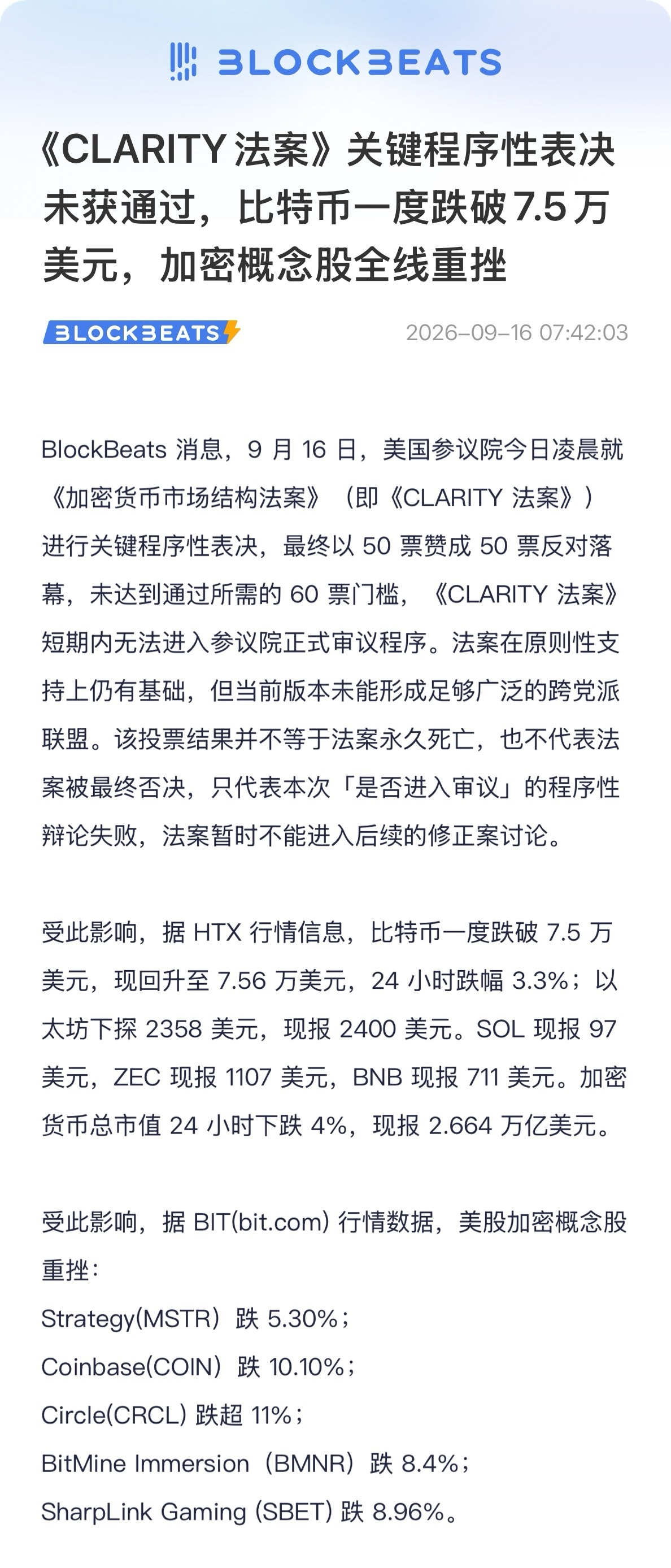
The CLARITY Act results are in: it didn’t pass!
50 in favor, 50 against—didn’t even reach the 60-vote threshold 🤔
Not a single Democrat flipped; all voted “No.”
Also, three Republicans ended up turning against it.
After this vote, Congress is immediately set to recess and prepare for the midterm elections in mid-November—2026 is basically a lost cause…
The market reaction was very honest.
$BTC briefly dipped below $77,000, falling more than 5% intraday. Circle plunged 11%, while Coinbase dropped over 9%. The funds that had bet the bill would pass were effectively buried the moment the vote result came out 🤯
Why did it die? On the surface, it’s about crypto regulation—really, it’s the business interests of the Trump family.
Democrats insisted on limiting officials from profiting from crypto.
Warren went straight for the jugular in the Senate: the Trump family earned $1.4 billion from crypto business in 2025—“more than any U.S.-listed crypto company.”
The Republicans’ revised ethics provisions weren’t enough.
They dismissed them as a “small little fig leaf” 😂
But there’s one thing we need to understand: even though the bill is dead, regulation hasn’t stopped.
The SEC is already pushing forward its own token issuance framework, and the CFTC is also approving perpetual contract products.
It’s just that these are “institutional rules”—they could be overturned by a change of administration. They’re not as stable as enacted law.
I think you should still not treat “clear regulation” as a short-term bullish catalyst for trading.
The essence of this vote is that “the two parties couldn’t reach a deal.”
The core contradiction never got resolved from the beginning—this pace is much slower than you think. Let’s see again after the midterm elections~
#贝森特支持CLARITY法案终稿 #美联储加息是否已成定局
50 in favor, 50 against—didn’t even reach the 60-vote threshold 🤔
Not a single Democrat flipped; all voted “No.”
Also, three Republicans ended up turning against it.
After this vote, Congress is immediately set to recess and prepare for the midterm elections in mid-November—2026 is basically a lost cause…
The market reaction was very honest.
$BTC briefly dipped below $77,000, falling more than 5% intraday. Circle plunged 11%, while Coinbase dropped over 9%. The funds that had bet the bill would pass were effectively buried the moment the vote result came out 🤯
Why did it die? On the surface, it’s about crypto regulation—really, it’s the business interests of the Trump family.
Democrats insisted on limiting officials from profiting from crypto.
Warren went straight for the jugular in the Senate: the Trump family earned $1.4 billion from crypto business in 2025—“more than any U.S.-listed crypto company.”
The Republicans’ revised ethics provisions weren’t enough.
They dismissed them as a “small little fig leaf” 😂
But there’s one thing we need to understand: even though the bill is dead, regulation hasn’t stopped.
The SEC is already pushing forward its own token issuance framework, and the CFTC is also approving perpetual contract products.
It’s just that these are “institutional rules”—they could be overturned by a change of administration. They’re not as stable as enacted law.
I think you should still not treat “clear regulation” as a short-term bullish catalyst for trading.
The essence of this vote is that “the two parties couldn’t reach a deal.”
The core contradiction never got resolved from the beginning—this pace is much slower than you think. Let’s see again after the midterm elections~
#贝森特支持CLARITY法案终稿 #美联储加息是否已成定局

橙子Joyce
·
--
BullishWill the Federal Reserve raise rates as expected this week? Wall Street is debating: will it end the U.S. stock bull market?
After an unexpectedly strong U.S. CPI report came out last Friday, traders generally expect the Federal Reserve to begin raising rates at this week’s policy meeting—marking the first rate hike in more than three years.
Historically, previous rounds of rate hikes have offered a reference point for today’s market. Based on past experience (though history of course can’t guarantee the future), U.S. stocks may first weaken, then rebound.
Among the six tightening cycles since 1994, during the first four months after the rate-hike cycle began, the S&P 500’s average return was negative.
This suggests that once the “rate-hike shoe” drops, U.S. stocks may look lackluster through the beginning of next year.
As of the close last Friday, the benchmark U.S. equity index, the S&P 500, is up nearly 12% year to date. Strong corporate earnings and a fairly resilient economy have provided solid support for bulls in the stock market.
If you extend the time horizon, the S&P 500’s performance tends to improve gradually: in the 12 months after the start of a rate-hiking cycle, the index’s average return is close to 7%, with a median return of about 11%. (Using median-based statistics helps remove distortions from extreme outliers—for example, the index surged more than 40% after hikes began in March 1997.)
If the Federal Reserve implements a rate hike this Wednesday, it will be the first hike since July 2023—when the Fed raised rates to a range of 5.25% to 5.50%.
Currently, the federal funds rate in the U.S. is at 3.50% to 3.75%. According to the CME Group’s FedWatch tool, futures traders currently assign an 86% probability to a 25-basis-point hike this week.
One positive factor for the market is that mega-scale cloud service providers are still driving growth in excess returns through large-scale AI spending. The S&P 500 component stocks’ forecast for earnings growth in 2027 is expected to reach double digits. If the outlook for AI spending remains unchanged, it may be enough to offset any cooling in optimistic sentiment caused by the rate hikes.
Another bright spot for equities is that although inflation remains sticky, it appears to be slowing. The inflation rate has fallen from a May peak of 4.2%. This should allow the Federal Reserve to take a more gradual approach, and the data shows that the pace of rate hikes is crucial for stock performance—slower pacing gives investors more time to absorb policy changes!
$BZ
$CL
Energy
After an unexpectedly strong U.S. CPI report came out last Friday, traders generally expect the Federal Reserve to begin raising rates at this week’s policy meeting—marking the first rate hike in more than three years.
Historically, previous rounds of rate hikes have offered a reference point for today’s market. Based on past experience (though history of course can’t guarantee the future), U.S. stocks may first weaken, then rebound.
Among the six tightening cycles since 1994, during the first four months after the rate-hike cycle began, the S&P 500’s average return was negative.
This suggests that once the “rate-hike shoe” drops, U.S. stocks may look lackluster through the beginning of next year.
As of the close last Friday, the benchmark U.S. equity index, the S&P 500, is up nearly 12% year to date. Strong corporate earnings and a fairly resilient economy have provided solid support for bulls in the stock market.
If you extend the time horizon, the S&P 500’s performance tends to improve gradually: in the 12 months after the start of a rate-hiking cycle, the index’s average return is close to 7%, with a median return of about 11%. (Using median-based statistics helps remove distortions from extreme outliers—for example, the index surged more than 40% after hikes began in March 1997.)
If the Federal Reserve implements a rate hike this Wednesday, it will be the first hike since July 2023—when the Fed raised rates to a range of 5.25% to 5.50%.
Currently, the federal funds rate in the U.S. is at 3.50% to 3.75%. According to the CME Group’s FedWatch tool, futures traders currently assign an 86% probability to a 25-basis-point hike this week.
One positive factor for the market is that mega-scale cloud service providers are still driving growth in excess returns through large-scale AI spending. The S&P 500 component stocks’ forecast for earnings growth in 2027 is expected to reach double digits. If the outlook for AI spending remains unchanged, it may be enough to offset any cooling in optimistic sentiment caused by the rate hikes.
Another bright spot for equities is that although inflation remains sticky, it appears to be slowing. The inflation rate has fallen from a May peak of 4.2%. This should allow the Federal Reserve to take a more gradual approach, and the data shows that the pace of rate hikes is crucial for stock performance—slower pacing gives investors more time to absorb policy changes!
$BZ
$CL
Energy

心月势不可挡
·
--
In the early hours of September 16, Beijing time, the U.S. Senate delivered its result on a procedural vote regarding the “Clarity Act” for the digital assets market. The bill failed to clear the 60-vote threshold, so it cannot move on to the next stage of formal consideration. The highly anticipated crypto regulatory legislation—one that the industry had pinned great hopes on—has, for now, been stalled.
One point needs to be clarified: this time, the bill was not directly rejected. Instead, it failed at the procedural step required to advance. The bill remains on the congressional calendar, and in theory there is still a possibility of being brought back for reconsideration. However, given the pace of congressional proceedings, the likelihood of it being enacted again within 2026 has become extremely low.
What problem the bill was originally meant to address
The bill is widely seen as a landmark piece of legislation in the crypto industry. Its core goal is to clarify regulatory authority and responsibilities: to define the jurisdictional boundaries between the SEC and the CFTC; to lay out a federal-level compliance path for crypto exchanges and stablecoin projects; and to put an end to the long-standing situation where “regulation relies on enforcement actions and the rules are unclear.”
For a long time, the biggest pain point for the crypto industry has been vague and ambiguous rules. Institutional capital wants to enter the market but lacks a unified legal benchmark. Ordinary investors also face the risk of platform blowups and having no clear path to seek redress. Industry stakeholders from multiple sides have spent significant effort lobbying and negotiating, hoping that this bill could end the regulatory gray area.
Why it ultimately failed to clear the threshold
The bill was stalled due to irreconcilable disagreements between the two parties.
On the Democratic side, the view is that the existing version does not provide sufficient strength on consumer protection, anti-money laundering, and risk controls. They worry that the bill would give the industry overly relaxed space, sowing hidden financial risk vulnerabilities. Some Republican lawmakers, meanwhile, are concerned that expanding regulatory authority would raise compliance costs for businesses and dampen the innovative momentum of digital asset development.
Even though the legislative team revised the provisions multiple times and added patches such as interest-constraint measures for public officials, the core conflict still could not be bridged. In the end, the vote margin was clearly insufficient, and it failed to meet the Senate’s hard requirements to advance the bill.
One point needs to be clarified: this time, the bill was not directly rejected. Instead, it failed at the procedural step required to advance. The bill remains on the congressional calendar, and in theory there is still a possibility of being brought back for reconsideration. However, given the pace of congressional proceedings, the likelihood of it being enacted again within 2026 has become extremely low.
What problem the bill was originally meant to address
The bill is widely seen as a landmark piece of legislation in the crypto industry. Its core goal is to clarify regulatory authority and responsibilities: to define the jurisdictional boundaries between the SEC and the CFTC; to lay out a federal-level compliance path for crypto exchanges and stablecoin projects; and to put an end to the long-standing situation where “regulation relies on enforcement actions and the rules are unclear.”
For a long time, the biggest pain point for the crypto industry has been vague and ambiguous rules. Institutional capital wants to enter the market but lacks a unified legal benchmark. Ordinary investors also face the risk of platform blowups and having no clear path to seek redress. Industry stakeholders from multiple sides have spent significant effort lobbying and negotiating, hoping that this bill could end the regulatory gray area.
Why it ultimately failed to clear the threshold
The bill was stalled due to irreconcilable disagreements between the two parties.
On the Democratic side, the view is that the existing version does not provide sufficient strength on consumer protection, anti-money laundering, and risk controls. They worry that the bill would give the industry overly relaxed space, sowing hidden financial risk vulnerabilities. Some Republican lawmakers, meanwhile, are concerned that expanding regulatory authority would raise compliance costs for businesses and dampen the innovative momentum of digital asset development.
Even though the legislative team revised the provisions multiple times and added patches such as interest-constraint measures for public officials, the core conflict still could not be bridged. In the end, the vote margin was clearly insufficient, and it failed to meet the Senate’s hard requirements to advance the bill.


光明社区-赫方
·
--
Take a brief pause in life’s busyness, and steal a moment of quiet. Let go of worldly distractions, close your eyes to rest and recharge, and gather strength to return to everyday life amid the bustle of the world.


奋斗Hustle1688
·
--
[Replay] 🎙️ DCA into BNB and chatting about the crypto bill
02 h 41 m 14 s · 5.7k listens
奋斗Hustle1688
·
--
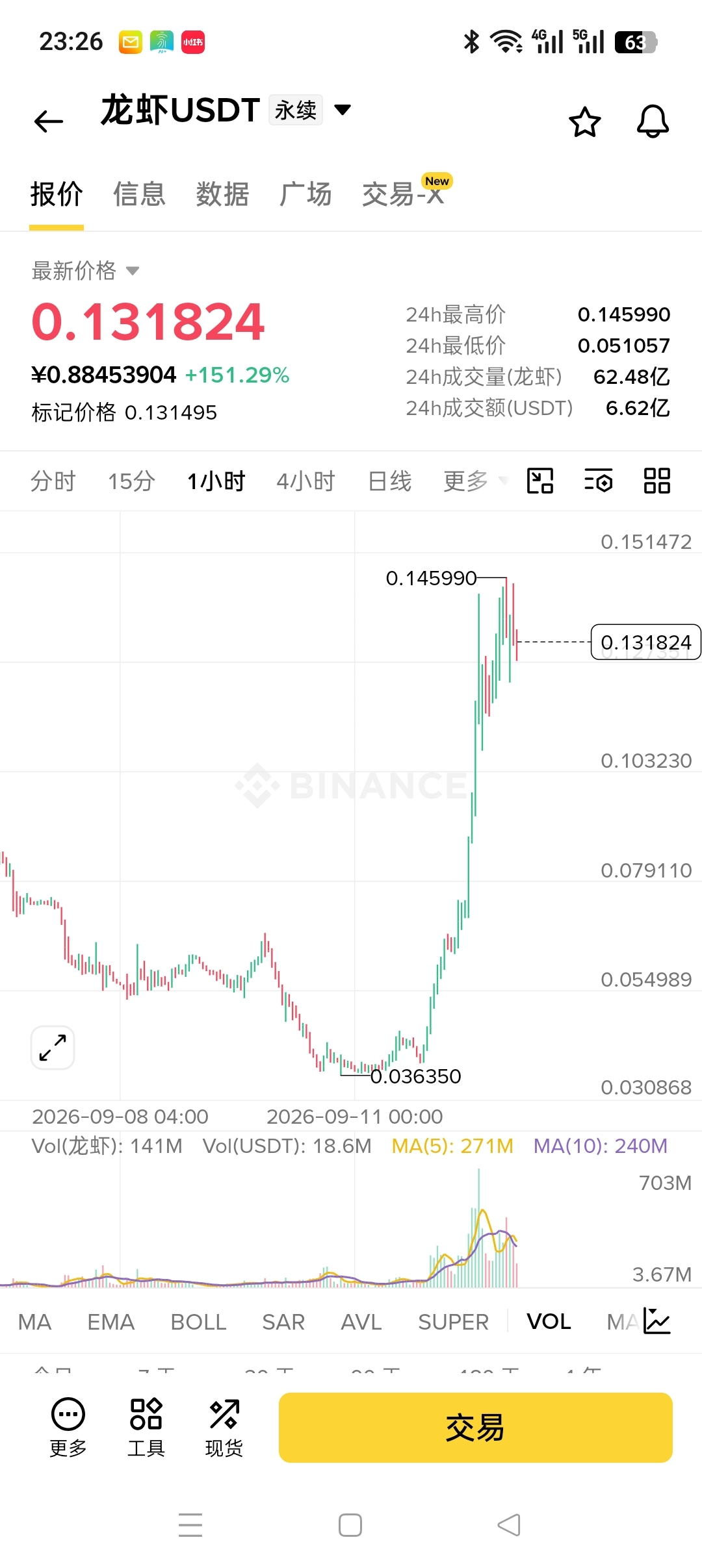
$龙虾 is insanely amazing, up by almost 20x, and it just broke the previous high again. Will it hit 1 USDT this time?

阿婧1688
·
--
Chase the wind and ride the waves, heading for the azure sea. Take the helm of a jet ski and race across the water’s surface—let the sea breeze brush through your hair, watch the splashing waves bloom at your side, cast your worries into the blue, and fully enjoy a free and passionate time.


慢就是快Mike
·
--
$ZEC Trump publicly stated that he will respect any interest rate decision made by the Federal Reserve Chair Kevin Warsh tomorrow at the FOMC meeting. However, he added a half-joking remark: if Warsh chooses to cut rates, he would “respect him even more.”
Nearly everyone in the market is betting that rate hikes are already a foregone conclusion. Therefore, the real focus has shifted from “whether there will be a rate hike” to Warsh’s policy remarks after the meeting: over the rest of this year, how many more times could the Federal Reserve still raise rates? Will he overall be more dovish or more hawkish? These are the key signals that will determine the direction of the markets afterward!
Nearly everyone in the market is betting that rate hikes are already a foregone conclusion. Therefore, the real focus has shifted from “whether there will be a rate hike” to Warsh’s policy remarks after the meeting: over the rest of this year, how many more times could the Federal Reserve still raise rates? Will he overall be more dovish or more hawkish? These are the key signals that will determine the direction of the markets afterward!


杨乐-光明社区
·
--
Every immortal has their own mountain,
and every bodhisattva has their own temple.
You must have your own place of practice.
This is a remedy of great value.
Good morning 🌻
and every bodhisattva has their own temple.
You must have your own place of practice.
This is a remedy of great value.
Good morning 🌻


灼见
·
--
🚨 The Fed rate hike—is it already a done deal?
Now, the market’s answer is already very close:
YES.
The latest market pricing shows the probability of the Fed hiking rates by 25BP today has reached over 90%.
If it happens, the target range for the Federal Funds rate will move from:
3.50%–3.75%
to:
3.75%–4.00%
But I think what Crypto truly needs to focus on today is no longer:
“Will the Fed hike or not?”
Because when an event is already priced in by more than 90%,
what usually creates volatility is—
something unexpected.
There are three possible scenarios:
🟡 Scenario 1: Hike 25BP, but Warsh is more dovish
If the Fed tells the market:
“This is just a policy adjustment; it doesn’t mean a new sequence of consecutive hikes has started.”
Then you could see a very interesting move:
The risk assets could actually rise after the hike is implemented.
Reason is simple:
Everyone already knew they were going to hike.
⸻
🔴 Scenario 2: Hike 25BP + clearly signals more hikes ahead
This could be the real source of pressure.
Because the market won’t just be trading a single 25BP move anymore;
it becomes:
NEW HIKING CYCLE?
The U.S. dollar, Treasury yields, and global liquidity will all be repriced.
That’s the real stress test for $BTC, $ETH, and $BNB.
⸻
🟢 Scenario 3: An unexpected no-hike
The probability is low, but precisely because it’s low,
if it happens, the market reaction could be the biggest.
The dollar could drop quickly,
and risk assets could see intense volatility.
⸻
So tonight,
I won’t just be watching the news headline:
“FED +25BP”
What I’m really watching are a few words from Warsh’s press conference:
ONE-OFF?
Or:
MORE HIKES AHEAD?
Because for Crypto,
one already Price In 25BP may not be the most terrifying part.
What matters most is:
Today is it just a single rate hike,
or the start of a new hiking cycle?
If the market ultimately finds that—
“It’s only this one time.”
Then tonight’s biggest surprise might not be the hike.
Instead, it could be:
After the hike, BTC still can’t drop.
👇 What do you think about tonight’s Fed?
Hike and stop once 🟢 / Keep hiking 🔴
#BTC #ETH #BNB
Now, the market’s answer is already very close:
YES.
The latest market pricing shows the probability of the Fed hiking rates by 25BP today has reached over 90%.
If it happens, the target range for the Federal Funds rate will move from:
3.50%–3.75%
to:
3.75%–4.00%
But I think what Crypto truly needs to focus on today is no longer:
“Will the Fed hike or not?”
Because when an event is already priced in by more than 90%,
what usually creates volatility is—
something unexpected.
There are three possible scenarios:
🟡 Scenario 1: Hike 25BP, but Warsh is more dovish
If the Fed tells the market:
“This is just a policy adjustment; it doesn’t mean a new sequence of consecutive hikes has started.”
Then you could see a very interesting move:
The risk assets could actually rise after the hike is implemented.
Reason is simple:
Everyone already knew they were going to hike.
⸻
🔴 Scenario 2: Hike 25BP + clearly signals more hikes ahead
This could be the real source of pressure.
Because the market won’t just be trading a single 25BP move anymore;
it becomes:
NEW HIKING CYCLE?
The U.S. dollar, Treasury yields, and global liquidity will all be repriced.
That’s the real stress test for $BTC, $ETH, and $BNB.
⸻
🟢 Scenario 3: An unexpected no-hike
The probability is low, but precisely because it’s low,
if it happens, the market reaction could be the biggest.
The dollar could drop quickly,
and risk assets could see intense volatility.
⸻
So tonight,
I won’t just be watching the news headline:
“FED +25BP”
What I’m really watching are a few words from Warsh’s press conference:
ONE-OFF?
Or:
MORE HIKES AHEAD?
Because for Crypto,
one already Price In 25BP may not be the most terrifying part.
What matters most is:
Today is it just a single rate hike,
or the start of a new hiking cycle?
If the market ultimately finds that—
“It’s only this one time.”
Then tonight’s biggest surprise might not be the hike.
Instead, it could be:
After the hike, BTC still can’t drop.
👇 What do you think about tonight’s Fed?
Hike and stop once 🟢 / Keep hiking 🔴
#BTC #ETH #BNB


⁰MR RAJ⁰
·
--
Bullish22 years later, Voyager 1’s “dead” thrusters roared back to life, keeping the legendary spacecraft connected to Earth. 🚀❤️
$CVC $LSK $FIL
#AnthropicCEOCallsForAISlowdown #CPIWatch #BitcoinThirdSingleBlockReorgInFourWeeks #WhiteHouseRejectsAISlowdownCalls #UKMayExemptTokenizedGoldFromFundRules
$CVC $LSK $FIL
#AnthropicCEOCallsForAISlowdown #CPIWatch #BitcoinThirdSingleBlockReorgInFourWeeks #WhiteHouseRejectsAISlowdownCalls #UKMayExemptTokenizedGoldFromFundRules


白鲨观点
·
--
Have you ever had this feeling?
You pick a coin you think will do well, watch it for a long time, don’t buy the whole time, and then it keeps rising. The higher it goes, the more afraid you are to buy. Finally, one day you can’t take it anymore and rush in—only to buy and watch it drop.
Or the other way around: you hold a coin that keeps falling. The more it drops, the harder it is for you to bring yourself to sell. Finally, one day you can’t hold on any longer and cut your position. Right after you sell, it starts to rise.
It’s like the market is watching your money specifically. When you buy it drops; when you sell it rises—so precise it’s unbelievable.
I used to think it was just bad luck on my part, or that my technical skills weren’t good enough. Later I realized it wasn’t that at all. The reason you keep buying at the highest point and selling at the lowest is because you’re thinking the same way most people do.
The market makes money from the majority. When most people can’t resist wanting to buy, that’s the top; when most people can’t stand holding on and want to sell, that’s the bottom. Since you’re just like the majority, you naturally end up being the one who gets harvested.
So sometimes, when it comes to trading, you have to think the other way around.
When you especially want to buy, hold back a bit—you might just avoid the top;
When you especially want to sell, stay the course—you might just make it through the bottom.
Of course, it sounds easy, but it’s hard to do. I’ve been trading for so many years myself, and I still fall into this mistake from time to time. Human nature isn’t something you can change just like that.
But at least you have to know what your problem is,
and once you know it, you can gradually fix it.
At 9 PM tonight, I’ll chat in the chat room about "how to overcome the mindset of chasing pumps and panic-selling." Just sharing—no coin calls. If you want to join, come in through my profile.
$BTC #BinanceSquare #BTC #交易心态 #交易心得以所以分享给大家,如果有欠缺的地方和不对的地方欢迎大佬指点批评,纯手打画图码字,如果觉得还不
You pick a coin you think will do well, watch it for a long time, don’t buy the whole time, and then it keeps rising. The higher it goes, the more afraid you are to buy. Finally, one day you can’t take it anymore and rush in—only to buy and watch it drop.
Or the other way around: you hold a coin that keeps falling. The more it drops, the harder it is for you to bring yourself to sell. Finally, one day you can’t hold on any longer and cut your position. Right after you sell, it starts to rise.
It’s like the market is watching your money specifically. When you buy it drops; when you sell it rises—so precise it’s unbelievable.
I used to think it was just bad luck on my part, or that my technical skills weren’t good enough. Later I realized it wasn’t that at all. The reason you keep buying at the highest point and selling at the lowest is because you’re thinking the same way most people do.
The market makes money from the majority. When most people can’t resist wanting to buy, that’s the top; when most people can’t stand holding on and want to sell, that’s the bottom. Since you’re just like the majority, you naturally end up being the one who gets harvested.
So sometimes, when it comes to trading, you have to think the other way around.
When you especially want to buy, hold back a bit—you might just avoid the top;
When you especially want to sell, stay the course—you might just make it through the bottom.
Of course, it sounds easy, but it’s hard to do. I’ve been trading for so many years myself, and I still fall into this mistake from time to time. Human nature isn’t something you can change just like that.
But at least you have to know what your problem is,
and once you know it, you can gradually fix it.
At 9 PM tonight, I’ll chat in the chat room about "how to overcome the mindset of chasing pumps and panic-selling." Just sharing—no coin calls. If you want to join, come in through my profile.
$BTC #BinanceSquare #BTC #交易心态 #交易心得以所以分享给大家,如果有欠缺的地方和不对的地方欢迎大佬指点批评,纯手打画图码字,如果觉得还不


Elena神话MUA
·
--
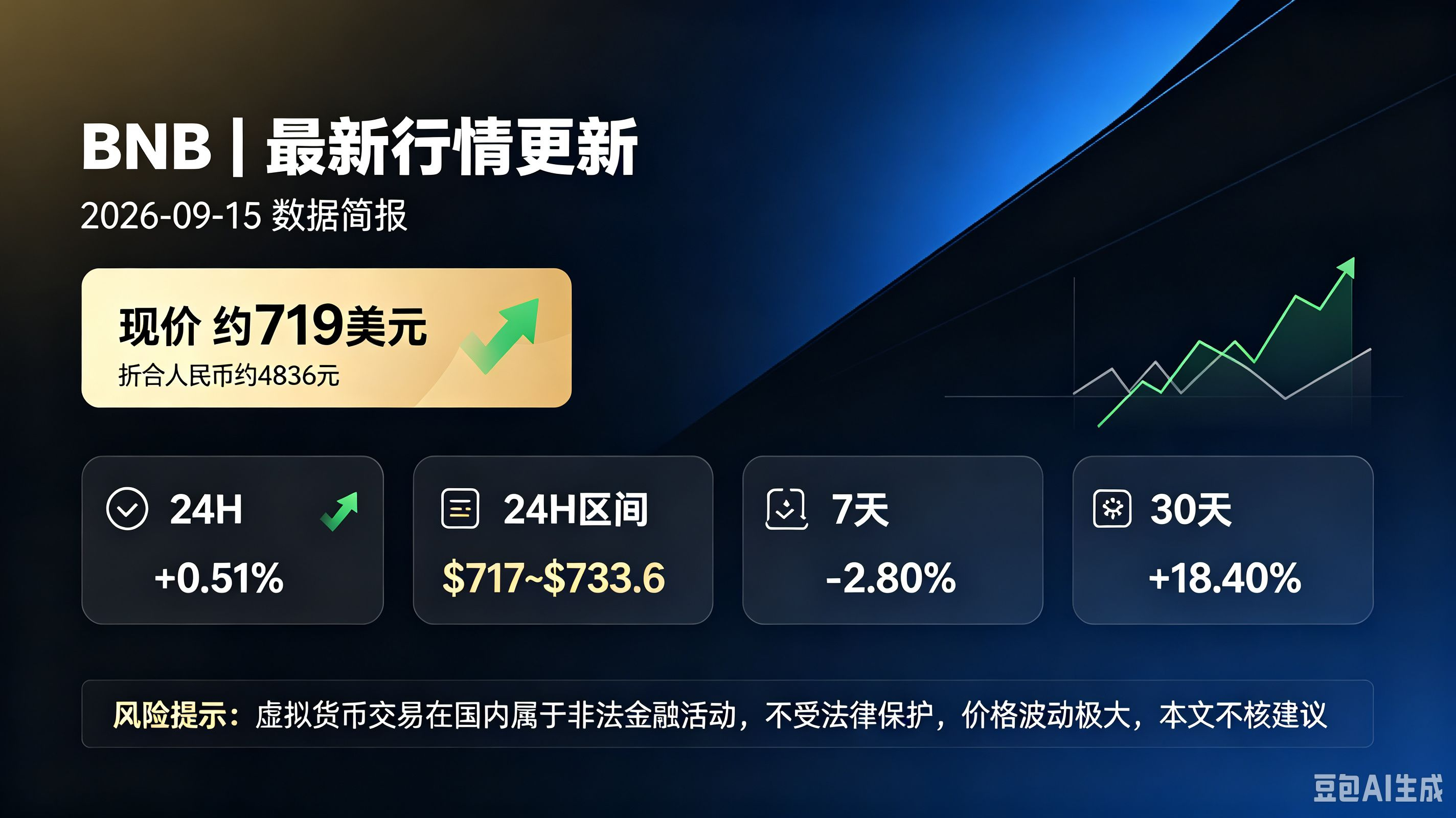
#MUA $BNB (BNB) market (2026-09-15)
- Current price: about $719 (equivalent to about RMB 4,836)
- 24 hours: slight increase of about +0.51%; 24H range $717~$733.6
- 7 days: -2.80%; 30 days: +18.40%
- Circulating market cap: about RMB 967.2 billion
Key points in the recent period
1. BNB is a platform token. Its price is heavily influenced by the Binance platform’s operations, regulatory news, and movements in the broader market, resulting in sharp volatility
2. Market news and regulatory policies can cause significant rises and falls at any time; the risks of futures trading are amplified by $BTC times
- Current price: about $719 (equivalent to about RMB 4,836)
- 24 hours: slight increase of about +0.51%; 24H range $717~$733.6
- 7 days: -2.80%; 30 days: +18.40%
- Circulating market cap: about RMB 967.2 billion
Key points in the recent period
1. BNB is a platform token. Its price is heavily influenced by the Binance platform’s operations, regulatory news, and movements in the broader market, resulting in sharp volatility
2. Market news and regulatory policies can cause significant rises and falls at any time; the risks of futures trading are amplified by $BTC times

奋斗Hustle-1688
·
--
$BTC Hike rates already—stop threatening people every day. Once the shoe drops, the bad news is exhausted, and it directly turns into positives.

Log in to explore more content