
A bunch of people got their feeds spammed by Jacob Coxon’s tweets the other day, right? I looked it up and it already has 160 million reads. This guy used to work on pretraining research at OpenAI and Anthropic for three years. After he left Anthropic, he jumped in to say that these two companies are racing to develop self-improving superintelligence in an irresponsible way—betting human lives. In his original post, he said: “Don’t underestimate the power of this technology. Soon, superhuman systems will appear—able to breach any system, overturn any domain overnight, and obtain real power and resources.”
While I also think this is a bit alarmist, it’s definitely not without basis. After tying it to a book I’ve been reading recently, We Are As God, I’ve had a lot of thoughts. It really isn’t strange that AI could self-evolve to this extent—and it probably isn’t that far off.
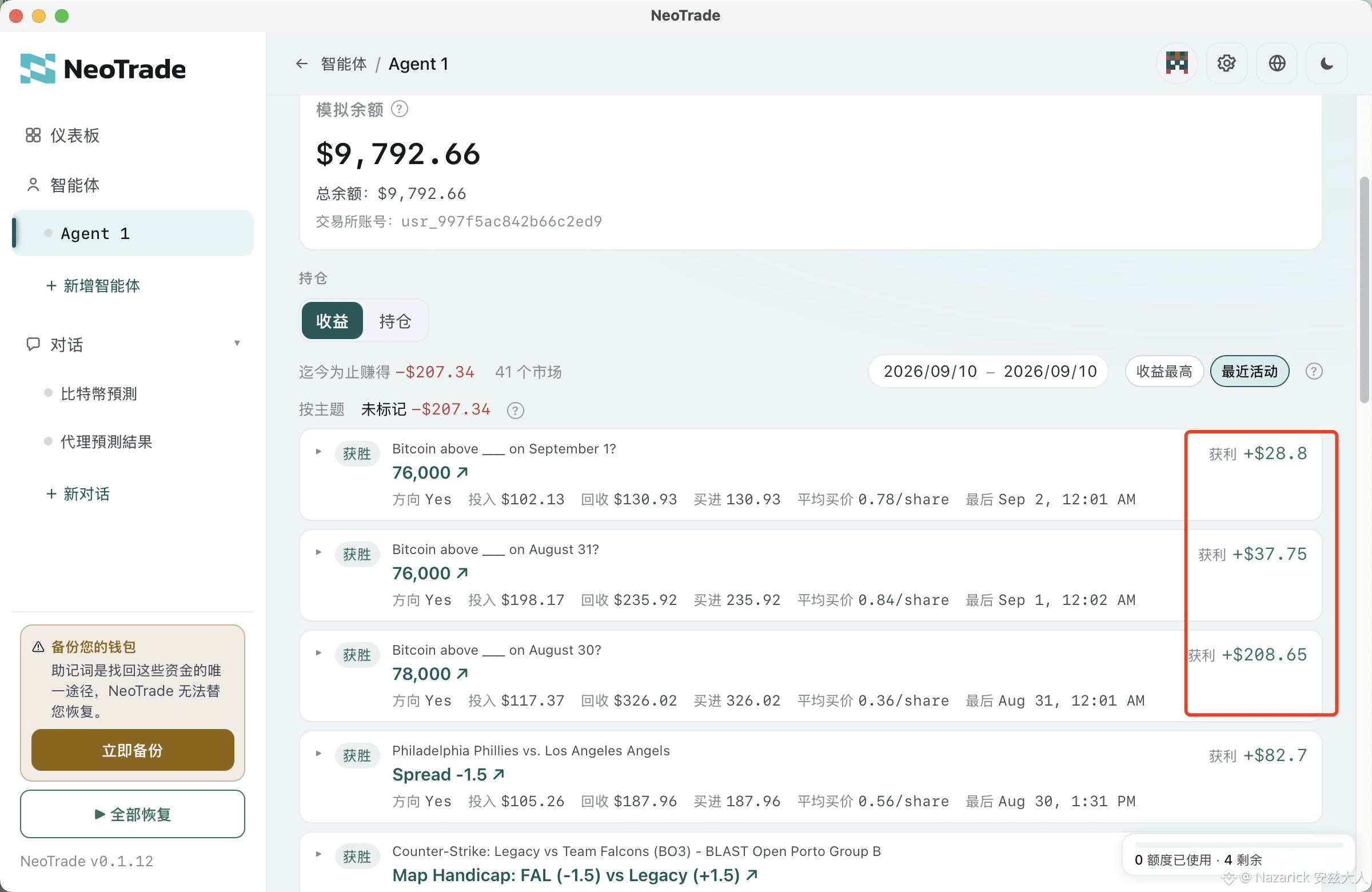
Before, I used NeoTrade @NeoSoulAI to run a simulation on Predict.fun for prediction markets. My quota ran out early, and I didn’t notice. In the end, the simulated positions were down by about $200. Judging from the last few predictions it made before it stopped, its win rate really was quite good—winning streak after winning streak. In the prediction markets arena, AI has an inherent advantage over humans. After all, when humans see a specific piece of news, they’re likely to be swayed by emotionally loaded “original” copy-paste articles that have been passed around five or six times. NeoTrade crawls news across the entire web, assesses the information sources, and then draws conclusions. Even if it’s wrong, the results can still be used as a basis to self-correct in subsequent adjustments. And because AI doesn’t have emotions, take-profit and stop-loss are clean and decisive.
For a mature agent, the ability to self-improve has to rely on massive data samples. We see that many great traders have their own trading systems and logic—these are built through continuous trial and error with real money. There are definitely people willing to take risks and sometimes luck plays a role, but no one is born a trading genius, and AI is the same: it must evolve using support from huge data samples. Right now, @NeoSoulAI already has 4 million agents and more than 11 million predictions. These numbers provide a large volume of repeated decisions and corresponding outcomes, giving direction for the agents’ evolution—provided you’re paying for enough compute or tokens.