
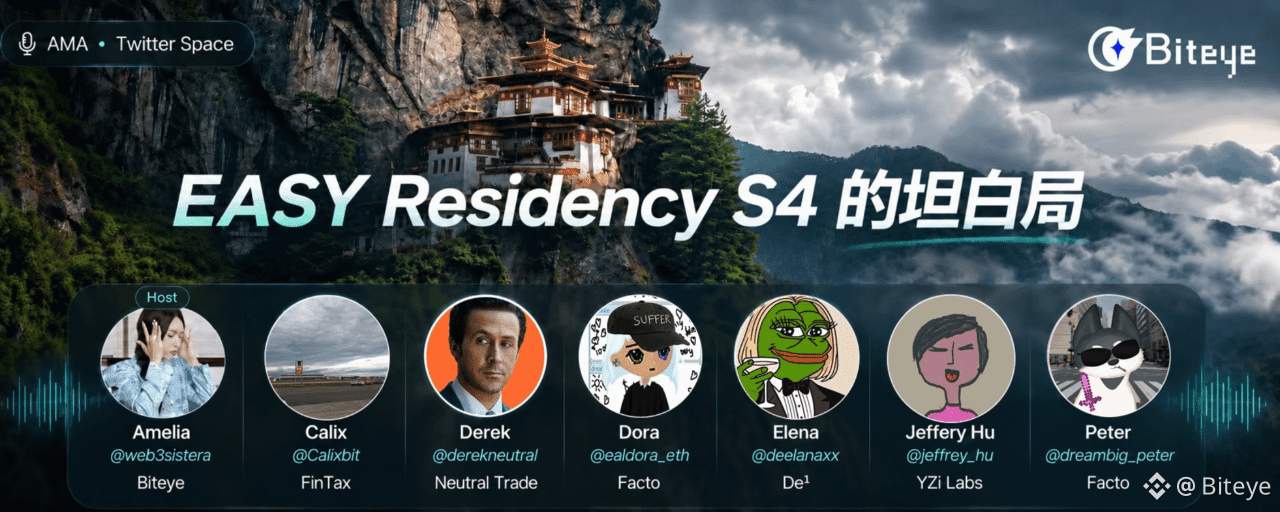

📅On the evening of September 2, Biteye hosted an online AMA, inviting the @easyresidency S4 founders who just returned from Bhutan to look back together on the little moments of those five weeks of life in Bhutan.
💡Guests sharing include:
Calix (@calixbit), Founder and CEO of @FinTax_Official
Dora (@realdora_eth), Co-founder of @facto_to
Elena (@deelenaxx), Co-founder of @de1_ai
Jeffrey (@jeffrey_hu), Investment Director at @yzilabs
Peter (@dreambig_peter), Co-founder of @facto_to
Here’s a warm memory share from this segment👇😘
Question 1: When you first landed in Bhutan, what were you thinking about? Which moment was the most unforgettable?
Elena:
It takes an hour and a half of mountain road to get from the airport to the hotel. Along the way, the mountains, the buildings, and the local humanistic sights made me instantly realize this place is very different from the bustling big cities. My whole self quieted down from the breakneck rhythm of always pushing forward.
At the time, I thought that living together and building together for five weeks with a group of excellent founders would mean more than just project progress. It would also mean deeper exchanges between people—and an opportunity to rethink “why we started.”
The hardest-to-forget thing for me happened on a day of heavy rain. The four people in the car couldn’t find the destination. The driver didn’t complain or show impatience—he just kept smiling, detouring to ask for directions, and finally got us there. Similar details kept repeating throughout those five weeks, and I could feel the local people’s kindness and calmness. After leaving the daily high-speed routine, I also started asking again: we talk about AI, financial innovation, and building faster every day—but in the end, what is it all really for?
Dora:
I took a small plane from Nepal to reach Bhutan. When we landed, I saw Calix and Jeffrey. Everyone wasn’t familiar yet—we just greeted politely. On the way to the hotel, we talked about each other’s projects. It was the first time I became more concretely aware that the work this cohort was doing was quite different, yet each person was excellent.
What I’ll never forget was the day before Demo Day. Chris and I returned to the office with Jon to pack up the keyboards and computer stands that everyone had left behind. A space that had been full of people just a few weeks ago had already been cleared out. We still walked the familiar route and entered the office as usual—but there was only the stuff to pack. Only at that moment did I truly realize this shared living experience was coming to an end, and it was the first time I felt a strong reluctance to leave.
Peter:
Before setting off, my understanding of Bhutan came mostly from the internet. I only knew it was a small country, and landing at the airport is very difficult, so when I first arrived, I had some doubts. After actually living here, I found it wasn’t as behind as I imagined: the city isn’t big, the streets are clean, and there isn’t continuous honking or a sense of constant noise.
I usually need some time to make friends, but in Bhutan, everyone works and eats together every day, and we get familiar quickly. The most special memory happened in the gym. I rarely worked out normally, but after coming to Bhutan, I ended up training with other partners often. It became a daily routine I hadn’t expected.
Calix:
When I just got out of the airport, I actually felt a sense of familiarity. In the early years, when I worked in mining-related businesses, I’d been to many places in the Sichuan–western region. Bhutan’s natural environment and some building styles made me think of Western Sichuan. Also, the local use of hydroelectric and hydropower to develop bitcoin mining added to that sense of similarity.
I left Bhutan midway and returned. On the trips back and forth, I ran into the same local driver a few times, and we slowly became friends. At first, he proudly asked me how I thought about Thimphu. Later he kept asking about mainland China, Hong Kong, and Singapore, hoping he’d get a chance to go out and see the world. Making a friend locally was an interesting gain from this journey.
I also really admire the founders from the same cohort. The living conditions changed a lot, yet everyone’s projects kept moving forward. The intensity of work before Demo Day didn’t let the team relax either.
Jeffrey:
Looking back, at the moment participants first meet offline in each cycle, everyone is usually a bit unfamiliar and reserved. The difference in S4 is that everyone lived together in the same place for five weeks. Slowly, people became more willing to talk about deeper issues, and it also led to collaboration between projects. This is exactly the meaning of the offline residency and concentrated co-building.
Question 2: In the Bhutan Build, what’s the biggest difficulty? How is it different from New York and Silicon Valley?
Calix:
For FinTax, the most direct problems are infrastructure and the fact that To B business can’t be advanced face-to-face. The team normally needs to visit customers and partners frequently, and during the Bhutan period, a lot of communication can only be done online. I personally don’t handle the Demo Day pitch; I mainly provide logistical support and encouragement for the co-founders.
On the other hand, there aren’t many distraction activities locally. Arrangements like hiking and meditation also give me time to quietly think through the business’s strategic planning.
Peter:
The fact that Bhutan is “small” is at the core of the experience. There aren’t many places in Thimphu to eat or host activities. On workdays, founders meet in the office, and on weekends they often go out together. Those five weeks felt like going back to school once more.
If it were New York or another big city, there would be more choices and people’s attention might be more scattered, making it hard to build equally close relationships. The work itself isn’t beyond the usual day-to-day pressures of starting a business. What’s really tense is the high-intensity practice before Demo Day, and finally standing on stage, presenting to CZ and the King of Bhutan.
Dora:
Living conditions are very different from New York and Silicon Valley, but that difference turns Bhutan into a very small and pure “container.” Founders support one another and get to understand each other’s projects more deeply. Some friends’ projects later even became potential partners.
I’ve also had a payment fail once. The merchant didn’t have my contact information, and I couldn’t confirm whether I’d come back later to pay, yet they naturally agreed that I could pay at a later time. This kind of trust between people affects how founders get along and collaborate. If S4 happened in New York or Silicon Valley, we wouldn’t form exactly the same kind of relationship.
Jeffrey:
The biggest practical difficulty is the network. During the weekly check-in, the connection in the meeting room would often drop. The hotel and co-working space also occasionally had similar problems, which really disrupted some teams’ work rhythm.
In the end, S4 landed in Bhutan. With the backdrop of YZi Labs, the Binance ecosystem, and long-term local connections, plus some fortunate coincidences. Looking back, the offline time together for five weeks helped different teams build deeper friendships and led to collaborations—something very different from the previous San Francisco residency.
Elena:
There are too many meetings, exhibitions, social events, and external noise in New York and Silicon Valley—so people easily keep rushing forward. Bhutan slows us down. It gives us time to focus on thinking, and also offers more opportunities to connect emotionally, discuss projects, and collaborate.
For me, the biggest challenge isn’t only the hardware conditions, but also the extremely high information density every day. Founders keep receiving feedback from mentors and other entrepreneurs, and they need to judge which decisions should be kept and which must change. Meanwhile, the company is still running at high speed. We need to step back and rethink, but we also have to immediately return to the project and execute. In a way, the biggest challenge and the biggest value are the same thing.
Question 3: What’s the biggest help YZi Labs brought to the project?
Elena:
Each week’s catch-up meeting revolves around project progress, current blockers, and specific needs. The YZi Labs team doesn’t just offer advice; they also help us connect with customers, partners, and resources in the BNB Chain ecosystem.
For De¹, the biggest direct help was finding a starting point to enter the BNB ecosystem. We started thinking about how the financial world model could collaborate with upstream/downstream scenarios like Agent Studio and Agentic OS.
Dora:
Facto originally planned to start with smaller payment service providers and push forward one by one. YZi Labs reminded us that a startup team’s time, technology, and credibility are all limited. If you concentrate resources on the most critical top customers—just one of a few main customers adopting first can make the later expansion much easier.
This isn’t just an adjustment to sales strategy. YZi Labs also helps us connect with customers and provides important trust endorsements.
Calix:
I’d summarize the biggest help as “courage.” FinTax had planned to enter the government and large financial institutions market from the beginning, but it wasn’t clear when to start, or where to enter. Over five weeks of exchanges with CZ, Ella, Jeffrey, and others, we confirmed that government departments truly have real needs for compliance infrastructure. It also reduced the team’s ineffective hesitation—we adjusted our plan immediately and pushed the business forward.
This choice also changed our fundraising rhythm. After the team finished the Seed round, we started the Pre-A round to raise funds for more large-scale To B and TO G solutions. At the same time, we began connecting more directly with partners inside the Binance ecosystem whose needs were clearly defined.
Question 4: Why did you apply for EASY Residency in the first place?
Calix:
Very early on, I knew about this program and also knew the competition would be intense. In the first few attempts, the team wanted to apply but ended up backing out for various reasons. By S4, many friends kept insisting I should try, but I still felt that our business, valuation, and customer scale might not be mature enough.
Being ultimately selected is an important confirmation for a team that’s stuck with the direction of tax and financial compliance infrastructure for years and has also experienced low points.
Peter:
Facto started paying attention to EASY Residency since S1. At that time, we were still working on a lending protocol and didn’t have the product direction fully worked out. Our first application didn’t go through. Later, we kept following each cycle and, two years ago, formed the idea for Facto. We waited a long time, but still didn’t see others solving the same problem. So at the end of last year, the team went all in.
When S4 opened, Ricky reminded us again to apply. This time, we finally got into the program. For To B companies, the credibility endorsement YZi Labs later provided truly helped sales move things forward.
Elena:
De¹’s product was already relatively mature when we applied. I initially wasn’t sure how much value the accelerator could still provide at this stage. Later, a friend who participated in S3 strongly recommended it, and I also asked the participants of S1 and S2. I found that besides Funding, it could also provide ecosystem resources and strategic collisions.
Before the S3 deadline, a friend reminded me again, and that’s when I submitted the application.
Question 5: What should applicants pay attention to? What elements does YZi Labs care about?
Elena:
The first piece of advice is to do subtraction. Don’t cram everything—product, tech, market, Vision, Milestone, and Traction—into your application materials. Reviewers have limited time to read a large number of projects. Most important is that after they finish reading, they can explain in one sentence what problem you’re solving and why you should be the one to solve it.
Second, don’t temporarily package a direction you don’t actually believe in just to fit the Narrative popular in that cycle. Experienced investors can easily tell whether founders are talking about things they believe in long-term, or just trying to guess what the reviewers want to hear.
Dora:
I also agree with doing subtraction, and at the same time being clear about what exactly is different about the project. YZi Labs reviews thousands of projects each cycle. Applicants don’t need to show every achievement. More important is to explain what problem is being solved, and why the product is different.
Even if the product is only halfway done—still even if it’s only an assumption—if the pain points are real and the direction is unique, it’s worth being heard.
Calix:
I’d like to add “a unique position.” A project or team needs clear distinctiveness—such as pioneering ideas, direction, and judgment. YZi Labs has reviewed a large number of projects, so it checks those differences from a more rigorous perspective, and that distinctiveness also reflects the team’s taste.
Jeffrey:
From the investors’ perspective, we split the screening into two parts.
First is the founder and the team: including the way they think about problems, execution strength, and how they act when things change. Early-stage investment often starts by investing in people.
Second is the project itself: what problem it solves, what approach it uses, whether there’s already initial revenue, user demand, or Go-to-Market capability. An incubator can connect resources and drive growth, but the team still needs to show some early evidence that can be amplified further.
Peter:
Don’t Take It Too Personally direct feedback during interviews. If you weren’t selected this time, you can look back at each piece of feedback and ask what it exposed: is there a gap in the project itself, or did the team fail to clearly demonstrate the capabilities it already has?
Question 6: How was Demo Day prepared? What was the most “gut-punching” feedback?
Elena:
The biggest challenge is explaining everything clearly and completely within three minutes, and also making people want to keep listening. The amount of content we can actually cover is less than we imagined. We can only keep cutting down and rewriting the expression.
During the first rehearsal, Ella told me the feedback was: “You need stronger presence.” Later I realized that Demo Day is different from a normal introduction. A founder’s presence and conviction directly affect how the audience in the room understands the project.
Peter:
For me, the preparation process is still about subtraction. Founders always want to pack every advantage and proof of the product into the presentation, but the amount of information an audience can process in a short time is very limited.
In the end, we had to find the most unique part of the product and explain what it does and what problem it solves in the simplest way. This training also helped the team distinguish core value from supporting features.
Amelia:
For a three-minute speech, you must first ensure a closed loop in logic: who your core users are, what the most painful problem is, and how your solution addresses it. Each link can’t be out of alignment.
The most “gut-punching” feedback I received was: “Your current digital proof can’t prove Product-Market Fit.” It wasn’t saying that there’s no market for the product—it was asking us to find data that truly demonstrates demand. Later we re-examined the business and ultimately completed the argument using the repeat purchase rate of existing users.
Jeffrey:
The most common problem in rehearsal is going over time. Everyone wants to cram in more information, but the structure of Demo Day and normal meetings/pitching to investors aren’t exactly the same.
In three minutes, you need to clearly answer: what problem you’re solving, why this is the right team, where the advantages are, and whether you hope the audience will provide investment or partnership support. The purpose of repeated rehearsals is to compress all of these into something clear enough.
Question 7: If you could give one sentence to yourself before applying, what would you say?
Calix:
We’re more confident and more proactive in seizing every opportunity. The team doesn’t have to wait until the business, valuation, and customer scale are all at ideal levels before taking action. Apply first—then new collisions can happen.
Peter:
Go all in when applying. If you aren’t selected, don’t interpret the feedback as a rejection of you as a person. Understand the reasons behind the feedback, then decide what to add next or what to change.
Dora:
Believe in what you truly want to build. Sometimes the issue isn’t the direction or the product—it’s market maturity and timing. Founders need to keep insisting on the thing they believe in for the long term even when external conditions haven’t fully matured.
I connect this to my two experiences of climbing a precarious cliff temple. The first time, I didn’t know how many slopes there were ahead; each step was facing the unknown. The second time, the route didn’t change, but I knew exactly where the next turn was. My fear was much smaller. Many startup problems are like that too—only by truly moving forward does the unknown become known.
Elena:
When they came, everyone might have had a product. When they left, what they took with them was a bigger vision. The value of the residency isn’t only about completing the original plan faster; it also forces founders to rethink: with existing technology, products, and resources, how can they be amplified tenfold, or even a hundredfold? And what exactly is it that you truly want to build?
Question 8: Where can I check S5 information? If I haven’t been selected before, can I still apply again?
Jeffrey:
Official information can be found on the YZi Labs website and the X accounts of EASY Residency. According to the plan at the time, the S5 application deadline was September 13. There would be several weeks of an online stage first, followed by a concentrated offline phase in Thailand. Demo Day is expected to be around the time of Binance Blockchain Week in late November in Bangkok; the exact details should be confirmed on the official website and the @EASYResidency announcement.
Teams that applied before but were not selected can apply again. Since the application form for the new cycle has changed, it’s recommended to resubmit a complete new application and follow the new project’s review process.
The final question—and the one the audience cares about most—is: after five weeks, what are the biggest tangible progress made by the product and the team?
Amelia:
When XHunt entered the program, it wasn’t yet clear about the real needs of some To B users. Over the five weeks, the founders around us themselves were potential customers—we could keep communicating and confirming needs. By Demo Day, what we were demonstrating was already a product different from the one at the very start.
Elena:
De¹’s biggest change is moving from single-product thinking to ecosystem thinking. Before that, we mainly focused on how to make the product better. Then we started thinking about how to use mature ecosystems to amplify product value.
In the financial world model, you need a real market, real capital flows, and a large number of user participants. Therefore, upstream-and-downstream cooperation and ecosystem nodes are no longer just external resources—they become part of the product itself.
Dora:
The biggest practical progress for Facto is building deeper partner relationships. Next, we’ll work with Binance Pay and embed Facto’s services into the payment scenarios of Binance Pay.
⭐ Lastly, this AMA didn’t provide a single unified startup answer.
Some people took bigger visions with them, some found key customers, and some launched new businesses that had been stalled for a long time. But living and working together for five weeks made each team see more concretely: which judgments are worth sticking with, and what needs to change immediately.