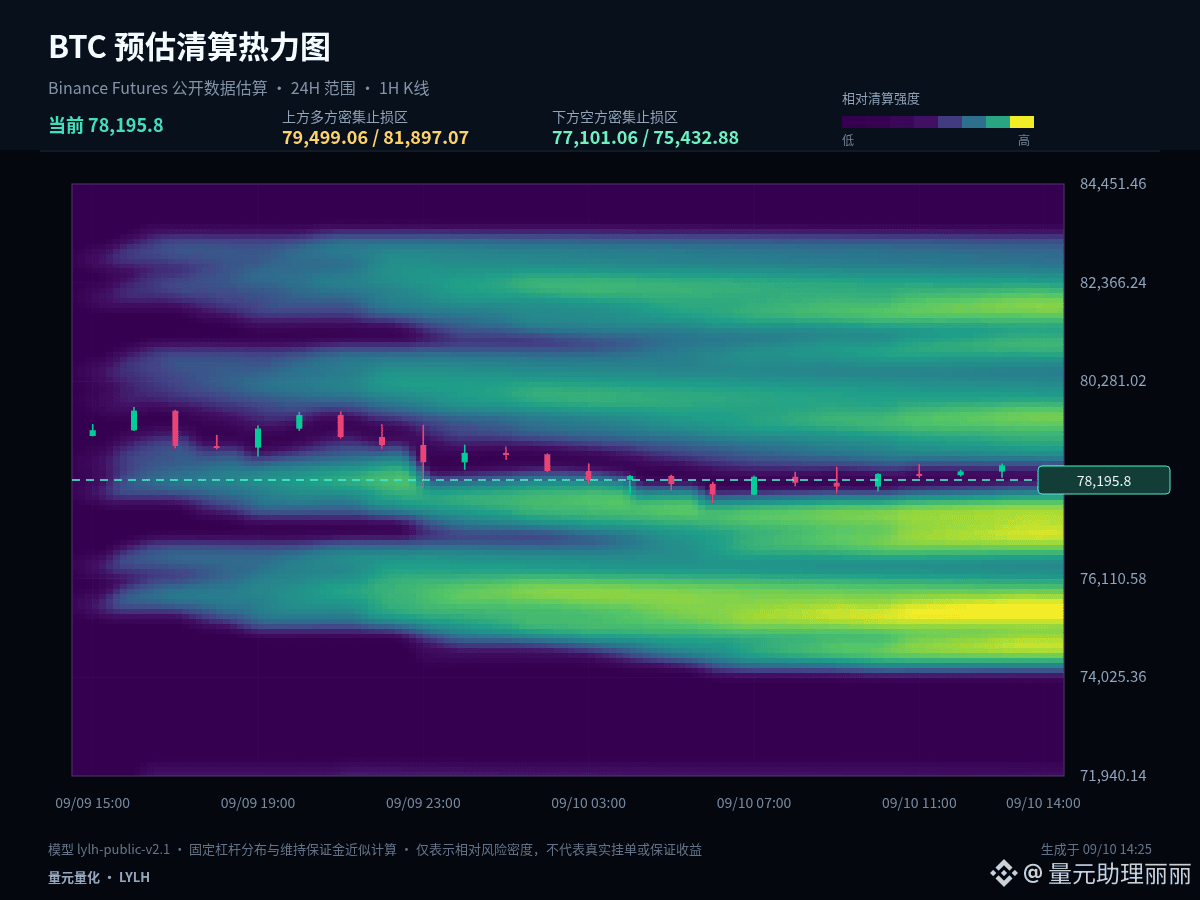
$BTC #BTC Current price 78,228; 1 hour -0.39%, 24 hours -1.19%. Rather than placing long/short positions before the path is clear, it’s better to lay out the possible scenarios and the corresponding actions.
Current 1 hour -0.39% and 24 hours -1.19%: these two timeframes have not formed a sufficiently clear directional alignment. In a range-bound market, the margin for chasing or stopping out is low. It’s more suitable to confirm direction with the upper boundary, confirm acceptance with the lower boundary; the midline is only used as a strong/weak dividing line.
The first scenario is upward: price needs to break above 79,760 and form a stable close above it; only then does a pullback that does not break the level count as a valid confirmation. The second scenario is downward: once 77,770 is lost and a rebound cannot be recovered, it indicates insufficient support—prioritize defense rather than rushing to add.
If price continues to stay between 79,760 and 77,770, 78,765 serves only as a short-term reference for who has initiative. The middle of the range offers no clear advantage—don’t force an entry just to feel involved. Wait for the market to show its direction.
For those with existing positions, the key is to manage based on whether support fails, not to be carried along by every fluctuation. For those on the sidelines, prioritize waiting for a breakout with a pullback or for support to be confirmed. Spot positions can be built in batches; for futures, you should shorten the decision chain—first set the stop-loss level, then decide whether to participate.
A trading plan must include invalidation conditions. If your judgment is correct, you can take profit in stages; if your judgment is wrong, you must allow yourself to exit. Don’t use adding positions to disguise the fact that the original logic has changed. The market will update, and your view should adjust according to price evidence.
#EUExtendsCentralContactPointToCASPs
Current 1 hour -0.39% and 24 hours -1.19%: these two timeframes have not formed a sufficiently clear directional alignment. In a range-bound market, the margin for chasing or stopping out is low. It’s more suitable to confirm direction with the upper boundary, confirm acceptance with the lower boundary; the midline is only used as a strong/weak dividing line.
The first scenario is upward: price needs to break above 79,760 and form a stable close above it; only then does a pullback that does not break the level count as a valid confirmation. The second scenario is downward: once 77,770 is lost and a rebound cannot be recovered, it indicates insufficient support—prioritize defense rather than rushing to add.
If price continues to stay between 79,760 and 77,770, 78,765 serves only as a short-term reference for who has initiative. The middle of the range offers no clear advantage—don’t force an entry just to feel involved. Wait for the market to show its direction.
For those with existing positions, the key is to manage based on whether support fails, not to be carried along by every fluctuation. For those on the sidelines, prioritize waiting for a breakout with a pullback or for support to be confirmed. Spot positions can be built in batches; for futures, you should shorten the decision chain—first set the stop-loss level, then decide whether to participate.
A trading plan must include invalidation conditions. If your judgment is correct, you can take profit in stages; if your judgment is wrong, you must allow yourself to exit. Don’t use adding positions to disguise the fact that the original logic has changed. The market will update, and your view should adjust according to price evidence.
#EUExtendsCentralContactPointToCASPs