
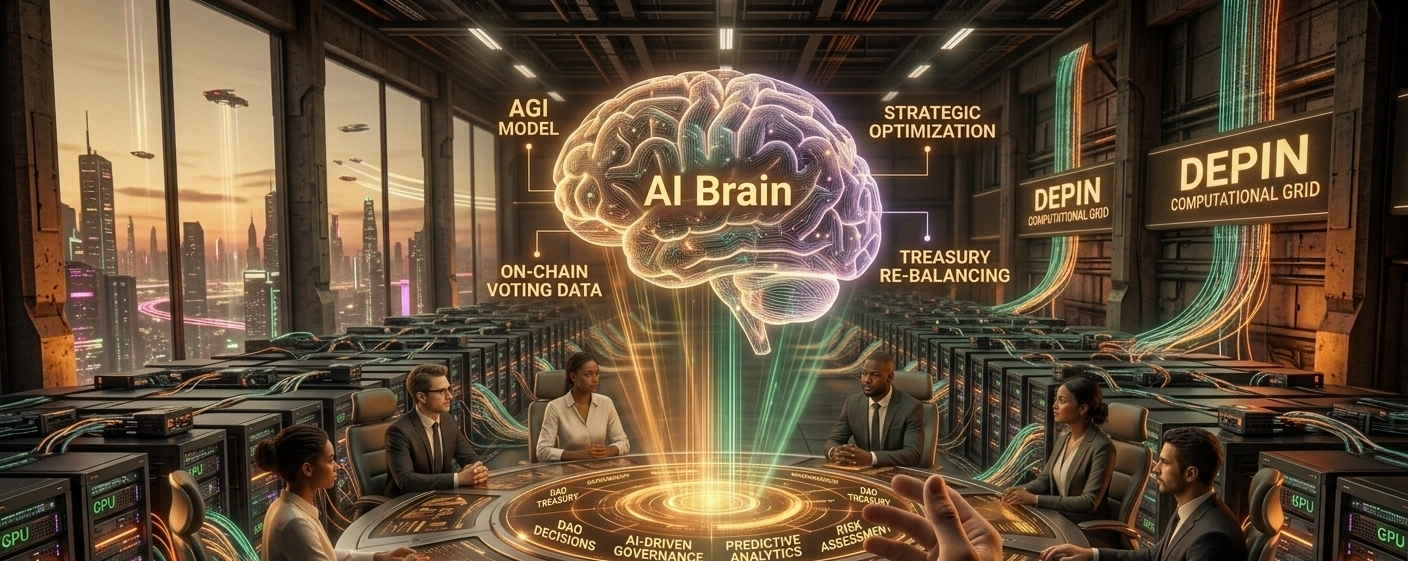

For years, Artificial Intelligence (AI) and blockchain technology have evolved as two of the most disruptive technological forces of the 21st century. However, their development had been following parallel paths: while AI advanced in large-scale data processing and the automation of thinking, blockchain did so by decentralizing trust and enabling an immutable record of value.
Today we find ourselves at the turning point where both technologies converge. This union not only overcomes the structural limitations of each, but also lays the foundation for a new digital economy that is more efficient, transparent, and equitable.
1. From Chatbots to Autonomous Financial Agents (AI Agents On-Chain)
The first major change lies in AI’s financial autonomy. Traditionally, AI was limited to processing information and suggesting actions to a human user. With the integration of smart contracts and digital wallets, the algorithms have become independent economic actors.
An on-chain AI agent can hold capital, pay network fees (gas), execute liquidity arbitrage, and manage investment portfolios in real time 24/7 without banking intermediaries. The decentralized architecture of crypto networks thus becomes the native financial system for artificial intelligence.
2. DePIN: Decentralizing Compute Power
The accelerated development of AI faces a critical obstacle: monopolization of the infrastructure. Training complex models requires thousands of graphical processing units (GPUs), whose costs and availability are concentrated in a handful of technology corporations.
Decentralized Physical Infrastructure Networks (DePIN) offer an open-market solution. Through tokenized incentives, protocols such as Bittensor or Render Network allow users, institutions, and miners around the world to rent out underutilized computing power. This architecture not only drastically reduces costs for independent developers, but also democratises access to the computing capacity needed for AI development.
3. Data Privacy and Security Through Zero-Knowledge Cryptography (ZK-Proofs)
To deliver hyper-personalized results in sensitive areas such as healthcare or finance, AI models require access to large volumes of data. However, the traditional centralized model forces the user to provide their private information to third-party servers, increasing the risks of leakage and misuse.
Zero-Knowledge Proofs solve this dilemma. Using this cryptographic principle, an AI algorithm can validate the authenticity, solvency, or status of a user by verifying immutable mathematical proofs, without needing to view, access, or store the underlying private information.
4. Authenticity in the Synthetic Age: Digital Identity and the Fight Against Deepfakes
As generative tools produce text, audio, and images indistinguishable from reality, verifying authenticity becomes a critical need for the digital environment.
In this context, the blockchain acts as the global layer for validating the truth. Through immutable timestamping and Proof of Personhood protocols, it is possible to cryptographically sign the content from its creation. This makes it possible to transparently distinguish genuine content from that generated by software, ensuring the integrity of transactions and network communication.
5. Hybrid Governance: The Evolution of Decentralized Autonomous Organizations (DAOs)
Decision-making in Decentralized Autonomous Organizations (DAOs) has historically faced challenges such as slowness, absenteeism, and exposure to financial vulnerabilities. The integration of language models and AI into governance frameworks is transforming organizational management.
AI models in a DAO act as predictive auditors: they evaluate the impact of proposals in real time, simulate risk scenarios for the treasury, and analyze code security before any execution. Decision-making evolves from a purely political or bureaucratic model into a hybrid system, where AI provides precise quantitative analysis and the community retains strategic control.
Conclusion
The intersection between Artificial Intelligence and cryptoassets goes far beyond a market trend; it represents a deep restructuring of how the Internet and financial systems work. While AI provides the analytical capability and autonomous execution, blockchain technology supplies the trust, privacy, and decentralization infrastructure needed to coordinate this new