


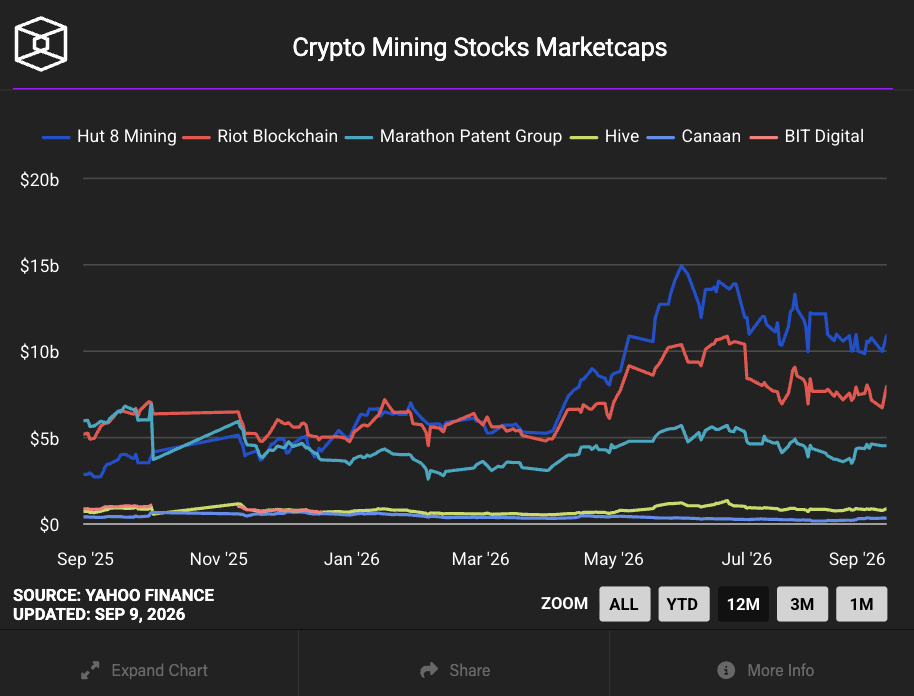
Bitcoin has risen roughly 22% since August 17, and stocks tied to crypto trading platforms and stablecoins have strengthened alongside it. Mining companies have not.
Of 11 Bitcoin mining and related companies analysed, only Canaan outperformed BTC. The other 10 underperformed, with a median gain of just 1.8% across the period.
Core Scientific and TeraWulf performed worst, lagging Bitcoin by 27% and 24% respectively.
The AI Pivot Has Broken the Hash Price Link
The explanation is the transformation several miners undertook in recent years — shifting focus toward high-performance computing and AI data center businesses.
That pivot supported share prices through the crypto bear market, when hash price economics were punishing. It also diverted attention from Bitcoin mining itself and introduced operational risks that pure miners do not carry.
The consequence is visible in this rally. A company deriving a growing share of revenue from GPU cloud contracts does not re-rate on a Bitcoin move, because the marginal buyer is pricing data center cash flows rather than mining margins.
That works both ways, and it has cut against the sector this month.
AI Exposure Became a Liability When the Trade Turned
The miners with the largest AI pivots are the ones lagging hardest, and the timing explains why.
The AI complex has been under pressure through the same period Bitcoin rallied. Nvidia guided third-quarter gross margin to 74% from 75% — the first sequential decline of the cycle — citing memory, power, land and infrastructure costs, with a first-quarter price increase planned. Copper set a record above $6.80 per pound, a direct data center input.
Cipher Mining fell 6% and TeraWulf 3% on Wednesday alone as AI infrastructure names gave back gains.
The Wall Street Journal reported Nvidia paused some deals in a financing initiative extending credit support to AI cloud providers in exchange for revenue share — a facility that matters disproportionately to smaller operators in this cohort.
So the pivot exposed miners to a sector selling off while removing their leverage to the asset that was rallying.
Rate Sensitivity Compounds It
There is a second channel the source analysis does not name.
Data center buildout is capital intensive with cash flows weighted years forward, which makes these companies long-duration equities. The 10-year Treasury yield reached 4.845% this week, its highest since October 2023, and the two-year hit 4.427%.
Rising discount rates compress those valuations more severely than they compress a pure miner's, whose revenue is tied to a spot commodity.
Miners running the dual strategy therefore absorbed three headwinds at once: AI sector weakness, input cost inflation, and a rising discount rate applied to long-dated cash flows.
The Dual Strategy May Still Be Right Structurally
The counterargument is about cycles rather than this quarter.
The combination of AI data centers and Bitcoin mining may prove a long-term advantage: mining benefits during bull markets while data centers strengthen the balance sheet during crypto downturns.
The contract book supports that. IREN holds $2.8 billion across Microsoft, Nvidia, Perplexity and Figure AI. Hut 8 has its Beacon Point lease. HIVE signed a $350 million GPU cloud deal lifting contracted annual recurring revenue to roughly $180 million.
Those are multi-year revenue commitments that do not evaporate on a bad month for AI equities. What the current lag demonstrates is not that the strategy is wrong, but that it costs the sector its beta to Bitcoin — which is the exact thing many mining shareholders were buying the stocks for.
Canaan Is the Exception That Proves the Structure
Canaan outperforming Bitcoin while the diversified names lagged is consistent with the mechanism rather than a contradiction of it.
Canaan manufactures mining hardware. Its exposure runs to miner capital expenditure and hash rate expansion, which respond to Bitcoin price with a lag but respond directly. It carries no AI data center business to dilute that.
The company reported pre-market Monday at an estimated loss of $0.14 per share.
What Would Restore the Correlation
Two conditions would narrow the gap.
The first is Bitcoin holding above levels that make mining economics compelling enough to matter to earnings again. Bitcoin traded around $78,500 after giving back gains on the Treasury buyback's failure to suppress yields.
The second is stabilisation in the AI trade, which requires resolution of the margin question Investing.com's Thomas Monteiro identified after Nvidia's print — how much of that growth translates into margins and cash flow.
Neither is likely to resolve before Friday's CPI and the September 16 Fed decision, with markets pricing 60% odds of a hike, according to The Block.