


Bitcoin rose as much as 1.6% since midnight UTC to $79,742 as US Central Command said it destroyed five Iranian oil tankers Tuesday night and Tehran responded with missile strikes on American bases in Jordan.
Brent crude topped $100 a barrel for the first time since July. Bitcoin was recently trading near $79,000, with Ether 0.3% higher at $2,490 and XRP up 0.4% to $1.42.
Crypto Is Moving With Metals, Not Equities
The rally is happening against a risk-off backdrop elsewhere. The Stoxx Europe 600 fell 0.5% at the European open following a 1.2% decline in the Dow Jones Industrial Average on Tuesday. Nasdaq 100 futures were little changed.
Crypto moved with the metals instead. Gold rose 1.06% to $4,401 and silver added 1.33%.
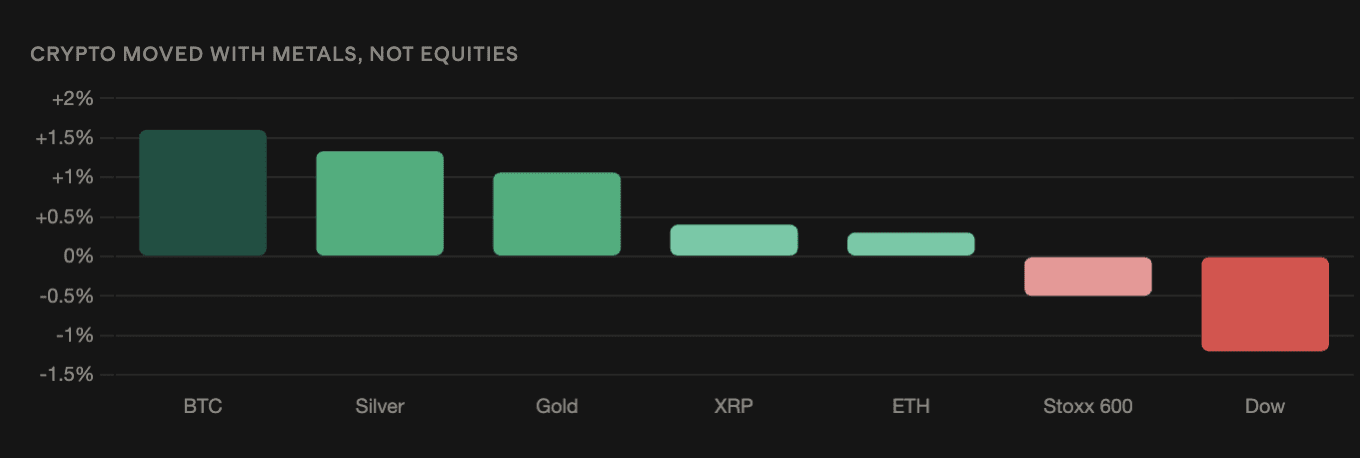
That is close to the inverse of September 2, when US strikes on Islamic Revolutionary Guard Corps targets sent Bitcoin lower alongside equities. Same conflict, same escalation category, opposite correlation — within a single week.
The distinction between those two sessions is worth holding rather than resolving. One week of alternating behaviour does not establish that Bitcoin has been repriced as a geopolitical hedge. It does establish that its correlation to equities is unstable enough that a single session's move should not be read as a regime.
Yesterday's Shorts Have Been Closed, But No Fresh Longs Arrived
The taker buy-sell volume ratio flipped to neutral after two consecutive bearish days, coinciding with the bounce back above $79,000.
Bitcoin's retreat from $80,000 Tuesday was matched by a pickup in open interest across major USD and USDT-denominated futures, pointing to a buildup of short positions. Twenty-four hours later, that same open interest has declined alongside the spot bounce, per Velo.
The shorts taken yesterday appear to have been closed. But the decline also means no fresh bullish capital has entered — the bounce is short covering rather than accumulation.
Overall Bitcoin open interest remains well under 700,000, pointing to still-light positioning. The same holds in ether.
HYPE's Record Run Is Spot-Driven
HYPE hit a record $88 over the weekend and has steadied just below that level after surging 60% in August.
Open interest has barely moved, standing at 1.02 million HYPE — well below the January peak of around 59 million. That divergence indicates the price rise has been driven mainly by spot flows rather than leveraged futures activity.
Zcash shows the opposite structure. Its futures open interest ticked higher, snapping a two-day decline as the token hit a record $1,260. Open interest has risen steadily alongside price since August 1, pointing to a buildup of long positions, and ZEC's 24-hour cumulative volume delta is the most positive among major cryptocurrencies.
Both are constructive readings, but they carry different risk. Spot-driven moves have no leverage to unwind. Long buildups do.
Uniswap sits at the other end of the CVD spectrum, under pressure for a third straight day near $6.65, down 1.4% since midnight. Negative CVD alongside near-record futures open interest points to potential volatility ahead.
Options Traders Are Positioned for Upside Into CPI
Bitcoin's front-end volatility on Deribit remains relatively flat, indicating traders are not yet pricing big moves ahead of Friday's CPI release. But front-end risk reversals have repriced meaningfully in favour of calls, according to Laser Digital.
The top five most-traded instruments by 24-hour volume are all calls, at strikes ranging from $80,000 to $90,000. The same holds in ether.
That combination — flat front-end volatility with a call-skewed book — describes traders buying upside cheaply rather than hedging. It is a bullish positioning stance that has not yet been priced into the volatility surface.
The 30-day implied volatility index BVIV is now hovering above its 50- and 100-day simple moving averages, which could mark the start of another volatility spike. That is typically a bear market feature, though August's price rise also occurred against rising BVIV. EVIV is also looking to break above its 100-day average.
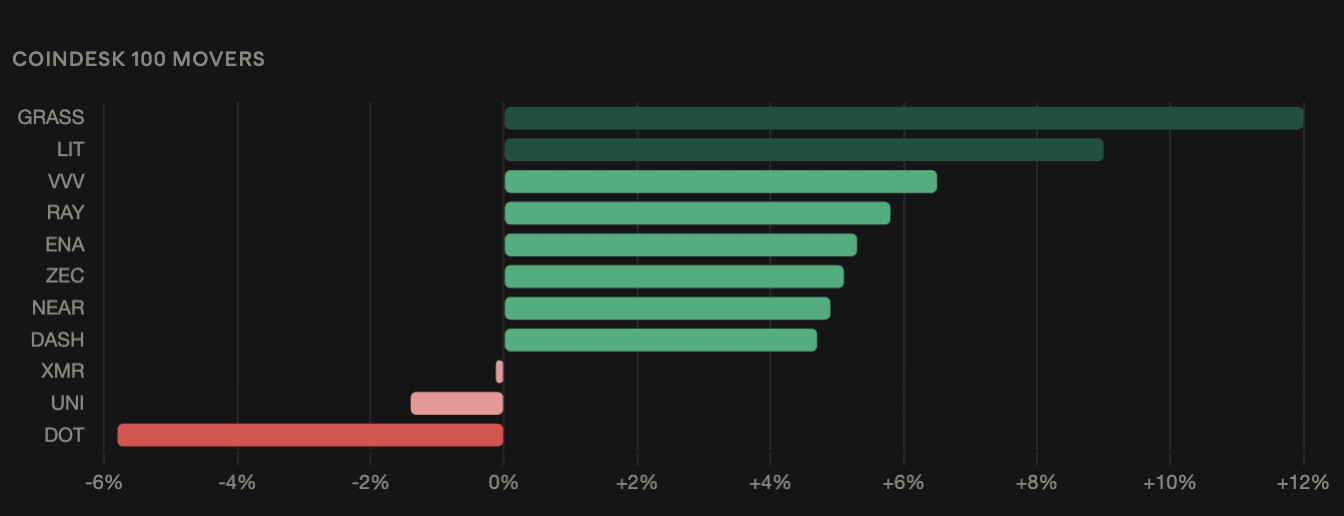
Grass, Venice and Lighter Lead the CoinDesk 100
Solana-based DePIN token GRASS topped the index, up 12% since midnight to $0.37 and 11% over 24 hours.
Venice Token added 6.5% on the day to $27.59 and is 55% higher over 24 hours after setting a record, with the AI platform completing the largest discretionary token burn in its history and announcing a NEAR integration.
Perpetuals exchange token Lighter climbed 9% to $5.27, extending an 11% gain over 24 hours on consecutive days where volume topped $125 million — up from last Wednesday's $92 million.
The privacy trade continues, with Zcash rising 5.1% to $1,238.61 and Dash up 4.7% to $65.42. Monero is the exception, down 0.12% on the day and 4.6% over 24 hours.
Raydium reversed hard, adding 5.8% to $1.31 and 19% over 24 hours after falling 6.7% Tuesday — the sharpest turnaround in the index. Ethena gained 5.3% and NEAR Protocol 4.9% to $2.43, the latter on the Venice integration.
Polkadot is the day's biggest decliner at 5.8% to $1.17, though it remains 10% higher over 24 hours, placing the entire decline after midnight UTC.
The ETF Bid Has Not Followed the Price
US spot Bitcoin ETFs saw a $46.65 million net outflow Tuesday, per SoSoValue, following $174.6 million of inflows Friday.
Grayscale's GBTC drove that outflow with $66 million of redemptions while BlackRock's IBIT, Bitwise's BITB, ARKB and Morgan Stanley's MSBT added roughly $41 million between them — a fee-driven migration rather than allocators exiting, given GBTC charges 1.50% against IBIT's 0.25%.
Bitcoin ETF net assets closed at $99.52 billion, back under the $100 billion line crossed on September 3, and the funds remain roughly $1 billion negative year-to-date.
PPI arrives Thursday and CPI Friday, with markets pricing 60% odds of a September 16 hike and Fed officials already in communications blackout.