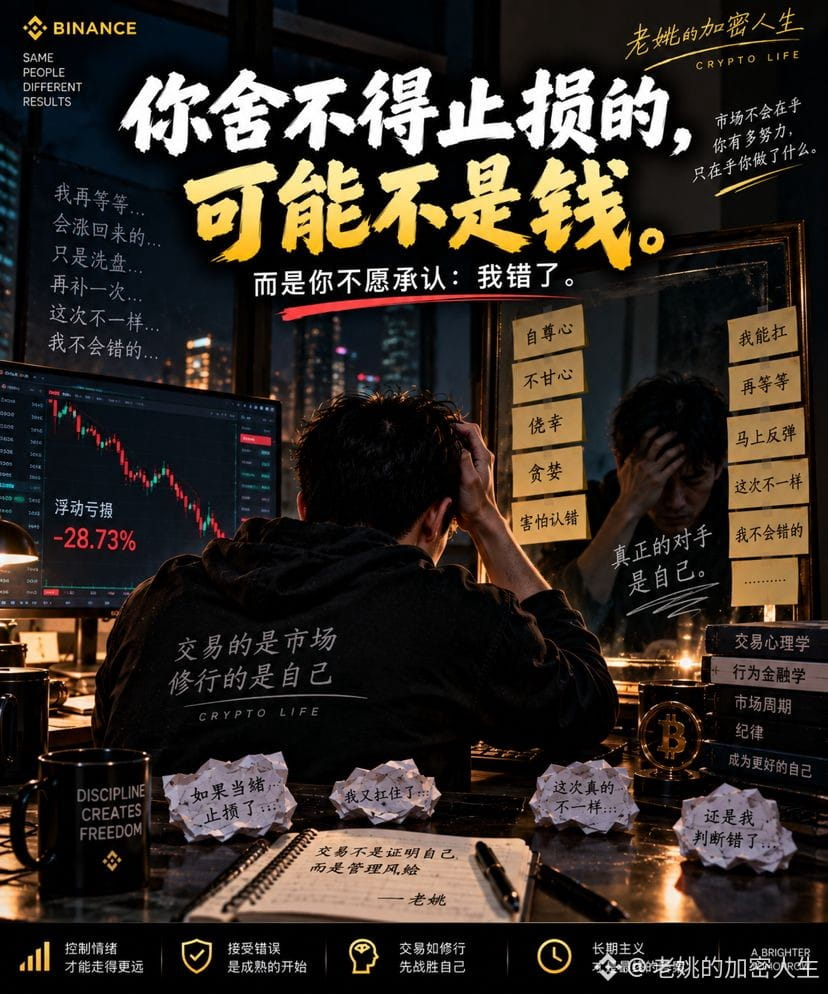
The hardest thing to stop-loss in trading may never be the position itself. #美加关税战升级
It might instead be that sentence:
“I was wrong.”
You buy and the price falls.
Your first reaction isn’t to cut the loss—
it’s to find a reason:
“It’s just a shakeout.”
“The main force is accumulating.”
“It’ll rebound soon.”
It drops a little more, and you start averaging down.
It drops a little more, and you start looking for good news.
In the end, you’ll discover a painfully real fact:
You’re no longer trading.
You’re doing everything you can
to prove that your original judgment was correct.
So many people won’t let go of a loss.
On the surface, it’s just a losing trade.
In reality, it’s your pride, unwillingness to admit defeat, and hope.
Because a stop-loss means:
“I was wrong.”
And holding on at least lets you tell yourself:
“As long as I didn’t sell, there’s still a chance to prove I’m right.”
This may be the most dangerous psychological trap in trading.
The market has no idea how much you paid.
It doesn’t know how long you studied.
And it certainly won’t give you a rebound
just because you’re down 30%.
Price has no obligation to prove you’re right.
Later, I came to accept something more and more:
Trading isn’t an exam.
You don’t need to prove you got every question right.
What truly matters is—
when you’re wrong, lose a little less;
when you’re right, make a little more.
Admitting mistakes won’t make you a failed trader.
On the contrary:
Refusing to admit mistakes can turn one ordinary mistake
into a deadly one.
So when it’s time to trigger the stop-loss now,
I try not to ask anymore:
“Will it go back up?”
Instead, I ask myself:
“If I didn’t have this position right now, would I still buy it at this level?”
If the answer is no,
then in many cases,
the answer is already crystal clear.
Have you ever held on to a trade—
knowing you might be wrong,
yet still refusing to admit it?
If so, leave a “held on” in the comments.
I believe people who’ve experienced it are more common than we think.
Shared solely for personal trading psychology and market reflections; not investment advice.
It might instead be that sentence:
“I was wrong.”
You buy and the price falls.
Your first reaction isn’t to cut the loss—
it’s to find a reason:
“It’s just a shakeout.”
“The main force is accumulating.”
“It’ll rebound soon.”
It drops a little more, and you start averaging down.
It drops a little more, and you start looking for good news.
In the end, you’ll discover a painfully real fact:
You’re no longer trading.
You’re doing everything you can
to prove that your original judgment was correct.
So many people won’t let go of a loss.
On the surface, it’s just a losing trade.
In reality, it’s your pride, unwillingness to admit defeat, and hope.
Because a stop-loss means:
“I was wrong.”
And holding on at least lets you tell yourself:
“As long as I didn’t sell, there’s still a chance to prove I’m right.”
This may be the most dangerous psychological trap in trading.
The market has no idea how much you paid.
It doesn’t know how long you studied.
And it certainly won’t give you a rebound
just because you’re down 30%.
Price has no obligation to prove you’re right.
Later, I came to accept something more and more:
Trading isn’t an exam.
You don’t need to prove you got every question right.
What truly matters is—
when you’re wrong, lose a little less;
when you’re right, make a little more.
Admitting mistakes won’t make you a failed trader.
On the contrary:
Refusing to admit mistakes can turn one ordinary mistake
into a deadly one.
So when it’s time to trigger the stop-loss now,
I try not to ask anymore:
“Will it go back up?”
Instead, I ask myself:
“If I didn’t have this position right now, would I still buy it at this level?”
If the answer is no,
then in many cases,
the answer is already crystal clear.
Have you ever held on to a trade—
knowing you might be wrong,
yet still refusing to admit it?
If so, leave a “held on” in the comments.
I believe people who’ve experienced it are more common than we think.
Shared solely for personal trading psychology and market reflections; not investment advice.