
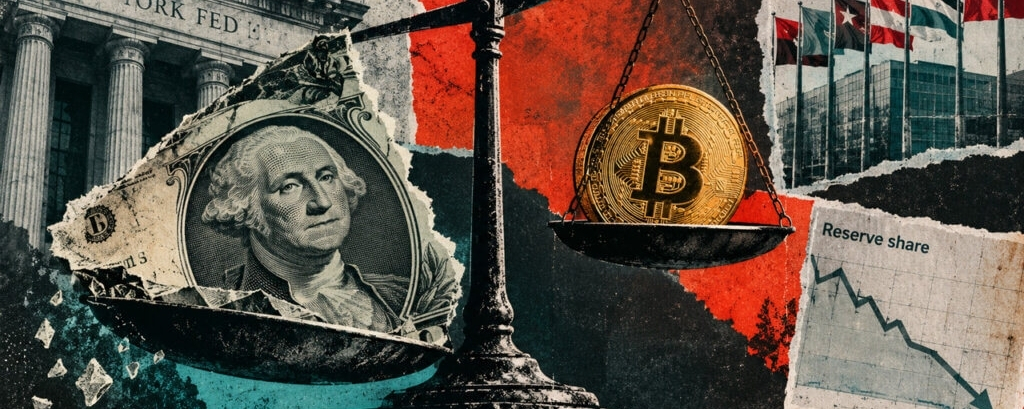


I’ve been looking at the recent debate around declining dollar reserves, and one thing stands out: a smaller share of global reserves does not automatically mean central banks are buying Bitcoin. The difference between a changing percentage and an actual investment decision is easy to overlook.
A Sept. 2 analysis from New York Fed researchers found that the U.S. dollar’s share of global official foreign-exchange reserves declined from 64% at the end of 2015 to 56% at the end of 2025, based on IMF COFER data.
At first glance, that decline may look like central banks are moving away from the dollar. But the researchers highlight another possibility: the global percentage can change because countries alter their currency preferences, or because the size of their overall reserves changes.
This is the important distinction between "currency preference" and "reserve-size effects."
A country can increase its reserves without reducing the percentage held in dollars. If that country has a below-average dollar allocation, simply accumulating more reserves can push the global dollar share lower.
Switzerland provides a useful example. Between 2015 and 2019, its reserves grew while its own dollar allocation increased, yet its reserve growth still contributed to a decline in the global dollar share.
The research shows why investors should be careful when interpreting aggregate reserve data. A falling percentage does not necessarily reveal where the money is going.
And that becomes even more important when Bitcoin enters the discussion.
The underlying New York Fed research separates reserves needed for liquidity from an investment portion held beyond those immediate requirements. Central banks need liquid foreign-currency reserves for things such as trade payments, foreign-currency debt and currency stabilization.
Only after those liquidity needs are satisfied does greater diversification become more relevant.
But "diversification" does not automatically mean "Bitcoin."
There is a real-world example of why this distinction matters. In November 2025, the Czech National Bank announced a $1 million digital-asset test portfolio that included Bitcoin, a dollar stablecoin and a tokenized deposit. However, the central bank explicitly said the portfolio was outside its international reserves.
That example shows why simply pointing to a declining dollar share is not enough to establish a sovereign Bitcoin-buying trend.
To make a serious case for growing government demand for Bitcoin, we need separate evidence: a disclosed allocation, the source of funding and confirmation that purchases were actually executed. It also matters whether those Bitcoin holdings are officially classified as reserves or held separately.
The New York Fed research does not provide those details. It explains how the composition and size of reserve portfolios can change the global dollar percentage, but it does not measure sovereign Bitcoin purchases or estimate their impact on Bitcoin’s price.
So my takeaway is simple: "A shrinking dollar share is a signal of changing reserve dynamics, not proof of central banks buying Bitcoin."
If sovereign Bitcoin demand is increasing, the evidence needs to come from actual allocations and purchases not from interpreting a single global reserve percentage as something it doesn’t prove.