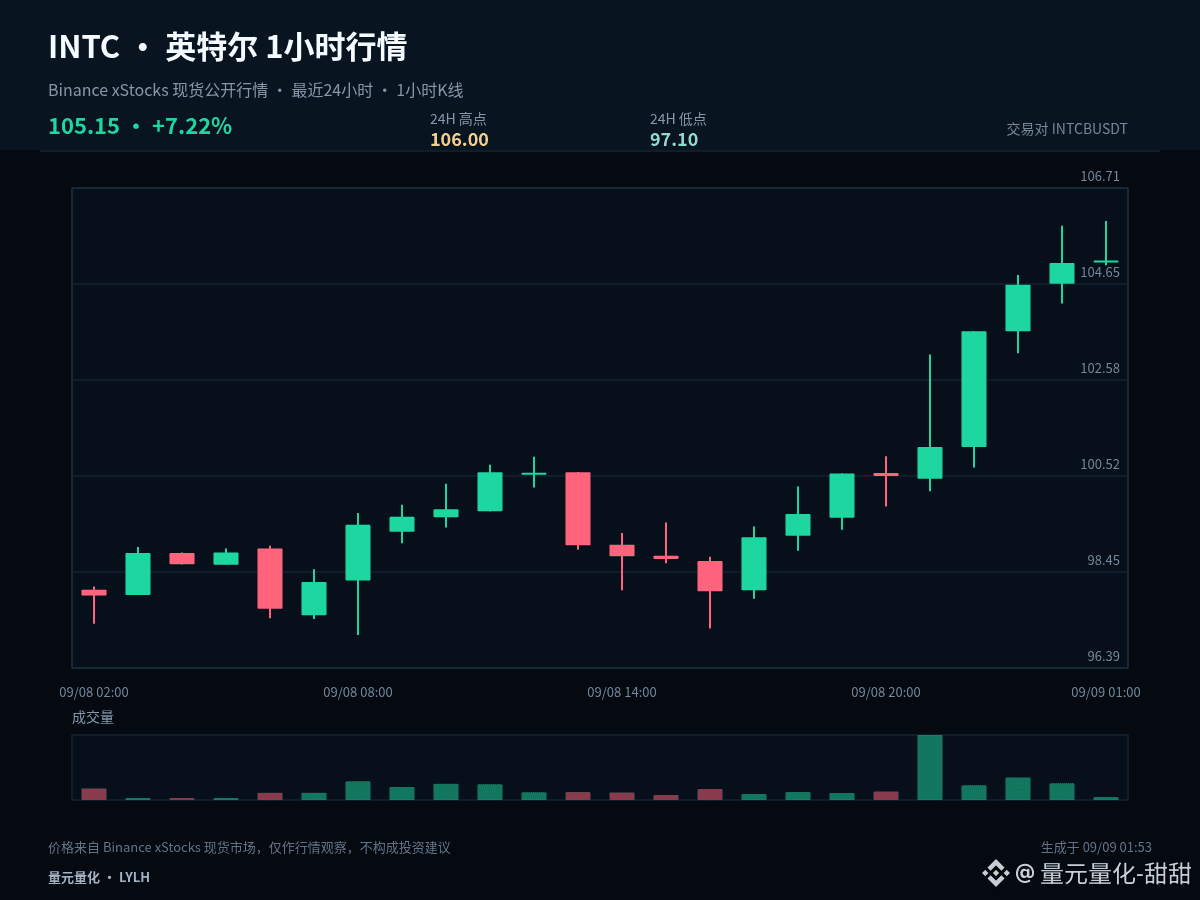
$INTCB #INTC Current price 105.15, +0.05% in 1 hour, +7.20% in 24 hours. Rather than locking in a long or short position immediately, it’s better to list the possible paths and the corresponding actions.
The current price is near the upper band of the last 24-hour range: +0.05% over 1 hour and +7.20% over 24 hours. The most important thing at the high end is to confirm acceptance after a breakout. If the price can stay above the upper band, it means the market recognizes a higher range; if it only briefly pierces and then quickly falls back, you need to guard against a false breakout.
The first path is upward: price needs to break above 106 and form stable closes above it; only then does a pullback that does not break back underneath count as a valid confirmation. The second path is downward: once 97.1 is lost and any rebound fails to reclaim it, it indicates insufficient support—so you should prioritize defense rather than rushing to add positions.
If the price continues to trade between 106 and 97.1, then 101.55 is only a reference for short-term initiative. The mid-range has no clear edge, so don’t open trades just for the sake of having a position—wait for the market to show direction first.
Position management should distinguish between swing trades and short-term trades. For existing swing positions, first check whether the structure is broken; don’t let repeated fluctuations on single 1-hour candles repeatedly shake you. For short-term positions, execute around support, resistance, and confirmation from closes. If you’re currently flat, there’s no need to chase price in the middle of the range—waiting for a clearer location usually offers an advantage.
For short-term positions, the focus isn’t to predict every single K-line. It’s to ensure there is a basis for entry, trimming, and exiting. Do less without confirmation; if a key level fails, redo the plan. Control the risk per trade first, and then talk about potential upside or downside afterward.
#IranSaysItCapturedUSUnmannedSubmarine
The current price is near the upper band of the last 24-hour range: +0.05% over 1 hour and +7.20% over 24 hours. The most important thing at the high end is to confirm acceptance after a breakout. If the price can stay above the upper band, it means the market recognizes a higher range; if it only briefly pierces and then quickly falls back, you need to guard against a false breakout.
The first path is upward: price needs to break above 106 and form stable closes above it; only then does a pullback that does not break back underneath count as a valid confirmation. The second path is downward: once 97.1 is lost and any rebound fails to reclaim it, it indicates insufficient support—so you should prioritize defense rather than rushing to add positions.
If the price continues to trade between 106 and 97.1, then 101.55 is only a reference for short-term initiative. The mid-range has no clear edge, so don’t open trades just for the sake of having a position—wait for the market to show direction first.
Position management should distinguish between swing trades and short-term trades. For existing swing positions, first check whether the structure is broken; don’t let repeated fluctuations on single 1-hour candles repeatedly shake you. For short-term positions, execute around support, resistance, and confirmation from closes. If you’re currently flat, there’s no need to chase price in the middle of the range—waiting for a clearer location usually offers an advantage.
For short-term positions, the focus isn’t to predict every single K-line. It’s to ensure there is a basis for entry, trimming, and exiting. Do less without confirmation; if a key level fails, redo the plan. Control the risk per trade first, and then talk about potential upside or downside afterward.
#IranSaysItCapturedUSUnmannedSubmarine