
FAMILY
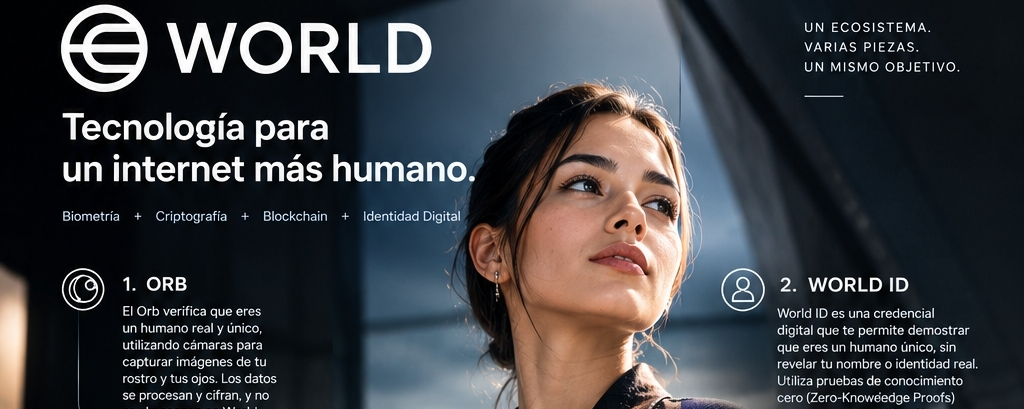
What is really behind World?
Today we’re not going to talk about the price of any asset.
We’re going to talk about its technology and how this ecosystem is built.
We can imagine World as a system made up of several pieces:
First: the Orb.
The Orb is a device designed to check that a person is a real, unique human being.
It uses cameras to capture images of the face and eyes, and performs the processing needed to verify uniqueness.
The core idea isn’t to know who you are, but to verify that you are a real person and that you haven’t previously gone through another verification.
According to World’s documentation, images are processed and encrypted, and the system is designed so that biometric data is not stored by World.
Second: World ID.
Then World ID comes into play.
World ID works as a digital credential that allows you to prove:
“I am a unique human being”.
But without necessarily having to reveal your real name or identity.
Here a very important technology comes into the picture:
zero-knowledge proofs, or Zero-Knowledge Proofs.
These make it possible to prove that a certain condition is met without revealing all the information used to make that proof.
That’s why World uses cryptography to try to separate proof of humanity from the user’s personal identity.
Third: privacy.
One of the important technical components is the use of cryptographic and anonymized multiparty computation mechanisms, known as AMPC.
Its goal is to enable certain uniqueness checks without any single entity having direct access to all the underlying biometric information.
Fourth: World App.
World App is the application that serves as one of the main entry points to the ecosystem.
From it, you can manage World ID, use a digital wallet, and access different compatible applications and assets.
And fifth: World Chain.
Here we find the blockchain part.
World Chain is an Ethereum layer 2 network.
It is built using the OP Stack and is part of the Superchain.
This means that transactions are executed on this layer, while Ethereum provides security properties, data availability, and finality.
But World Chain has a particular feature:
it is designed to integrate World ID and prioritize verified interactions as human over certain types of automated activity or Sybil attacks.
So if we want to summarize World’s technological “skeleton,” we can see it like this:
Orb → verifies humanity and uniqueness.
World ID → turns that verification into a digital credential.
Cryptography → helps protect the privacy of that verification.
World App → provides an interface to use the ecosystem.
World Chain → provides the blockchain infrastructure for applications and transactions.
And around all of this there is a fairly clear technological goal:
to try to build an infrastructure capable of distinguishing between real humans and bots on the Internet, without turning that verification into a public identification of the person.
That’s essentially what’s behind World’s technology.
It’s not just a token.
It’s a combination of biometrics, cryptography, digital identity, blockchain, and decentralized applications.
And precisely because of that, to really understand World, you have to look much further than the price of its asset.
Important note
World has been updating its architecture and its privacy mechanisms. The documentation itself indicates that the protocol continues to evolve.
Blessings and successes
Thanks for following me
Important note: I have avoided presenting as absolute facts privacy claims that depend on a specific implementation; for example, World has been updating its architecture and its privacy mechanisms. The documentation itself indicates that the protocol continues to evolve.$WLD #venezuela #ElSalvador #Colombia #w

Article
What is really behind World?
Disclaimer: Includes third-party opinions. No advice. Binance AI may be used without guarantee. See T&Cs.