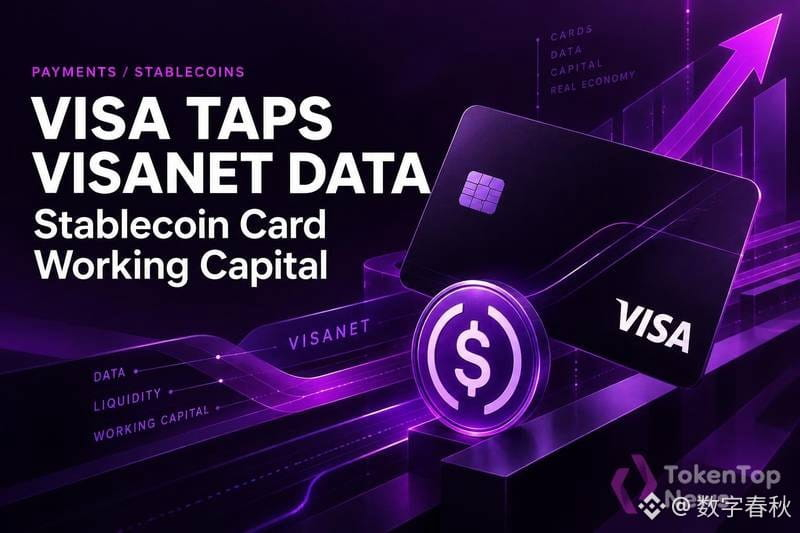
The money behind a stablecoin credit card probably won’t come from a bank anymore—it could be escrowed by an on-chain protocol. Visa has just connected the most critical piece.
Here’s the news in plain language: Visa announced it will open VisaNet settlement data to on-chain lending parties, giving stablecoin card projects a new route to operating liquidity. Put simply: when you swipe a Visa card, the merchant side generates something like “money others owe you”—i.e., settlement receivables. In the past, this float depended on the banking system. Now Visa allows these receivable records to be used as collateral for on-chain lending protocols, which can then automatically underwrite and automatically handle repayments through programmable lending infrastructure.
What’s clever here is two details.
First, Visa hasn’t thrown settlement data onto a public blockchain. The data still flows through the authorization channel. It goes through a licensed third party called Credit Coop, which receives Visa settlement files every day through secure pipelines. Then, combined with on-chain transaction records, it decides how much can be borrowed and when it should be repaid. On-chain is responsible for the funds and repayment logic; the data itself remains Visa’s lifeblood—opened, but not handed over as a full “master key.”
Second, this step pulls Visa’s stablecoin strategy from payments into financing. Before, it played in Korea with Dunamu on stablecoin payments, and it piloted stablecoin issuance and corporate settlement with Shinhan Bank—both were “spending” scenarios. This time it’s a “borrowing” scenario, with collateral backed by the real daily cash flows generated by Visa’s settlement system.
The real information edge is this: banks’ most valuable assets are their settlement networks and customer data. By voluntarily distributing interpretation rights over settlement data to on-chain protocols, Visa is effectively admitting that future credit checks may not have to be done entirely inside a bank’s black box. Transparent on-chain transaction records can also demonstrate you’ll be able to repay.
What ordinary people see is a press release. The subtext is: the battleground for stablecoins is shifting from the payment side to the credit side. If your spending transactions can directly become collateral for on-chain loans, how much moat does the traditional credit card business model still have?
So—do you think this will actually kill bank lending as we know it, or is it just a patch?
💥 清算数据群里实时更新
Here’s the news in plain language: Visa announced it will open VisaNet settlement data to on-chain lending parties, giving stablecoin card projects a new route to operating liquidity. Put simply: when you swipe a Visa card, the merchant side generates something like “money others owe you”—i.e., settlement receivables. In the past, this float depended on the banking system. Now Visa allows these receivable records to be used as collateral for on-chain lending protocols, which can then automatically underwrite and automatically handle repayments through programmable lending infrastructure.
What’s clever here is two details.
First, Visa hasn’t thrown settlement data onto a public blockchain. The data still flows through the authorization channel. It goes through a licensed third party called Credit Coop, which receives Visa settlement files every day through secure pipelines. Then, combined with on-chain transaction records, it decides how much can be borrowed and when it should be repaid. On-chain is responsible for the funds and repayment logic; the data itself remains Visa’s lifeblood—opened, but not handed over as a full “master key.”
Second, this step pulls Visa’s stablecoin strategy from payments into financing. Before, it played in Korea with Dunamu on stablecoin payments, and it piloted stablecoin issuance and corporate settlement with Shinhan Bank—both were “spending” scenarios. This time it’s a “borrowing” scenario, with collateral backed by the real daily cash flows generated by Visa’s settlement system.
The real information edge is this: banks’ most valuable assets are their settlement networks and customer data. By voluntarily distributing interpretation rights over settlement data to on-chain protocols, Visa is effectively admitting that future credit checks may not have to be done entirely inside a bank’s black box. Transparent on-chain transaction records can also demonstrate you’ll be able to repay.
What ordinary people see is a press release. The subtext is: the battleground for stablecoins is shifting from the payment side to the credit side. If your spending transactions can directly become collateral for on-chain loans, how much moat does the traditional credit card business model still have?
So—do you think this will actually kill bank lending as we know it, or is it just a patch?
💥 清算数据群里实时更新