

So that real-world assets (RWAs) and tokenized sovereign bonds have real utility within the decentralized economy, it is not enough to keep them locked in a wallet generating yield. They need an infrastructure that enables the free circulation of liquidity. This is where Flux Finance comes in.
1. Decentralized Loan Protocol
Flux Finance operates as a decentralized money market protocol designed specifically to support assets that require regulatory compliance.
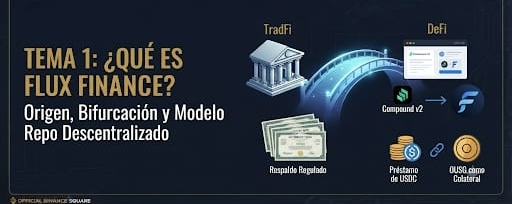
Compound v2 Bifurcation: Its base architecture takes the proven and secure code of Compound v2, ensuring a robust technical foundation with high confidence in smart contracts.
Specific Approach to RWA: Unlike traditional money markets focused on highly volatile crypto assets, Flux was designed to integrate regulated real-world financial assets (such as Ondo Finance’s OUSG tokens).
2. The role of a Repo Market on the Blockchain
In traditional finance (TradFi), a repurchase agreement (repo) allows institutions to obtain short-term liquidity using government bonds as collateral. Flux Finance moves this model directly onto the blockchain:
It acts as a liquidity bridge between TradFi and DeFi.
It allows institutional investors and holders of tokenized sovereign debt to use their positions to obtain immediate liquidity in stablecoins without breaking their long-term investment strategy.
⚠️ DYOR (Do Your Own Research): This article is for educational and informational purposes only and does not constitute financial advice. Always research on your own before interacting with decentralized lending protocols.
#EliseCrypto #LearnCrypto #OndoFinance #FluxFinance #RWA #defi #Web3 #Blockchain $ONDO
 ONDO0.3607-2.75%