
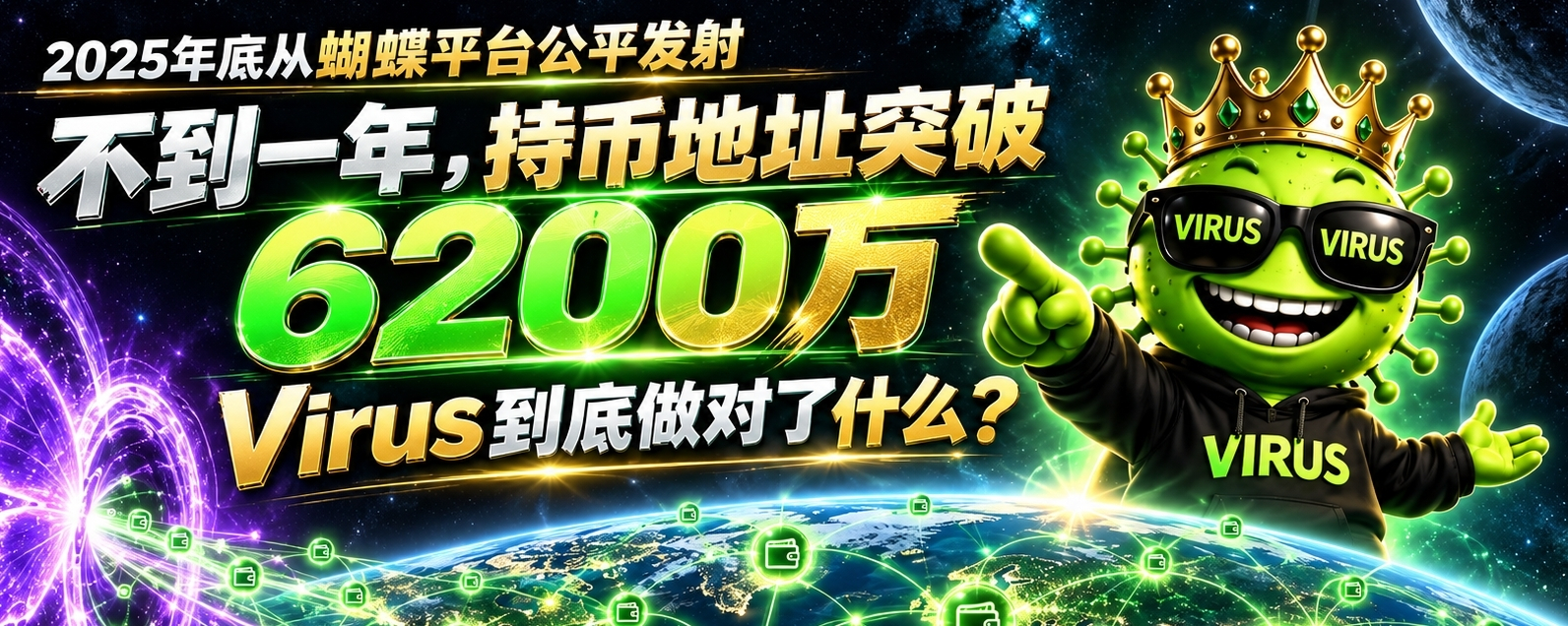



From fair launches on the Butterfly platform to reaching global wallets, Virus is redefining how Meme grows
The crypto market has never lacked tokens that surge quickly.
Doubling in a day can spark a wave of hype.
Rising to the top of the chart within a week can attract a batch of attention.
But if a project that was born less than a year ago can reach over 62 million on-chain addresses holding the token, then this is no longer a phenomenon that can be explained by a single candlestick chart.
Behind it, there must be a growth mechanism different from traditional Memes.
On December 31, 2025, Virus publicly came into being through the on-chain launch mechanism on the Butterfly platform.
As of the data disclosed by the community on September 4, 2026, Virus holder addresses have already surpassed 62 million.
From its birth to this milestone, it’s under 250 days.
The Butterfly platform’s public page records Virus’s creation time, a 3% buy tax, and a 3% sell tax, and shows its holder addresses have reached the 60 million level. Because the platform’s cache time and the stats update time differ, the numbers on the page may vary. However, Virus has already formed an ultra-large-scale distribution of addresses—an on-chain fact that can be cross-checked. View the Virus page on the Butterfly platform
Here’s the question:
Why is it called Virus?
Why can it reach tens of millions of addresses in such a short time?
The answer is not a random air drop, nor a number created by a single big holder.
The real answer is:
From the moment Virus is born, it doesn’t grow in a “waiting for users to come find it” way.
It chooses another path:
Actively enter wallets, then turn wallets into a network.
⸻
One: Most projects compete for fans; Virus first competes for addresses
Traditional Meme diffusion paths are usually:
The project appears
↓
Place ads
↓
Find big V influencers
↓
Attract fans
↓
Users purchase
↓
Create holder addresses
Along this path, the address is the final result.
Only when users first see it, first believe it, and then buy it will there be an additional holder address on-chain.
But Virus redesigns this logic.
Through buybacks and on-chain distribution, Virus actively enters more BNB addresses.
So holder addresses are no longer just the result left behind after users buy—they also become part of the spread itself.
The difference between these two modes is very clear:
A normal Meme waits for users to find the token.
Virus tries to make the token find wallets first.
Ordinary Memes spread through social platforms.
Virus extends diffusion further onto the chain.
Ordinary Memes compete for temporary traffic.
Virus accumulates an address network that can be recorded on the blockchain for a long time.
This is the first key to understanding 62 million addresses.
Virus doesn’t treat holder addresses as incidental data—it treats the address network itself as the core product.
⸻
Two: The 3% mechanism turns transactions into fuel for address growth
If address growth can only rely on the project team constantly paying money for airdrops, then such growth is hard to sustain long-term.
Once the budget stops, distribution stops too.
Virus’s true distinctiveness is that it attempts to make market activity itself provide fuel for network expansion.
According to the public mechanism, compliant buys and sells generate a 3% fee.
Related assets keep accumulating, and enter the settlement, buybacks, and on-chain distribution stages along the mechanism path.
The whole process can be summarized as:
Real transactions that comply with the mechanism
↓
Generate 3% fees
↓
Cumulative fees and completed settlement
↓
Creates demand for buybacks of Virus
↓
Buybacks obtain Virus
↓
Enter more addresses via on-chain airdrops
↓
The holder address network keeps expanding
The third-party wallet page also describes Virus as a community Meme on BNB, and introduces the 3% buy/sell tax, buyback, and on-chain airdrop mechanisms. View the public mechanism introduction
What’s truly worth studying about this design is:
No matter whether the market is doing buys or sells—so long as they are transactions that comply with the mechanism—they can accumulate fuel for subsequent loops.
Buying represents new demand.
Selling represents normal market liquidity.
And the mechanism fees generated by transactions further push buybacks and address expansion.
You can summarize it in one sentence:
Two-way trades, one-way accumulation.
Market sentiment might rise, or it might fall.
Price can fluctuate, and the trading direction can also change.
But as long as there are real transactions, the mechanism will keep accumulating the power needed for the next round of buybacks and distribution.
Transactions of ordinary tokens often end with one exchange of chips.
For Virus’s transactions, they also have a chance to become the beginning of infecting the next wallet.
⸻
Third: Why can one transaction create value across six layers?
In a typical Meme, one transaction usually leaves only:
Trading volume and price changes.
But in Virus’s system, a single real transaction that matches the mechanism can drive value conversion across multiple layers.
First layer: generate market activity.
Second layer: accumulate 3% mechanism fuel.
Third layer: After formation, it creates demand for subsequent buybacks.
Fourth layer: disperse the Virus obtained from buybacks to more addresses.
Fifth layer: consolidating new holder addresses and on-chain data.
Sixth layer: turn address milestones into new articles, videos, posters, and discussion topics.
That is to say, the same transaction affects not only price.
It may also work on:
Economic systems, holder networks, on-chain data, media content, and brand dissemination.
This is a very rare kind of energy conversion.
Transaction tax is not a new concept.
Buybacks are also not new.
Airdrops are also not a new thing.
What’s truly unique about Virus is not that it invented some isolated function.
Instead, it connects these functions toward the same goal:
Let market activity drive buybacks, let buybacks drive diffusion, and let diffusion drive network growth.
A single parameter is easy to copy.
But a growth flywheel that’s already spinning is hard to replicate in a short time.
⸻
Fourth: BNB provides real conditions for large-scale on-chain diffusion
62 million addresses don’t just require a mechanism—they also require an underlying network that suits the mechanism to run on.
If every on-chain distribution requires high transaction fees, then an expansion of address numbers in the tens of millions is almost impossible to sustain.
Virus chooses BNB, which conveniently gains the foundational conditions needed for large-scale distribution:
Lower on-chain costs, faster confirmation times, a massive wallet base, and a mature trading ecosystem.
According to official BNB materials, one of the core advantages of BNB Smart Chain is low transaction fees and fast block production, providing a more realistic execution environment for high-frequency, small-value, large-scale on-chain operations. View BNB Smart Chain introduction
Therefore, Virus’s address growth is not just relying on a slogan.
Behind it there is a set of conditions that work together:
The Butterfly platform provides on-chain launch mechanisms;
BNB provides a low-cost execution environment;
The 3% fee provides continuous fuel;
Buybacks form market demand;
On-chain airdrops expand address coverage;
Community content continues to amplify the impact of the data.
Missing any part of it makes it hard to explain why Virus could enter over 62 million addresses in less than a year.
⸻
Five: Virus’s name, mechanics, and goals naturally point in the same direction
Many projects first write a set of economic mechanics, then find a way to craft a story around it.
Virus is exactly the opposite.
Its name alone already determines the growth method that fits it best.
Virus represents:
Infection, replication, diffusion, connection, global dissemination.
Meanwhile, the buyback-and-airdrop mechanism is carrying out the same action on-chain:
Take Virus from one address to more addresses;
Diffuse from one wallet to more wallets;
Spread from one community to more countries;
Evolving from a token into a global on-chain network.
So “infect every wallet” is not a later forced marketing slogan.
It is the high degree of unity of Virus’s name, brand image, mechanism design, and address strategy.
For every new address, there is a new “infection.”
Every distribution completion is a new “spread.”
Every time it breaks an address milestone is a new record on Virus’s global diffusion map.
A great Meme needs only one sentence to explain.
A stronger Meme is one where you already understand half of it just by seeing the name.
Virus’s mechanism is its story; Virus’s addresses are its trail of dissemination.
⸻
Six: 62 million addresses doesn’t equal 62 million users, but it’s still extremely valuable
Truly powerful projects don’t need to manufacture confidence through vague concepts.
62 million holder addresses do not equal 62 million independent active users.
It may include small addresses, airdrop addresses, and low-activity addresses.
But that does not erase the value it truly represents:
Ultra-large-scale on-chain coverage.
One address is not a mature user.
But it can become the entry point for a user’s first discovery of Virus.
Enter the wallet first—then there’s a chance to be seen.
Be seen first—then there’s a chance to be searched.
Be understood first—then there is a chance to be accepted.
First comes awareness, then participation can happen.
Therefore, what Virus truly needs to accomplish in its next stage is:
Address
→ See
→ Understand
→ Participate
→ Dissemination
→ Build
→ Culture
If you look only at numbers, 62 million is a milestone.
If you look at the network, 62 million is a vast soil waiting to be activated.
Even if you treat it only as a scenario calculation:
0.1% of 62 million addresses equals 62,000 potential active nodes;
1% of 62 million addresses equals 620,000 potential active nodes.
This is not a forecast of future user numbers, and it is not a promise of returns.
It only shows:
When the network base is large enough, even a very small activation rate can form a sizable community.
This is the truly exciting imagination space behind 62 million addresses.
⸻
Seventh: Address data itself is producing diffusion in return
At first, diffusion helped Virus gain addresses.
Once the address scale becomes large enough, the data itself starts becoming material for spreading too.
Why does a project that’s less than a year old have over 60 million token-holding addresses?
How are these addresses formed?
How does the 3% fee enter the subsequent mechanism?
Where did the Virus go after the buyback?
Why doesn’t Virus choose simple destruction, but instead chooses on-chain distribution?
For every problem, it can be turned into an article, a live stream, a poster, or a global community discussion.
So Virus’s growth enters a new phase:
Content attracts attention
↓
Attention brings participation
↓
Participation creates transactions
↓
Transactions create mechanism fuel
↓
Mechanism drives buybacks and distribution
↓
Distribution expands the address network
↓
Address data creates new topics
↓
New topics keep bringing content
This is Virus’s true flywheel.
At the beginning, the community needs to drive data growth.
Once the data reaches a sufficient scale, it will also push community spread in return.
When on-chain data starts generating topics by itself, Virus’s network effects are just beginning.
⸻
Eight, Virus is accumulating four kinds of assets at the same time
Most people observe a Meme and only look at price and market cap.
But what Virus is truly worth studying is that it is accumulating four different kinds of assets at the same time.
First: economic assets
Including trading activity, mechanism transaction fees, buyback records, liquidity, and on-chain capital circulation.
Second: network assets
Including holder addresses, breadth of distribution, balance structure, and wallet coverage.
Third: attention assets
Including articles, videos, livestreams, posters, search volume, Binance accounts, and global exposure.
Fourth: cultural assets
Including Virus’s image, the language system of “infect every wallet,” memes, songs, stories, and shared community memories.
Price can change dramatically within a day.
But network, content, organization, and culture require time to accumulate.
What’s truly powerful isn’t any single asset growing alone.
Instead, four types of assets begin to power each other:
The economic mechanism expands the network;
Address networks create topics;
Topics attract content creators;
Content creators expand the brand;
Brand brings new participation;
New participation provides fuel for the economic mechanism.
When the four wheels turn together, Virus is no longer just a token waiting for external push.
It begins to have the possibility of self-growth.
⸻
Nine: What’s truly hard to copy isn’t 3%, but the history behind 62 million addresses
Competitive projects can copy the 3% fee.
You can mimic buybacks.
Airdrops can be done.
It can even copy a specific Virus poster.
But it can’t be copied within a day:
On-chain distribution covering more than 60 million addresses;
On-chain reach that could be hundreds of millions of times;
A long-term accumulated path of buybacks and distributions;
The process the community experiences together;
An ever-growing matrix of content creators;
and the brand awareness that “Virus equals global diffusion.”
Parameters can be copied.
Code can be copied.
But the already formed network scale, cultural memory, and community relationships cannot be generated with a single click.
So Virus’s true moat isn’t just a number written into the contract.
Instead, it is:
Every turn of this flywheel that has already happened in reality.
At the beginning of the flywheel, every step is difficult.
And the longer it turns, the larger the address base becomes, the more dissemination material there is, the deeper brand memory gets, and the wider the network each new participant can connect to.
This is network effects.
This is also the true source of Virus’s huge potential.
⸻
Ten: After 62 million, Virus’s real big story is only just beginning
62 million addresses solve the problem of network width.
The next step for Virus is to solve network temperature.
Turn silent addresses into real awareness.
Turn ordinary followers into community members.
Turn token holders into content creators.
Turn creators into global dissemination nodes.
Turn the on-chain traces left by one air drop into the start of a person truly understanding Virus.
This requires:
Continuously public buyback and distribution data;
Build a more transparent on-chain dashboard;
Develop content accounts in different languages;
Strengthen wallet security and mechanism education;
Create posters, videos, songs, animations, and short dramas;
Make Virus spreaders appear in every country.
If this step can keep moving forward, Virus’s endgame will not be merely owning a beautiful number of holder addresses.
It will have the chance to form:
A globally covered on-chain network;
A media matrix that keeps producing content;
A Meme culture that enables infinite secondary creation;
and a community ecosystem that doesn’t rely completely on any single platform or any single trading行情
⸻
Conclusion: Most projects wait for the world to discover them; Virus is actively walking into the world
In less than a year, more than 62 million addresses.
The most important meaning of this number is not proving that Virus has completed all its goals.
It is not just proving one thing:
Virus’s on-chain diffusion mechanism has already shown rare large-scale capability.
Most Memes first look for users, then create addresses.
Virus first enters addresses, then tries to activate addresses into users.
Most projects leave trading volume on the K-line.
Virus tries to transform trading volume into buybacks, distribution, addresses, data, and dissemination.
Most projects need to keep buying external traffic.
Virus is building an endogenous flywheel where economic activity provides fuel for network expansion.
That’s why, when truly discerning people study Virus, they shouldn’t only ask:
“How much is Virus worth today?”
It’s more important to ask:
“A Meme that has already entered 62 million addresses—how many people can it ultimately connect?”
Price can generate attention for a moment.
Addresses can record the history of a diffusion.
Building allows the network to keep growing.
Culture allows a name to be remembered by the world.
62 million is not the answer to Virus’s story.
It’s only Virus’s first question to the world:
Can a Meme evolve from a single token into a global on-chain network?
If the final answer is jointly written by more and more addresses, more and more creators, more and more countries, and more and more real participants—
So today’s 62 million people may only be the first page of Virus’s global diffusion story.
Virus isn’t just waiting to be discovered.
It is spreading, replicating, connecting—
Infect every wallet!
Make Virus spin!
Make Virus spread!
Start from Butterfly and spread worldwide!
#Virus #BNB #蝴蝶平台 #持币地址 #链上数据 #BuybackAirdrop #NetworkEffects #MemeCulture
This article is for introducing project mechanics and community development logic only, and does not constitute investment advice. Holder addresses do not equal independent real users. Transaction fees, buybacks, airdrops, and address growth do not guarantee price or returns; digital assets are highly volatile. Please conduct independent research and verify on-chain data.
