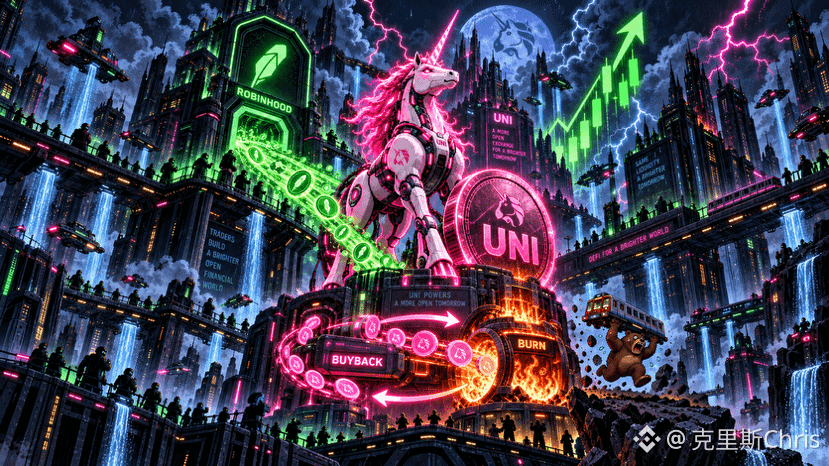
$UNI The core reason behind this round of upswing is that after the Fee Switch is enabled, the market’s way of valuing UNI has changed.
Previously, Uniswap had an issue: transaction volumes were high, and revenue was also high, but these had no direct link to UNI token holders. Even if the protocol earned more, it was difficult to translate that into the token itself. UNI largely still played a governance role.
Now that the Fee Switch is turned on, some of the protocol’s fees can be used for UNI buybacks and burning. There’s finally a direct connection between trading volume and the token.
The logic is very easy to understand:
Transaction volume increases → protocol revenue increases → UNI buybacks and burning increase → circulating supply decreases
In other words, the more people use Uniswap and the more trading they generate, the more protocol fees can be captured, which in turn supports more UNI buybacks and burning. The protocol’s business growth can begin to flow through to the token itself.
So, this round of UNI’s rally cannot be explained solely by rotation within the DeFi sector.
What the market is repricing is UNI’s shift—from a token mainly used for governance, to an asset that can capture protocol revenue.
Previously, Uniswap had an issue: transaction volumes were high, and revenue was also high, but these had no direct link to UNI token holders. Even if the protocol earned more, it was difficult to translate that into the token itself. UNI largely still played a governance role.
Now that the Fee Switch is turned on, some of the protocol’s fees can be used for UNI buybacks and burning. There’s finally a direct connection between trading volume and the token.
The logic is very easy to understand:
Transaction volume increases → protocol revenue increases → UNI buybacks and burning increase → circulating supply decreases
In other words, the more people use Uniswap and the more trading they generate, the more protocol fees can be captured, which in turn supports more UNI buybacks and burning. The protocol’s business growth can begin to flow through to the token itself.
So, this round of UNI’s rally cannot be explained solely by rotation within the DeFi sector.
What the market is repricing is UNI’s shift—from a token mainly used for governance, to an asset that can capture protocol revenue.