$63 DASH—are you betting on a “latecomer rebound,” or did you grab the very last torch from the “follow-the-crowd” orders?
First, look at the surface: wild pumps and dumps, a total mess on the ground.
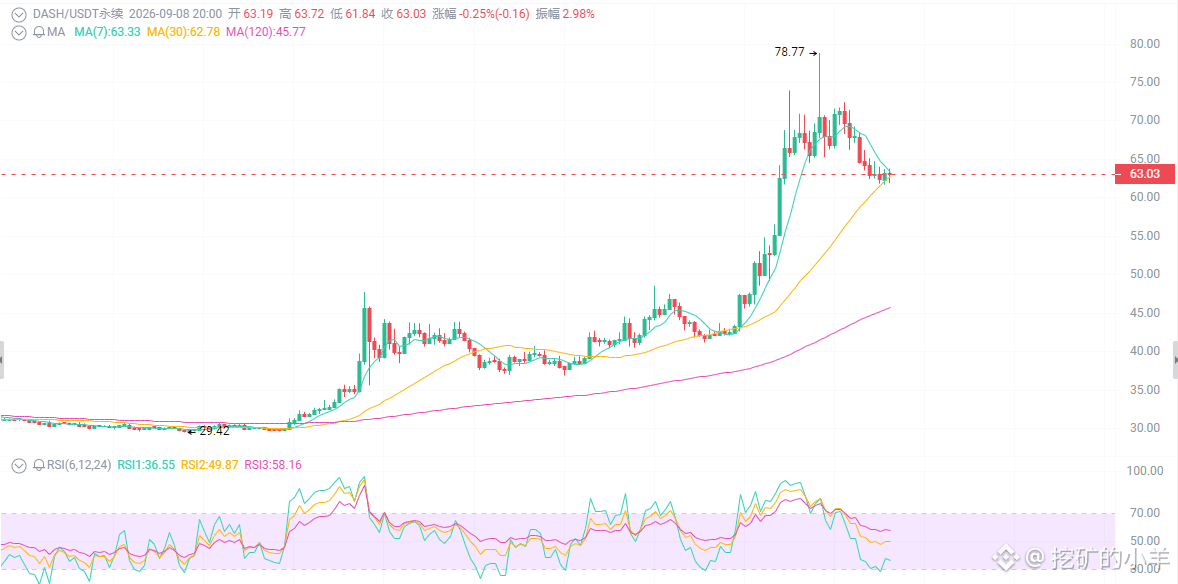
Over the past half month, DASH ripped out of the $30 support like it was pulling itself up out of thin air. In just a week it surged 40%-55%, even tagging 78 at one point, while its market cap jumped from $400 million to nearly $1 billion. But the good times didn’t last. In a single day it fell more than 10%, straight back down to 63.
DashCon 2026 was held, but as soon as the event ended, the price leaked. That’s the classic “conference coin / upgrade coin” pattern.
First thing: this DASH spike wasn’t really its own doing—it was riding ZEC’s light.
With the Zcash ETF rolling out and ZEC breaking above $1,000, hot money went on a frenzy to hunt for the “next privacy coin.” Funds rotated into DASH and XMR. At one point, DASH’s 24-hour trading volume topped 50% of its market cap—turnover was wildly extreme and frankly unbelievable.
After ZEC runs up, liquidity spills over to DASH; once ZEC pulls back, DASH will fall even harder.
Second thing: DashCon and Platform upgrades are real—but “product delivery” doesn’t automatically mean “price takes off.”
DASH is indeed evolving: it has added shielded transactions on the zk path, decentralized storage and on-chain usernames, InstantSend with sub-second confirmation still in place, and the masternode network plus DAO governance are also running. There are payment cards, fiat on/off-ramp support, and rollouts across Southeast Asia, too.
But DASH is a “second-time packaging of an older project,” not “the next ZEC.” In the short term, the run-up has overdrawn expectations—now it’s the repayment phase.
Third thing: the candlestick structure is crystal clear—an “event-driven spike” has already formed, and now it’s the typical surge-then-pullback.
Look at the daily chart: after breaking 60, price shot straight up to 72-78, leaving long upper wicks, then one big bearish candle smashed it back to around 63. RSI cooled off from overbought, MACD on the short cycle turned weaker, and the short-term moving averages (20/50) started flattening or getting dragged down.
During the pump, volume exploded; during the pullback, volume is still present. That indicates someone is unloading in large size—not a low-volume, slow bleed.
Trading strategy
Short term:
Wait for 61.5-62 to stabilize and stop the downside, and if the 4-hour candle closes firm, go long with a small position size. Set your stop-loss below 60.2. Targets: 66.5-68. If the rebound reaches 67-68, you must cut down the long positions.
If it breaks below 61.5 on rising volume, don’t catch a falling knife—wait and reassess at 56-58 for potential “hammer” candlesticks.
Mid term:
The weekly structure hasn’t broken, and the privacy-sector thesis hasn’t finished playing out either. But the more comfortable entry is around 56-58; at the worst, you should at least see a breakout-and-retest near 50. As long as the weekly candle doesn’t close below 50, this leg of the primary uptrend from 30 hasn’t been invalidated.
First, look at the surface: wild pumps and dumps, a total mess on the ground.
Over the past half month, DASH ripped out of the $30 support like it was pulling itself up out of thin air. In just a week it surged 40%-55%, even tagging 78 at one point, while its market cap jumped from $400 million to nearly $1 billion. But the good times didn’t last. In a single day it fell more than 10%, straight back down to 63.
DashCon 2026 was held, but as soon as the event ended, the price leaked. That’s the classic “conference coin / upgrade coin” pattern.
First thing: this DASH spike wasn’t really its own doing—it was riding ZEC’s light.
With the Zcash ETF rolling out and ZEC breaking above $1,000, hot money went on a frenzy to hunt for the “next privacy coin.” Funds rotated into DASH and XMR. At one point, DASH’s 24-hour trading volume topped 50% of its market cap—turnover was wildly extreme and frankly unbelievable.
After ZEC runs up, liquidity spills over to DASH; once ZEC pulls back, DASH will fall even harder.
Second thing: DashCon and Platform upgrades are real—but “product delivery” doesn’t automatically mean “price takes off.”
DASH is indeed evolving: it has added shielded transactions on the zk path, decentralized storage and on-chain usernames, InstantSend with sub-second confirmation still in place, and the masternode network plus DAO governance are also running. There are payment cards, fiat on/off-ramp support, and rollouts across Southeast Asia, too.
But DASH is a “second-time packaging of an older project,” not “the next ZEC.” In the short term, the run-up has overdrawn expectations—now it’s the repayment phase.
Third thing: the candlestick structure is crystal clear—an “event-driven spike” has already formed, and now it’s the typical surge-then-pullback.
Look at the daily chart: after breaking 60, price shot straight up to 72-78, leaving long upper wicks, then one big bearish candle smashed it back to around 63. RSI cooled off from overbought, MACD on the short cycle turned weaker, and the short-term moving averages (20/50) started flattening or getting dragged down.
During the pump, volume exploded; during the pullback, volume is still present. That indicates someone is unloading in large size—not a low-volume, slow bleed.
Trading strategy
Short term:
Wait for 61.5-62 to stabilize and stop the downside, and if the 4-hour candle closes firm, go long with a small position size. Set your stop-loss below 60.2. Targets: 66.5-68. If the rebound reaches 67-68, you must cut down the long positions.
If it breaks below 61.5 on rising volume, don’t catch a falling knife—wait and reassess at 56-58 for potential “hammer” candlesticks.
Mid term:
The weekly structure hasn’t broken, and the privacy-sector thesis hasn’t finished playing out either. But the more comfortable entry is around 56-58; at the worst, you should at least see a breakout-and-retest near 50. As long as the weekly candle doesn’t close below 50, this leg of the primary uptrend from 30 hasn’t been invalidated.