

Bitcoin is once again at a point where the next few sessions could define the direction of the broader crypto market.
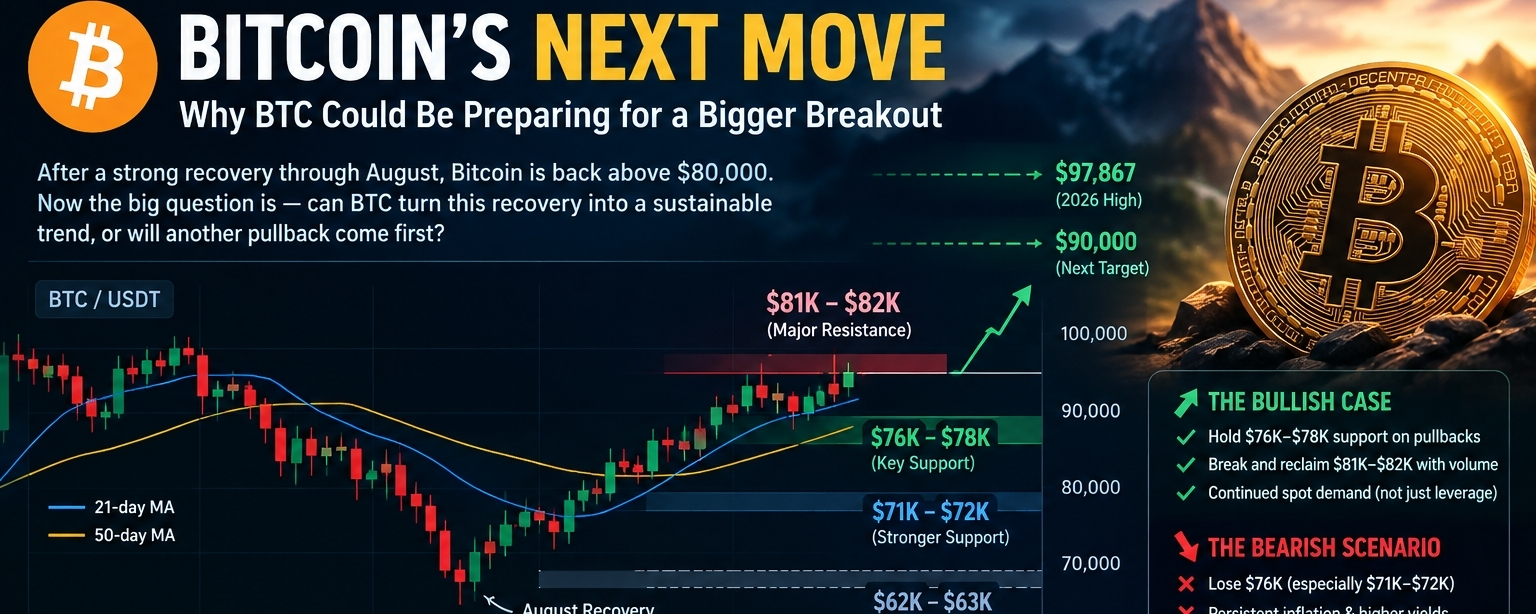
After a strong recovery through August, BTC pushed above $80,000 and briefly traded above $81,000 before momentum cooled. The market is now watching whether Bitcoin can turn this recovery into a sustainable trend or whether another pullback will come first.
What makes the current setup interesting is that Bitcoin is no longer showing the same structure it had during the earlier weakness. The recent rally pushed BTC back above several important moving averages, while the 21-day moving average has also formed a bullish signal. That doesn't guarantee another rally, but it suggests that buyers are gradually regaining control.
The $76K–$82K Zone Is Critical
For me, the most important thing right now isn't chasing every green candle. It's watching the levels where buyers and sellers are likely to fight.
The $76,000–$78,000 area has become an important support zone. If BTC continues holding above this region during pullbacks, it would suggest that buyers are defending the recent recovery.
On the upside, $81,000–$82,000 is the major area to watch.
Bitcoin has already tested this region, but a clean breakout with strong volume could change the entire market structure. Analysts have pointed to roughly $82,000 as an important resistance area, with a successful breakout potentially opening the path toward $90,000.
That is why the next move matters more than the current candle.
Institutional Demand Remains Important
Another major part of the Bitcoin story is institutional participation.
Recent reports indicate that U.S. spot Bitcoin ETFs have continued to attract meaningful demand, while renewed buying activity has helped support the recovery. 21Shares reported around $3.05 billion in ETF inflows during the August rally, suggesting that the move wasn't purely driven by speculative leverage.
This distinction matters.
A rally driven entirely by leverage can disappear quickly when traders start closing positions. But when spot demand is present alongside improving technical structure, the market has a stronger foundation.
At the same time, investors should not assume every rally is automatically sustainable. Some of the recent upside was accelerated by short liquidations, meaning part of the move came from forced buying rather than fresh long-term capital.
So the key question is simple:
Can BTC keep attracting real demand after the short squeeze fades?
Macro Could Decide the Next Breakout
Bitcoin is still highly sensitive to the macro environment.
The upcoming U.S. inflation data and Federal Reserve decision are particularly important. A softer inflation reading could strengthen expectations for easier monetary conditions, while persistent inflation could keep pressure on risk assets.
This is why Bitcoin's chart cannot be viewed in isolation.
Treasury yields, the dollar, liquidity conditions and expectations around Federal Reserve policy can all influence whether capital flows toward risk assets such as Bitcoin.
Recent comments from Fed Governor Christopher Waller also helped boost risk appetite, showing just how quickly monetary-policy expectations can affect crypto markets.
What Would Make the Bullish Case Stronger?
The bullish case becomes much more convincing if BTC can do three things:
First: Hold the $76K–$78K support region during pullbacks.
Second: Break and reclaim the $81K–$82K resistance zone with convincing volume.
Third: See continued spot demand rather than another rally dominated by leverage.
If those conditions line up, Bitcoin could begin targeting higher resistance zones, with $90K becoming a realistic technical objective rather than just a psychological number.
And if BTC eventually pushes beyond the major resistance near $82K, market attention could quickly shift toward the 2026 high near $97,867.
But There Is Still a Bearish Scenario
Being bullish doesn't mean ignoring risk.
If Bitcoin loses the $76K area and especially the stronger support around $71K–$72K, the current recovery structure could weaken considerably. Reuters' technical analysis identified $71,781 as an important level, with deeper downside potentially exposing the $62K–$63K region.
Macro conditions are another risk.
If inflation remains stubborn, Treasury yields continue rising and the Federal Reserve maintains a tighter stance, Bitcoin could struggle to sustain higher prices. Higher yields generally make risk assets less attractive, particularly when investors are already cautious about liquidity.
That means the market isn't simply waiting for a technical breakout.
It is waiting for confirmation from both price and macro liquidity.
My View on BTC
Bitcoin's structure is becoming much more interesting after the August recovery.
I wouldn't call every move above $80K the beginning of a new bull market yet. The market still needs confirmation. But the fact that BTC recovered strongly from the lower levels, reclaimed major moving averages and attracted renewed institutional interest is difficult to ignore.
For now, I would rather watch the reaction around support than chase the price after a sudden pump.
If BTC holds the $76K–$78K region and eventually breaks $82K with strong demand, the next major conversation could quickly become $90K and beyond.
But if support fails, the market may need another round of consolidation before buyers are ready to push higher.
Bitcoin doesn't need to move vertically to remain bullish.
Sometimes the strongest setups are built through patience, consolidation and repeated tests of resistance.
Right now, $82K is the door.
If Bitcoin can finally open it and stay above it, the market could enter a very different phase.
This is market commentary, not financial advice. Crypto remains highly volatile, and key levels can change quickly.#BTC走势分析