
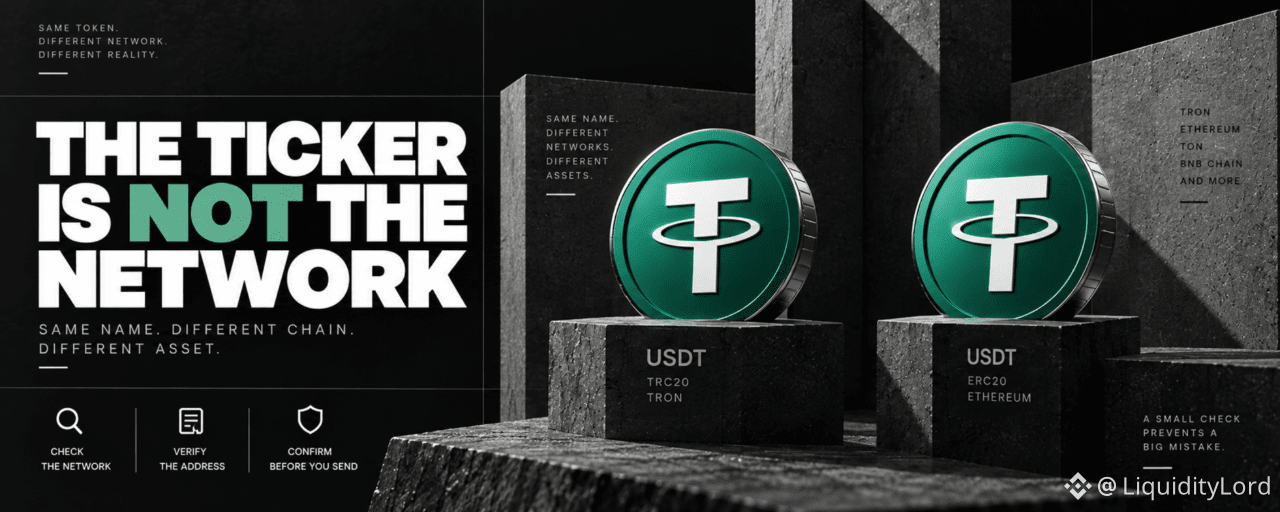

How to Check Which Network Your USDT or USDC Is On
I lost track of how many times someone has messaged me some version of "I sent my USDT and it's gone." Almost every time, the actual story is the same: right token, right address, wrong network. Not hacked. Not scammed. Just one unchecked dropdown between them and a transfer that can't be undone. 😬
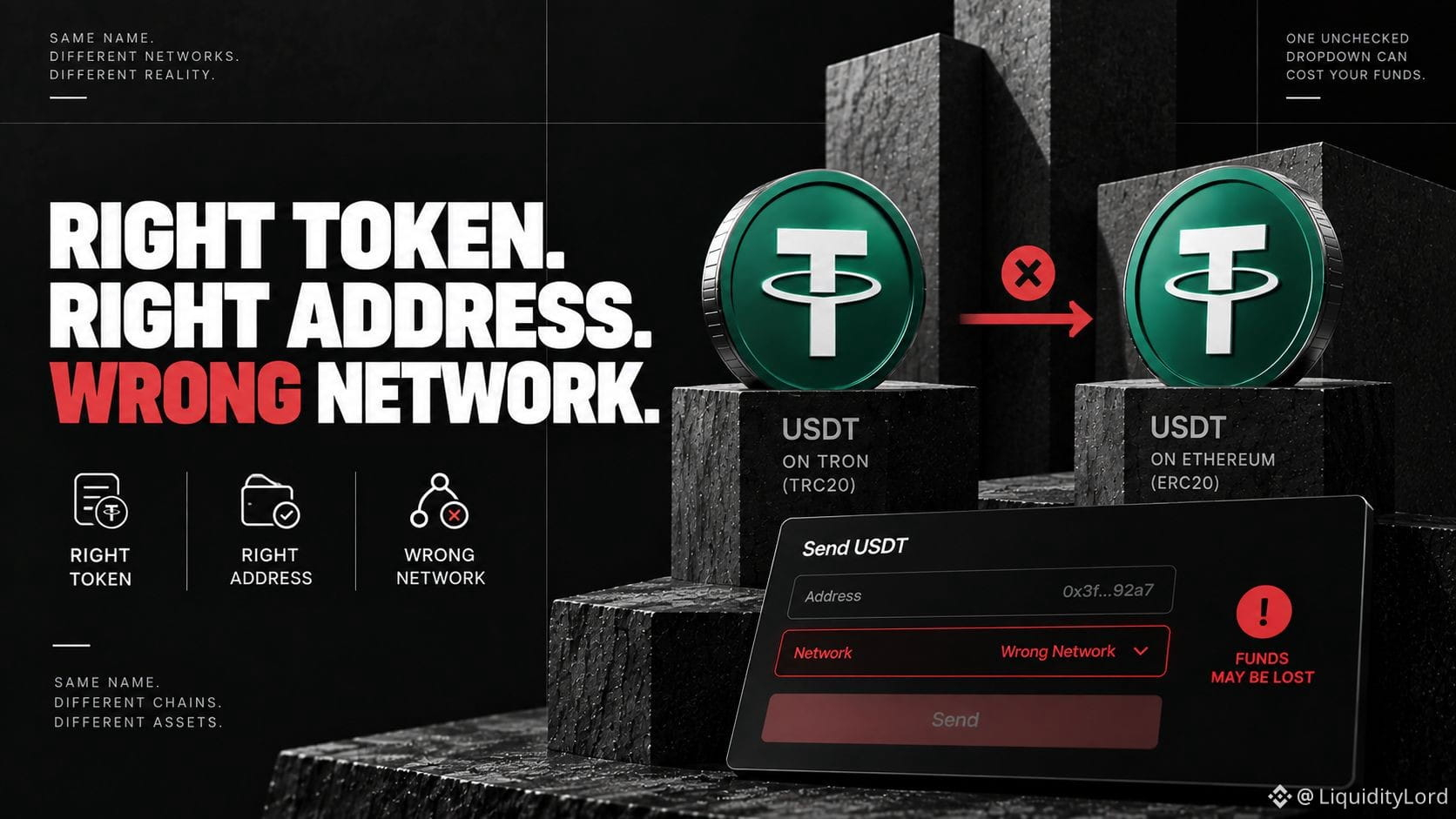
"USDT" isn't an address, and honestly it isn't even one asset. It's a name reused across a dozen separate blockchains, each with its own contract and zero built-in awareness that the other versions exist. Mixing up the name for the thing itself is the most avoidable way I've watched people lose money in this space — and I've been around long enough to watch it happen a lot, usually to people who would tell you, if you asked them directly, that they already knew better.
🎟️ The ticker tells you what it is, never where it lives
Say "USDT" out loud and you've communicated exactly one thing: dollar-pegged stablecoin, specific issuer. You've said nothing about which chain that particular token instance actually sits on. USDT exists as independently deployed contracts on Ethereum, TRON, TON, BNB Chain, and a few others, running in parallel, with no native path between any of them. Each one has its own total supply, its own minting authority, its own transaction history — they just happen to share a name and a target price.
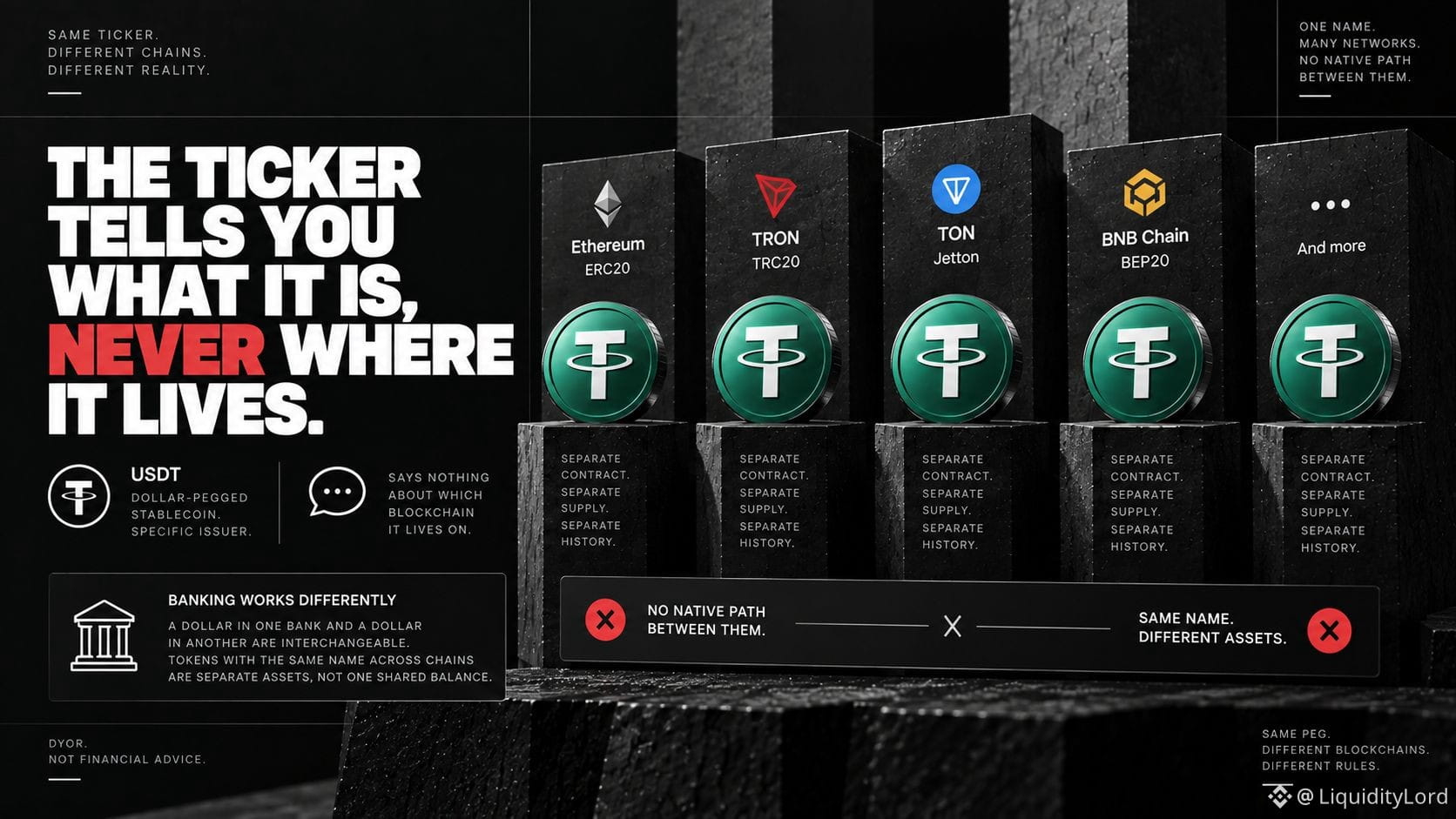
This trips people up because it breaks a habit everyone already has from regular banking. A dollar in one account and a dollar in another are basically interchangeable, and which bank happens to be holding it barely matters to how you think about the money itself. Tokens sharing a name across chains don't get that same interchangeability for free, even though the branding makes it feel like they should. They're separate implementations of the same peg, built and maintained independently, not one asset you can beam anywhere on request just because the letters match.
✅ What actually tells you the truth
Two things answer the "which network" question when the ticker can't:
Your wallet's own context. Most wallets group balances by network, so USDT shows up under a TRON section, a TON section, or an Ethereum section depending on where it actually lives. Fastest gut-check available, and it's usually sitting right there in the interface already, just easy to skim past when you're moving fast.
The contract address itself. Every token on every network has a unique address — infinitely more trustworthy than a name or logo, which any project can copy onto any chain with zero technical effort.
I check the contract address against an official source before anything beyond a small, routine transfer. Same habit I'd use before trusting any unfamiliar token in general — the muscle memory carries over.
A wallet that flattens everything into one "USDT" balance with no network separation is, frankly, hiding exactly the detail you need most, and I've never fully understood why some interfaces still do this in the name of simplicity. It's the one piece of simplicity that ends up costing people the most.
🔀 Same name, genuinely different assets
USDT on TRON is a TRC-20 contract, popular there historically thanks to low fees and fast confirmation times, which made it the default rail for a huge amount of everyday stablecoin movement long before TON was even part of the conversation. USDT on TON is a jetton — TON's own token standard, no native relationship to the TRON version beyond sharing an issuer and a peg. USDT on Ethereum is the original ERC-20, gas paid in ETH, the version most of the earliest DeFi infrastructure was actually built around. It exists again on Base as its own deployment, and again on BNB Chain as a BEP-20. USDC runs the identical pattern under a different issuer, with its own separate footprint across most of the same networks.
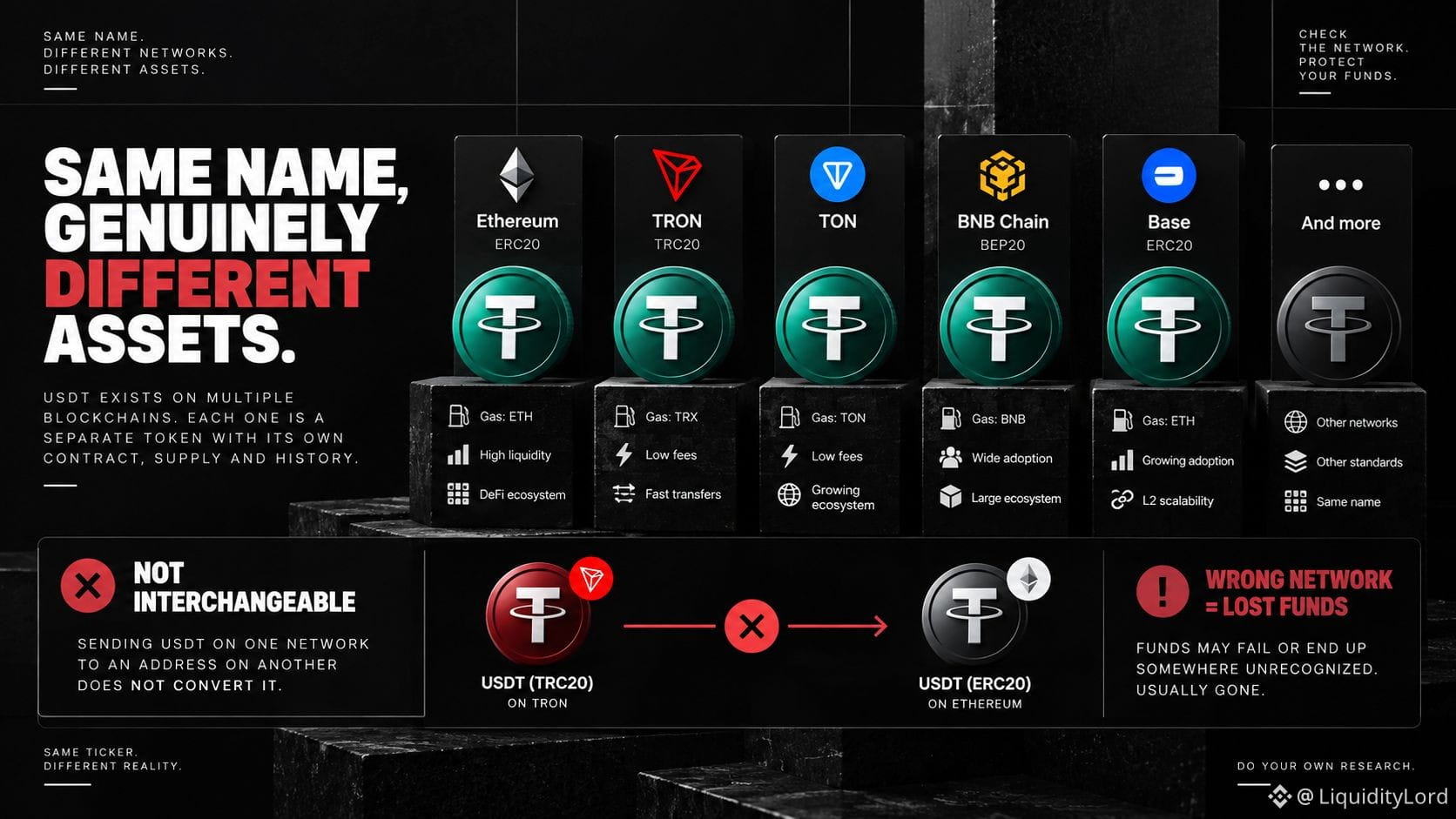
None of these convert into each other by just sending one toward an address expecting another. Send TRON-network USDT somewhere expecting the Ethereum version, and depending on exactly how the mistake happens, you either get an outright failure, or — worse — funds landing somewhere the receiving system was never built to recognize at all. In practice that usually means gone, not delayed, and there's rarely a support line on the other end that can pull it back for you.
What actually catches people isn't confusion about the concept once it's explained — most people get it instantly, it's not complicated. It's that nothing about tapping through a wallet or an exchange forces this fact to the surface until the one moment it matters, by which point the transaction is often already halfway out the door, and the interface has already moved on to a success screen that doesn't know anything went wrong.
⚠️ Why the check matters every single time, not just for big transfers
A few things worth knowing, and none of them are exotic:
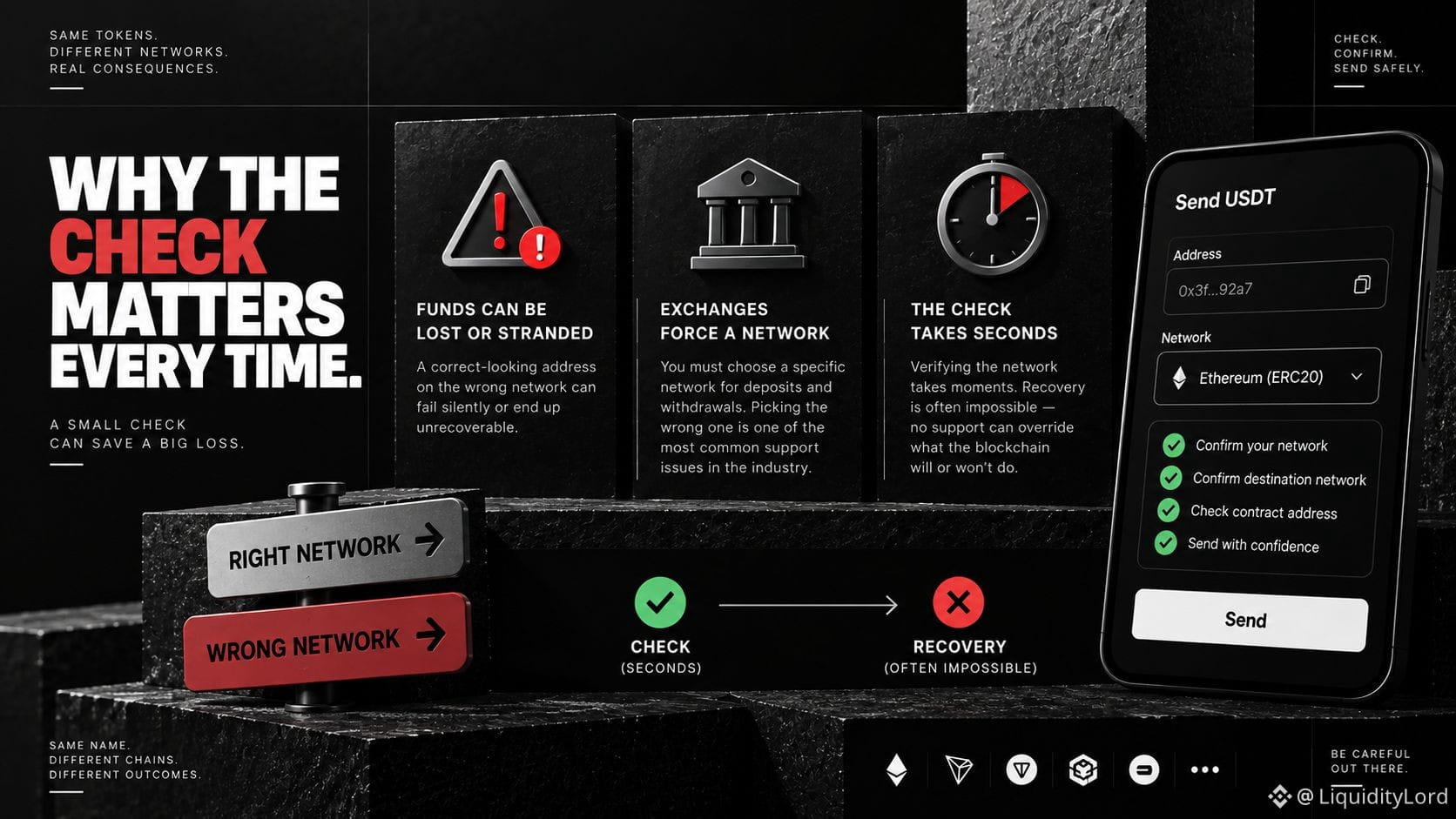
A transaction sent to a correct-looking address on the wrong network can fail silently, or complete in a way that leaves funds effectively stranded with no clean recovery path, even for a technically savvy support team on the receiving end
Exchanges make you pick a specific network for deposits and withdrawals for exactly this reason, and picking wrong against what they expect is one of the single most common support-ticket categories in the entire industry, year after year, regardless of how much clearer interfaces have gotten
The check itself costs seconds. Recovering from a wrong-network transfer, in most cases, isn't possible at all — no amount of urgency in a support chat changes what the chain itself will and won't do
My own routine before every cross-chain move, without exception: confirm the network my funds are actually on right now, confirm the network the destination expects, and if there's any doubt, check the contract address against an official source instead of trusting a name. It's not a large amount of extra effort. It just has to actually happen, every time, instead of the one time it doesn't.
🧭 Where STONfi forces this choice into the open
This isn't background theory sitting outside STONfi's own product — it's built directly into how the swap flow works, on purpose, not as an afterthought bolted on after enough people complained. STONfi's source and destination selectors require picking network and asset as genuinely separate choices. Selecting TRON as your source network and USDT as your source asset is a deliberately distinct step from selecting the asset name alone, specifically so the network can't quietly get assumed or skipped on autopilot the way it can on interfaces that treat the two as one dropdown.
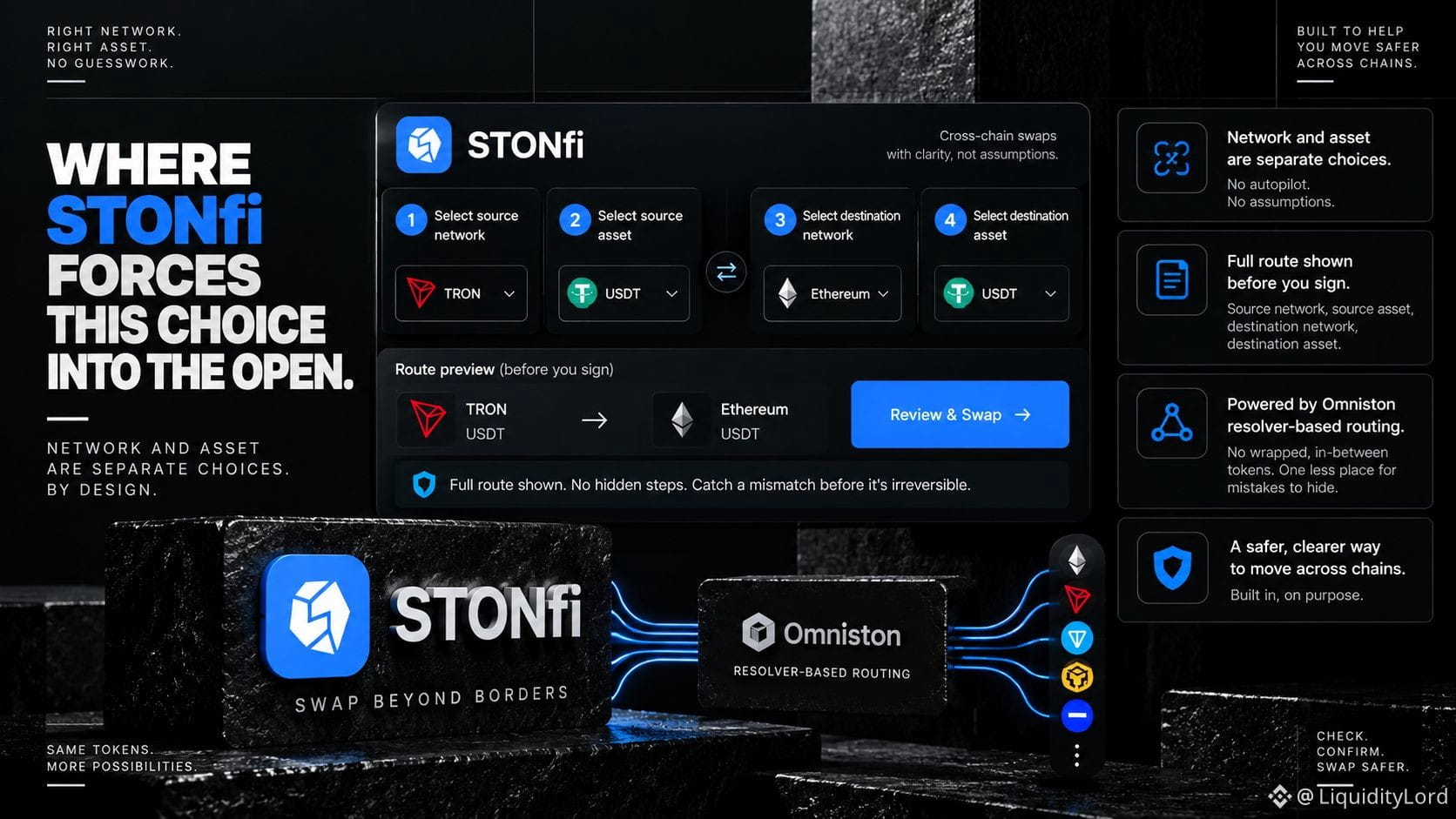
Before you sign anything, the interface shows your full selected route back to you — source network, source asset, destination network, destination asset. That's your real chance to catch a mismatch before it becomes irreversible, not after, and it's presented plainly enough that catching an error there doesn't require any particular expertise, just a second of actually reading it.
I've started thinking of that selector screen less as a form field and more as the one moment STONfi is actively doing due diligence with you, instead of just letting you click past it on the way to somewhere else.
It's also worth it for a quieter reason. Because STONfi's cross-chain execution runs through Omniston's resolver-based routing rather than a classic locked-vault bridge, there's no wrapped, in-between representation sitting on some intermediate chain that could reintroduce this exact same "which network is this actually on" confusion, one layer deeper, without you noticing it happened. One less place for the same mistake to hide.
⏱️ The short version
Before sending or swapping any USDT or USDC: check the network your funds are on, check the network the destination expects, and when anything feels uncertain, verify the contract address rather than trusting a name. Boring, takes ten seconds, and it's the one habit standing between you and the message I get more than almost any other. 🔍
❓ FAQ
If I send TRON-network USDT to a TON wallet address, will it just show up as TON USDT? No. Separate, unrelated contracts. Sending the wrong network's version toward something expecting a different network typically fails outright, or results in funds that can't be recovered.
Is checking the contract address really necessary if my wallet already labels the network clearly? For routine transfers, wallet labeling is usually enough. For anything larger or unfamiliar, checking the contract address adds real certainty for very little effort.
Why do USDT and USDC even exist on this many networks? Issuers deploy the same stablecoin across multiple chains to meet users and liquidity where they already are. No single network covers every use case equally well.
Does STONfi's cross-chain flow handle this risk for me automatically? It structures the choice explicitly by requiring separate source and destination selection, which removes most silent mismatches — but reviewing the route before confirming is still worth doing yourself, every time.
Not financial advice, DYOR. Disclosure: Official STONfi Ambassador.
