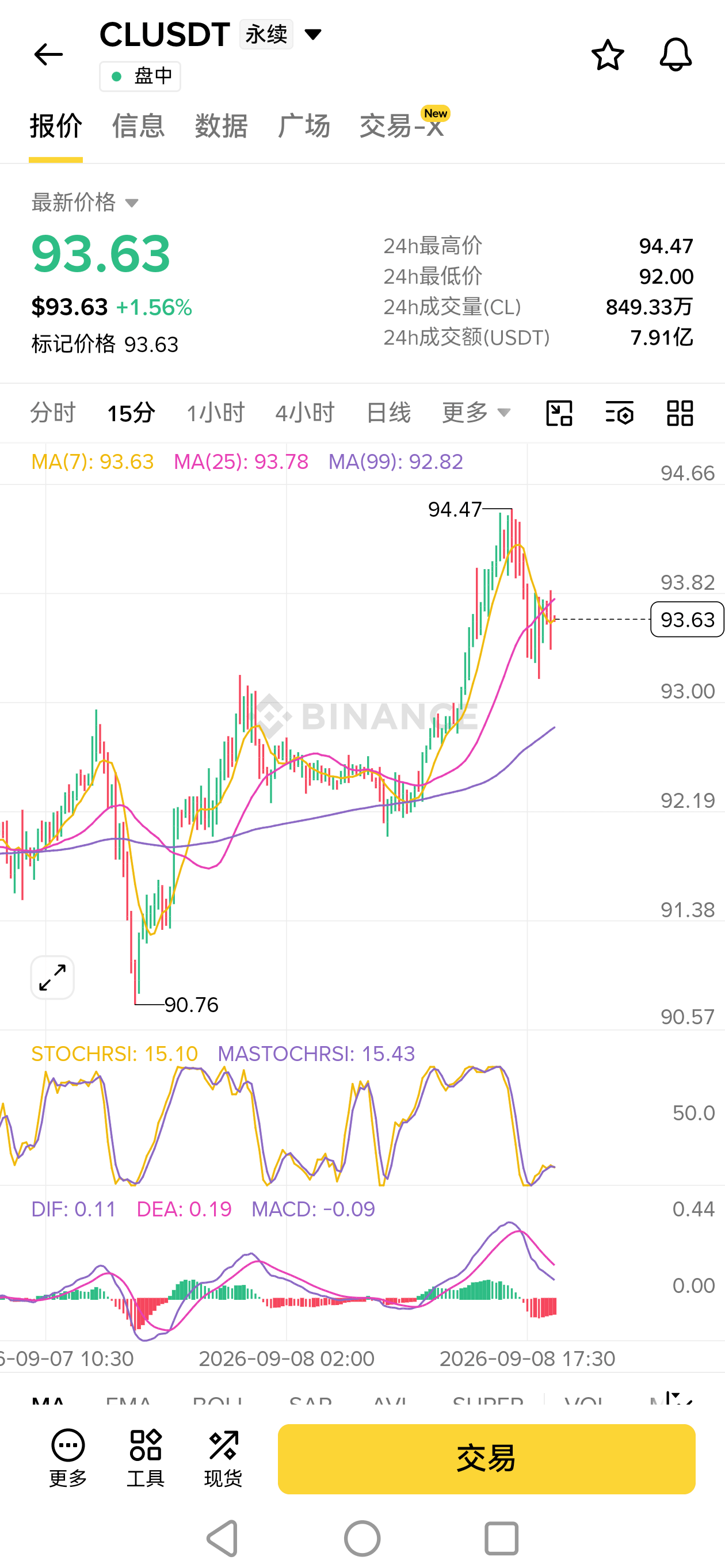

Local clashes escalate from verbal sparring to cross-sea attacks on oil tankers. What the market truly fears is never the “conflict news” itself, but whether it will directly choke the world’s energy supply. #美伊互袭油轮冲突升级 is not an ordinary military bulletin—it’s a warning bell for the global crude oil pricing system.
Why has the crypto market recently kept failing to rebound, only to pull back quickly? At its core, capital is simultaneously grappling with three things: wavering expectations for macro interest rates, repeated swings in the strength of the U.S. dollar, and ongoing escalation of geopolitical risks. And once tensions in the Middle East heat up, crude oil prices are the first to take a stance—igniting inflation expectations again—so risk assets naturally have a hard time staying truly at ease. In other words, oil prices are not a side character; they often mark the starting point for the next round of market sentiment.
Focus on crude oil. From a trading logic perspective, crude oil is not just a commodity—it’s an amplifier for “inflation expectations” and “risk appetite.” If tanker conflicts keep expanding, the market will first price in two directions: one is that supply-disruption expectations push oil prices higher; the other is that higher oil prices force the Fed to turn more hawkish, suppressing stock and crypto asset valuations. Once this chain forms, BTC and altcoins are often dragged down first by liquidity sentiment.
But what’s really worth watching isn’t the moment the news breaks—it’s whether oil prices can hold key levels. If $CL is only a pulse-like spike followed by a rapid drop, it means the market is still treating it as a short-term risk event. But if $CL keeps strengthening, volatility expands, and the term structure tightens, then it means traders have already started pricing in a “longer-duration energy premium.” At that point, the market shifts from “worrying about the conflict” to “worrying about inflation.”
That’s the most concerning part: many people in the crypto market only watch whether BTC is rising, but they overlook that crude oil is the macro sentiment outpost. When oil prices move first, capital will reorder itself—first to preserve itself, then to chase returns.
So if the Iran–U.S. reciprocal attacks and tanker conflict escalate, it’s not only a Middle East issue—it’s a test of global investors’ risk appetite. Do you think $CL will keep surging higher next, or will the market digest it quickly? #加密货币 #加密市场
Why has the crypto market recently kept failing to rebound, only to pull back quickly? At its core, capital is simultaneously grappling with three things: wavering expectations for macro interest rates, repeated swings in the strength of the U.S. dollar, and ongoing escalation of geopolitical risks. And once tensions in the Middle East heat up, crude oil prices are the first to take a stance—igniting inflation expectations again—so risk assets naturally have a hard time staying truly at ease. In other words, oil prices are not a side character; they often mark the starting point for the next round of market sentiment.
Focus on crude oil. From a trading logic perspective, crude oil is not just a commodity—it’s an amplifier for “inflation expectations” and “risk appetite.” If tanker conflicts keep expanding, the market will first price in two directions: one is that supply-disruption expectations push oil prices higher; the other is that higher oil prices force the Fed to turn more hawkish, suppressing stock and crypto asset valuations. Once this chain forms, BTC and altcoins are often dragged down first by liquidity sentiment.
But what’s really worth watching isn’t the moment the news breaks—it’s whether oil prices can hold key levels. If $CL is only a pulse-like spike followed by a rapid drop, it means the market is still treating it as a short-term risk event. But if $CL keeps strengthening, volatility expands, and the term structure tightens, then it means traders have already started pricing in a “longer-duration energy premium.” At that point, the market shifts from “worrying about the conflict” to “worrying about inflation.”
That’s the most concerning part: many people in the crypto market only watch whether BTC is rising, but they overlook that crude oil is the macro sentiment outpost. When oil prices move first, capital will reorder itself—first to preserve itself, then to chase returns.
So if the Iran–U.S. reciprocal attacks and tanker conflict escalate, it’s not only a Middle East issue—it’s a test of global investors’ risk appetite. Do you think $CL will keep surging higher next, or will the market digest it quickly? #加密货币 #加密市场