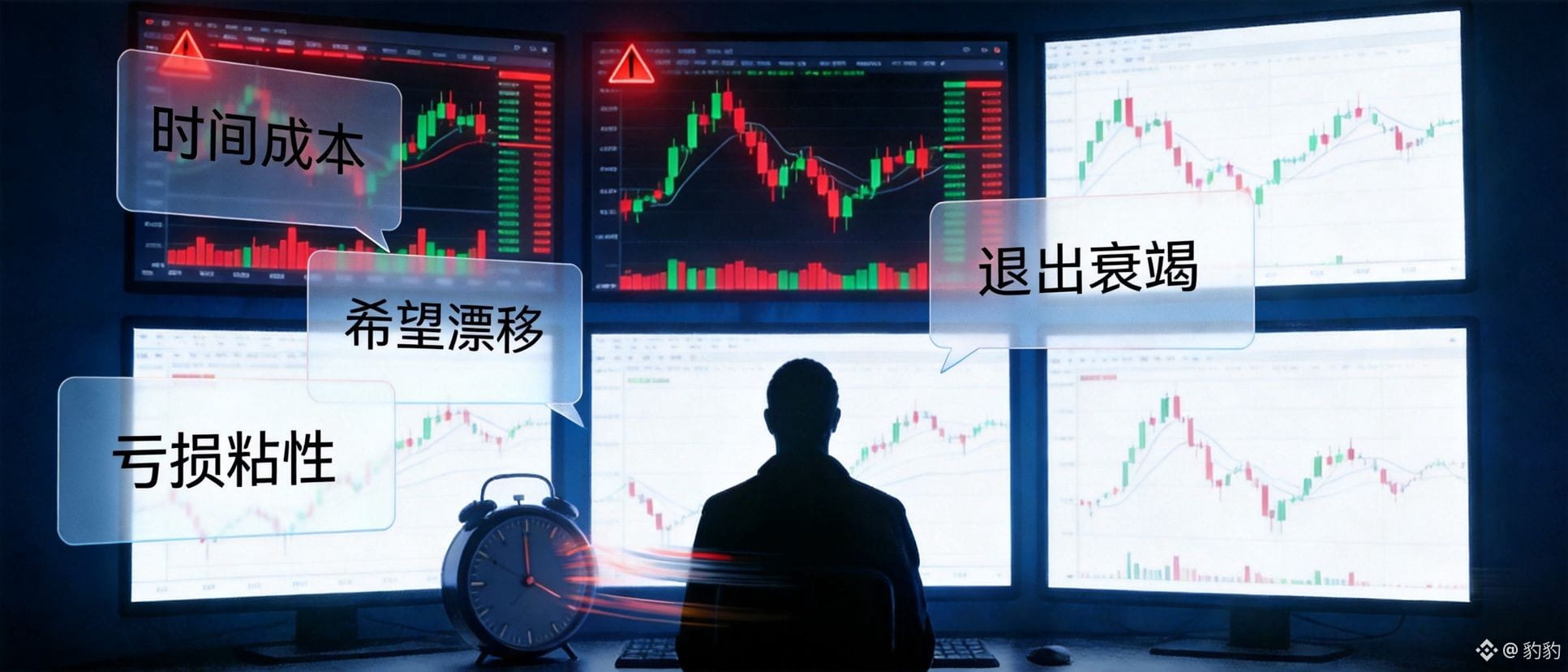
LeopardLeopard’s Trading Classroom 🏹: If a trade drags on too long, fantasies start to grow!
① Time cost
The longer you hold, the higher the psychological cost.
At the beginning you have a clear reason to enter, but as time passes, waiting itself starts consuming your decision-making ability. Every extra day, you have to ask yourself: Is the reason for waiting any longer still valid?
② Hope drift
The longer you hold, the more your expectations are likely to drift.
Your original goal was A, but as you keep holding, it turns into “If only it could reach B.” Your expectations keep floating upward, but the market doesn’t wait for you. Go back to the original trading conditions—don’t fall in love with your own plan.
③ Loss stickiness
The longer losses last, the harder it is to admit it and exit.
When you’re down 10%, you think, “Just wait a bit more and it’ll come back.” After a month, you start thinking, “I’ve already lost so much—cutting now is too painful.” That’s the stickiness of losses—you’re not reluctant to cut the position, you’re reluctant to let go of your own unwillingness.
④ Exit exhaustion
The longer a trade drags, the weaker your ability to execute the exit becomes.
When you first enter, you’re decisive and disciplined; after holding for a month, your focus is scattered and your emotions dull. And when it’s time to leave, you suddenly can’t. Procrastination itself is what dismantles your execution.
In plain terms, a good trade should be decisive—enter for a reason, and exit with evidence. The longer you drag it on, the less you’re actually trading—and the more you’re indulging fantasies. #美加关税战升级
① Time cost
The longer you hold, the higher the psychological cost.
At the beginning you have a clear reason to enter, but as time passes, waiting itself starts consuming your decision-making ability. Every extra day, you have to ask yourself: Is the reason for waiting any longer still valid?
② Hope drift
The longer you hold, the more your expectations are likely to drift.
Your original goal was A, but as you keep holding, it turns into “If only it could reach B.” Your expectations keep floating upward, but the market doesn’t wait for you. Go back to the original trading conditions—don’t fall in love with your own plan.
③ Loss stickiness
The longer losses last, the harder it is to admit it and exit.
When you’re down 10%, you think, “Just wait a bit more and it’ll come back.” After a month, you start thinking, “I’ve already lost so much—cutting now is too painful.” That’s the stickiness of losses—you’re not reluctant to cut the position, you’re reluctant to let go of your own unwillingness.
④ Exit exhaustion
The longer a trade drags, the weaker your ability to execute the exit becomes.
When you first enter, you’re decisive and disciplined; after holding for a month, your focus is scattered and your emotions dull. And when it’s time to leave, you suddenly can’t. Procrastination itself is what dismantles your execution.
In plain terms, a good trade should be decisive—enter for a reason, and exit with evidence. The longer you drag it on, the less you’re actually trading—and the more you’re indulging fantasies. #美加关税战升级