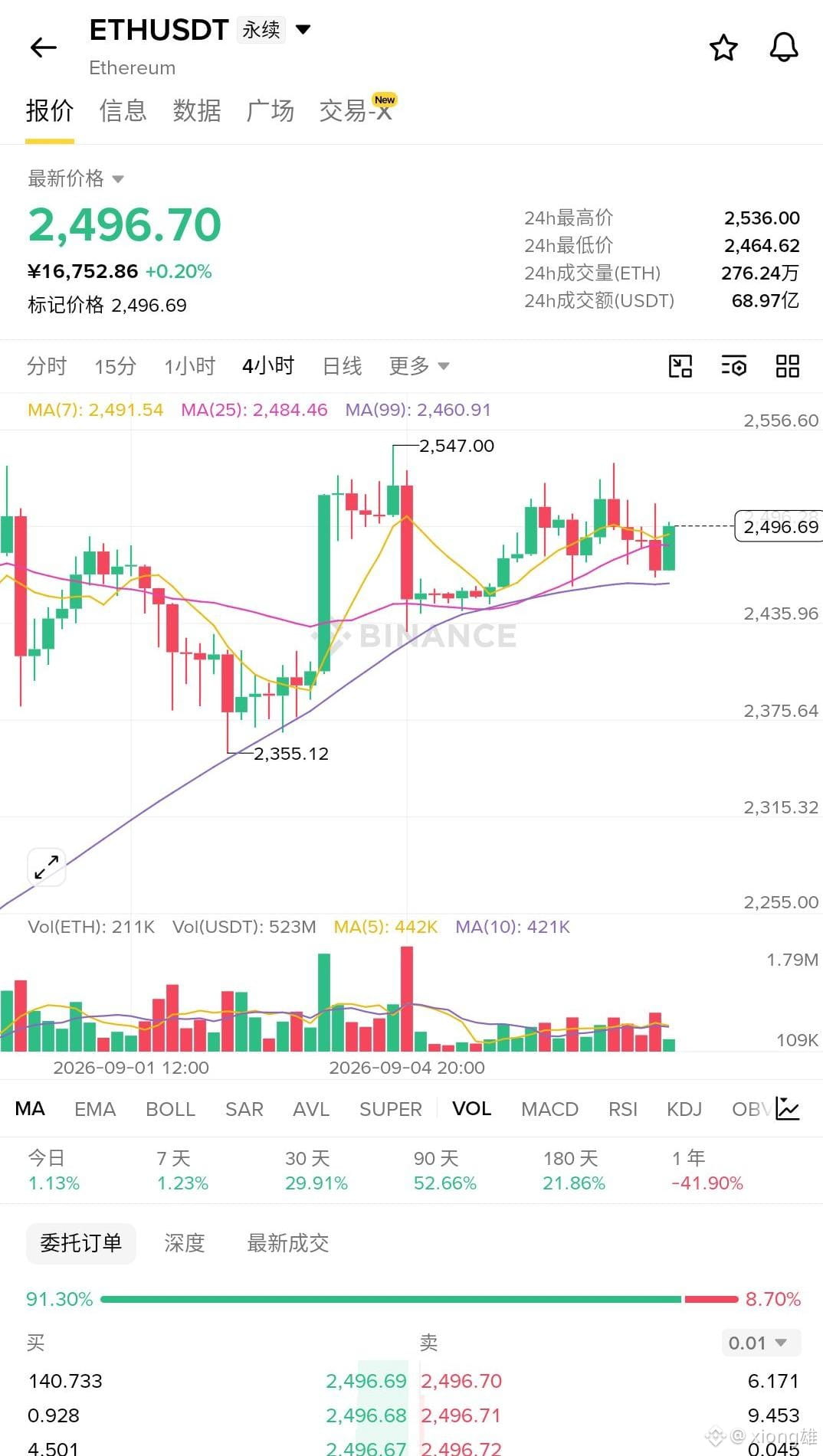
On the other side of the contract, the long account share for whales is already 57.3%; it rose another 5.5% over the past seven hours. The long/short positioning ratio is 1.70, with longs at 63%—and they’re still piling up. The bid wall at the order book is seven times the size of the ask wall, and within 15 minutes, the aggressive buy-side order flow pushed a 30-to-1 figure. Looking only at the order book, the longs are controlling the field.
But over the past nearly 3 hours, spot has seen a net outflow of 274,000 ETH, and across 12 consecutive 15-minute candlesticks, there hasn’t been a single period of net inflow. The harder the longs scramble on the order book, the more decisively real funds pull out on-chain—big players add to longs on futures, while money is being distributed and sold on the spot market. They’re moving in opposite directions.
In the last 7 hours, open interest also shrank by 0.42%. With the futures basis compressed into a discount, the share of aggressive buy orders is 53.5%, down nearly two tenths month-on-month. This isn’t adding positions to attack—it’s propping things up with reduced volume. Even though there’s net inflow of large orders in a short window, it can’t offset the net outflow on a three-hour scale.
So for this short: the price is capped below 2500, just a few points away from the 24-hour high at 2536. Spot continues to bleed out. The ‘face’ of longs at this level is being propped up by the futures side. Target 2459; if it breaks down, look for 2430.
When will I admit I’m wrong? If spot net flow turns from negative to positive, and price breaks up with volume and holds above 2536 to 2547—then it shows the outflow was just turnover and real money is stepping in. At that point, the short thesis is invalid. #eth $ETH
But over the past nearly 3 hours, spot has seen a net outflow of 274,000 ETH, and across 12 consecutive 15-minute candlesticks, there hasn’t been a single period of net inflow. The harder the longs scramble on the order book, the more decisively real funds pull out on-chain—big players add to longs on futures, while money is being distributed and sold on the spot market. They’re moving in opposite directions.
In the last 7 hours, open interest also shrank by 0.42%. With the futures basis compressed into a discount, the share of aggressive buy orders is 53.5%, down nearly two tenths month-on-month. This isn’t adding positions to attack—it’s propping things up with reduced volume. Even though there’s net inflow of large orders in a short window, it can’t offset the net outflow on a three-hour scale.
So for this short: the price is capped below 2500, just a few points away from the 24-hour high at 2536. Spot continues to bleed out. The ‘face’ of longs at this level is being propped up by the futures side. Target 2459; if it breaks down, look for 2430.
When will I admit I’m wrong? If spot net flow turns from negative to positive, and price breaks up with volume and holds above 2536 to 2547—then it shows the outflow was just turnover and real money is stepping in. At that point, the short thesis is invalid. #eth $ETH