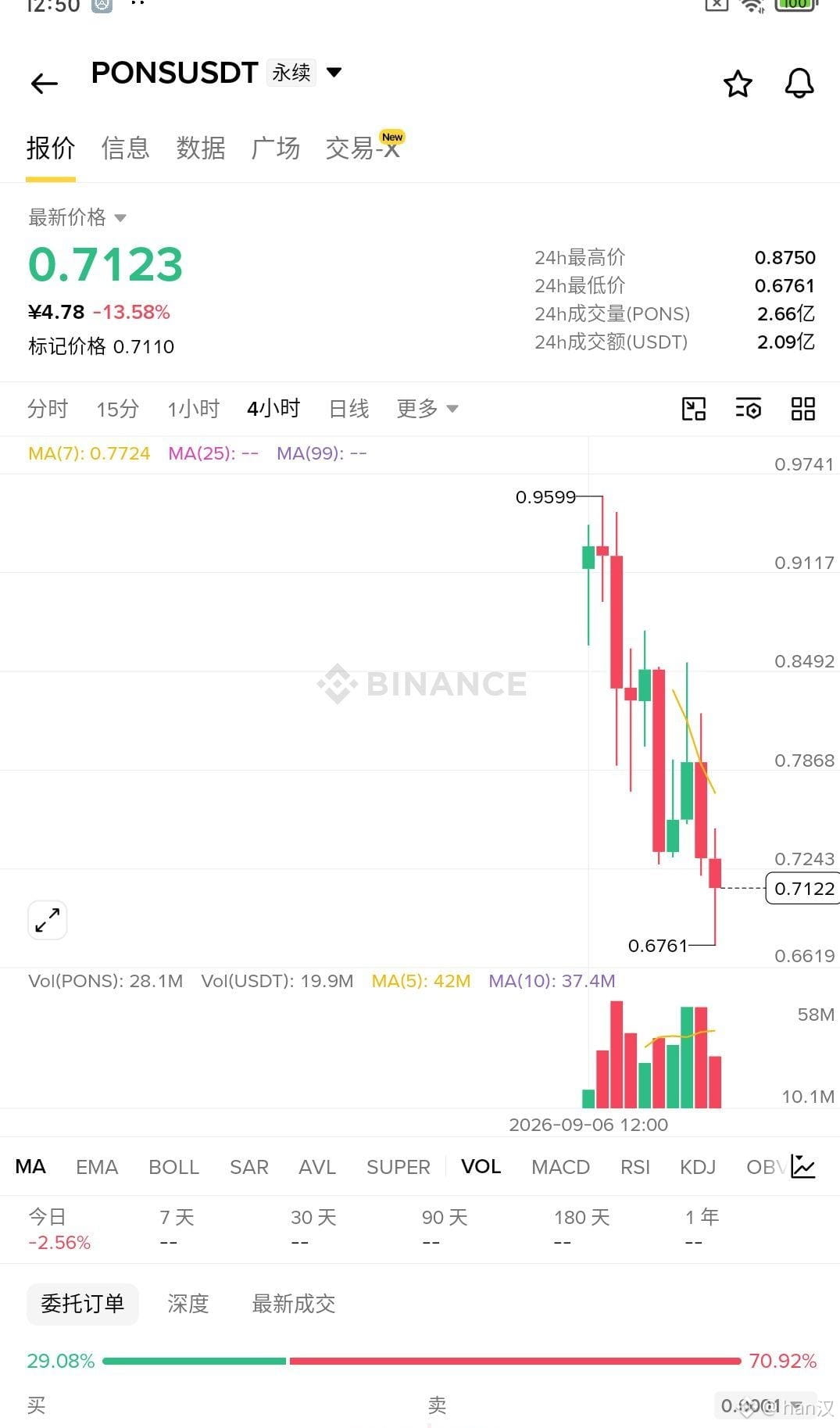
PONS — This drop: contract open interest (OI) actually surged 25.22% in seven hours. The price was smashed from 0.875 to 0.703, down 13.92% over 24 hours. During the decline, OI didn’t shrink—rather it increased. This looks more like longs catching the falling knife at the bottom, not shorts adding more.
The evidence is in the funding and trades: all eight funding samples are positive, with an average of 0.044%—the longs are paying to keep positions; active buy orders make up 51.9%, yet the price still can’t reclaim even the 20-day moving average (0.77). After rebounding to 0.85, it fails to push further and goes quiet; the four-hour trend is effectively dead—DOWN.
The big players’ stance is even more nuanced: the whale account long/short ratio was cut by 22.52% over seven hours, dumping back to the 1.01 threshold. Positions are also still hanging at 1.72, with 63% long exposure—meaning the account is reducing, but positions haven’t fully exited. Smart money uses the rebound to get out; those lifting the sedan are the later entrants with high leverage.
So, this setup should be shorted directly. On the spot order book, the sell-side liquidity at 20 levels is thicker than the buy-side. Any rebound to 0.73–0.77 is a short opportunity. First target the 24-hour low at 0.6761; if it breaks, we can look lower with room to run.
Risk: if OI spikes further and buys gain an edge, a sudden wick could sweep shorts at any time.
When to admit you’re wrong? If price rallies on volume back above 0.77, OI drops on decreasing volume, and the funding rate turns negative—that’s the signal of leveraged longs getting cleared and shorts closing. If the downtrend is truly taken over by buy pressure, then this trade should be exited.
#pons $PONS
The evidence is in the funding and trades: all eight funding samples are positive, with an average of 0.044%—the longs are paying to keep positions; active buy orders make up 51.9%, yet the price still can’t reclaim even the 20-day moving average (0.77). After rebounding to 0.85, it fails to push further and goes quiet; the four-hour trend is effectively dead—DOWN.
The big players’ stance is even more nuanced: the whale account long/short ratio was cut by 22.52% over seven hours, dumping back to the 1.01 threshold. Positions are also still hanging at 1.72, with 63% long exposure—meaning the account is reducing, but positions haven’t fully exited. Smart money uses the rebound to get out; those lifting the sedan are the later entrants with high leverage.
So, this setup should be shorted directly. On the spot order book, the sell-side liquidity at 20 levels is thicker than the buy-side. Any rebound to 0.73–0.77 is a short opportunity. First target the 24-hour low at 0.6761; if it breaks, we can look lower with room to run.
Risk: if OI spikes further and buys gain an edge, a sudden wick could sweep shorts at any time.
When to admit you’re wrong? If price rallies on volume back above 0.77, OI drops on decreasing volume, and the funding rate turns negative—that’s the signal of leveraged longs getting cleared and shorts closing. If the downtrend is truly taken over by buy pressure, then this trade should be exited.
#pons $PONS