🚢 U.S.-Iran Attacks on Tankers: Upgrading From “Bombing Facilities” to “Disrupting Shipping,” Yet Oil Prices Stall at the $100 Threshold
On September 5–6, the conflict escalated further: Iran’s Revolutionary Guard fired ballistic missiles at U.S. aircraft carriers and destroyers. The U.S. said it successfully intercepted them with zero casualties, while Iran claimed the two U.S. ships were damaged and withdrew.
The U.S. then launched a new “tanker-for-tanker” policy approved by Trump, destroying three Iranian tankers. Near Kharg Island, one tanker was disabled; outside Jask Port, another lost power; in the Gulf of Oman, one was completely sunk.
Iran “hits back double”: targeting three ships associated with the United States and three tankers that were “unauthorized” to transit through the Strait of Hormuz, and warning that it will designate the strait as a “no-go zone.”
Data is more honest than slogans: Kpler shows the strait’s 10-day average daily throughput is only 10 vessels (the lowest since May). At least three days have passed with not a single Very Large Crude Carrier (VLCC) departing.
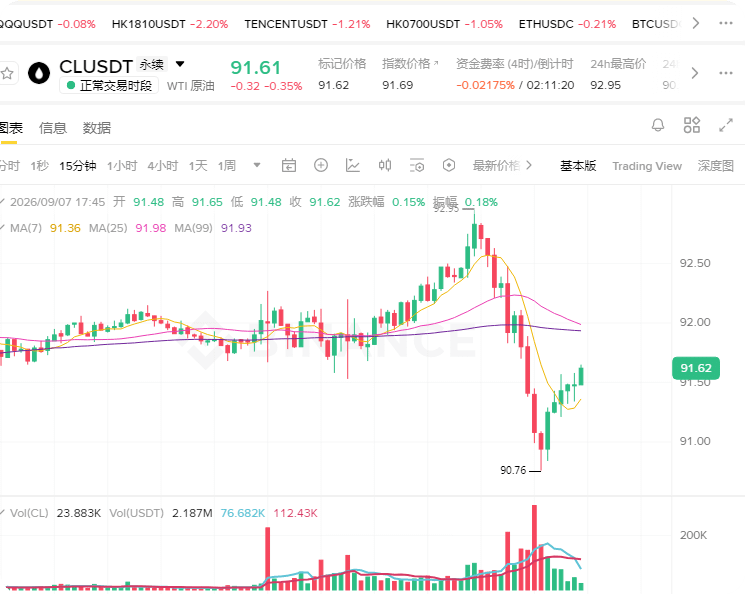
Market reaction remains restrained: on Monday, WTI broke above $92 and Brent rose to $96–97, with gains of about 1%. This is because Iran stated it was not sinking U.S. ships out of fear of pollution, and because both sides have their own “brake logic” driven by midterm elections in November and survival pressures.
My take: Oil prices are moving sideways between “fearing escalation” and “hoping it ends.” The real trigger is the on-the-ground reality of Iran’s “no-go zone.” When implemented, it means a blockade; when it fails, it becomes a bargaining chip.
#美伊互袭油轮冲突升级 #俄乌同时宣布停火3天 #伊朗将设霍尔木兹海峡限制区 #美国空袭伊朗油轮德黑兰限制霍尔木兹海峡
After the tanker war between the U.S. and Iran escalates, will BTC be even more afraid of crude oil?
On September 5–6, the conflict escalated further: Iran’s Revolutionary Guard fired ballistic missiles at U.S. aircraft carriers and destroyers. The U.S. said it successfully intercepted them with zero casualties, while Iran claimed the two U.S. ships were damaged and withdrew.
The U.S. then launched a new “tanker-for-tanker” policy approved by Trump, destroying three Iranian tankers. Near Kharg Island, one tanker was disabled; outside Jask Port, another lost power; in the Gulf of Oman, one was completely sunk.
Iran “hits back double”: targeting three ships associated with the United States and three tankers that were “unauthorized” to transit through the Strait of Hormuz, and warning that it will designate the strait as a “no-go zone.”
Data is more honest than slogans: Kpler shows the strait’s 10-day average daily throughput is only 10 vessels (the lowest since May). At least three days have passed with not a single Very Large Crude Carrier (VLCC) departing.
Market reaction remains restrained: on Monday, WTI broke above $92 and Brent rose to $96–97, with gains of about 1%. This is because Iran stated it was not sinking U.S. ships out of fear of pollution, and because both sides have their own “brake logic” driven by midterm elections in November and survival pressures.
My take: Oil prices are moving sideways between “fearing escalation” and “hoping it ends.” The real trigger is the on-the-ground reality of Iran’s “no-go zone.” When implemented, it means a blockade; when it fails, it becomes a bargaining chip.
#美伊互袭油轮冲突升级 #俄乌同时宣布停火3天 #伊朗将设霍尔木兹海峡限制区 #美国空袭伊朗油轮德黑兰限制霍尔木兹海峡
After the tanker war between the U.S. and Iran escalates, will BTC be even more afraid of crude oil?
我觉得会传导风险,BTC更偏弱
44%
我反而看对冲叙事,能扛通胀
11%
呜呜呜,我们已经被油价牵着走了
22%
先观察,原油怎么走我就怎么跟
23%
87 votes • Voting closed