

Most mornings in this market I already feel behind before I even open the charts. Coins keep showing up faster than anyone can properly look at them, the stories rotate like clockwork, and the same loud voices keep acting like the last few years never happened. You sit through another wave of AI tokens that feel more like branding exercises than actual breakthroughs, another round of people yelling about institutional money that somehow never quite turns into steady daily use. After a while the whole thing starts to wear you down. Honestly, the excitement just drains out of you.
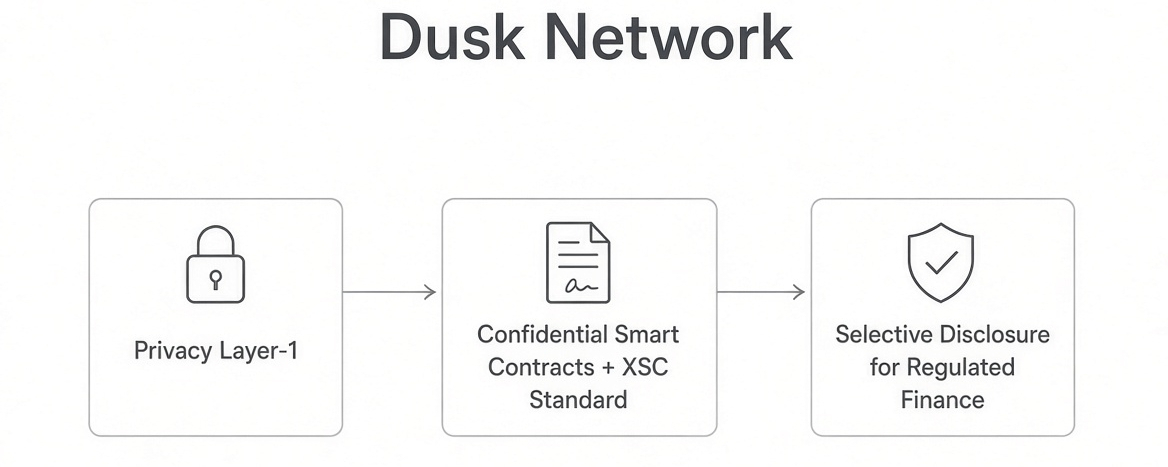
That is pretty much where my head is when Dusk Network drifts back into view. Privacy layer-1 for financial applications, confidential smart contracts, that XSC standard for security tokens. It does not shout the way most projects do, which is almost a relief in a space that rewards whoever talks the loudest. Still, the basic point underneath it is hard to ignore once you have watched enough public chains fail at ordinary financial work. Balances, positions, who is dealing with whom, the actual logic of a trade—everything sits out in the open for anyone to see. That is fine when people are just gambling with money they can afford to lose. It is not fine when real capital and real rules are involved. Institutions, regulators, regular companies that do not want their strategies or holdings turned into public data have mostly treated blockchains like experimental toys for exactly this reason. Selective disclosure—the ability to keep the sensitive stuff private by default but still prove what the right people need to see—is not some nice extra feature. It is the missing piece that keeps traditional markets from taking most of this technology seriously.
Let’s be real, the problem itself is genuine. I have seen enough attempts at private DeFi and compliant asset rails to know that adding privacy later almost never holds up under pressure. Building it into the foundation and pairing it with a contract standard meant for securities that actually have to behave like securities feels more careful than most of what gets launched. Ownership rules, eligibility checks, the boring legal machinery that stops markets from turning into free-for-alls—these are the unglamorous details that decide whether something can support real financial activity or just stays stuck in demo mode forever. The hard part is that technical seriousness does not magically create users. Institutions move slowly for reasons that have almost nothing to do with cryptography. Legal teams, risk committees, systems that already work well enough, the simple preference for what is already known and insured. A chain can look solid on paper and still sit mostly empty while the people it was built for keep running small tests that never turn into everyday work.
The token is the usual setup. DUSK pays for gas and staking, with emissions stretched out over years. On paper the utility is clear enough. Whether it ends up being more than a token for a network that still has to prove people actually want to use it is the same open question every infrastructure project faces. If activity stays thin, it is just another name on the list. If regulated flows eventually show up in real size, the numbers start looking different. Right now neither side is settled, and this market has almost no patience left for projects that need years of quiet progress before anything interesting shows up on the charts.
I keep coming back to how long the development took. Mainnet finally arrived after years of work. Patience is rare here, and projects that take the slow road often get ignored right when they finally have something real to show. Privacy mixed with compliance is a narrow path. Retail users do not care about ownership caps or selective auditor access. Most developers just want to ship fast without extra friction. The institutions that actually need those features will take their time evaluating, and time is the one resource crypto narratives rarely respect. That combination can leave a project sitting in a long quiet stretch where the technology is decent enough but the visible usage stays thin. This space has a habit of walking away from things that do not produce heat quickly, even when the original problem is still sitting there unsolved.
Maybe the mix of confidential contracts and regulated asset standards finds a real niche in tokenized securities or private institutional settlement. Maybe it stays a specialized tool that never reaches critical mass. I honestly do not know. The gap it is trying to close is real. The approach is more careful than the usual cycle of big promises and thin delivery. Whether careful is enough in a market that still rewards noise over substance is the part that keeps the curiosity low rather than excited. For now it just sits there as one more serious attempt in a crowded field, watched with the same tired attention that remains after enough cycles of disappointment. Interested in the idea, unconvinced by the timeline, and no longer willing to get loud about anything until the usage stops looking theoretical and starts looking ordinary.
$DUSK #dusk #DUSK @Dusk $GIGGLE $GRVT
