How much liquidity is actually in Web3?
The answer depends on what we mean by “liquidity.”
As of 2 September 2026, some useful indicators are:
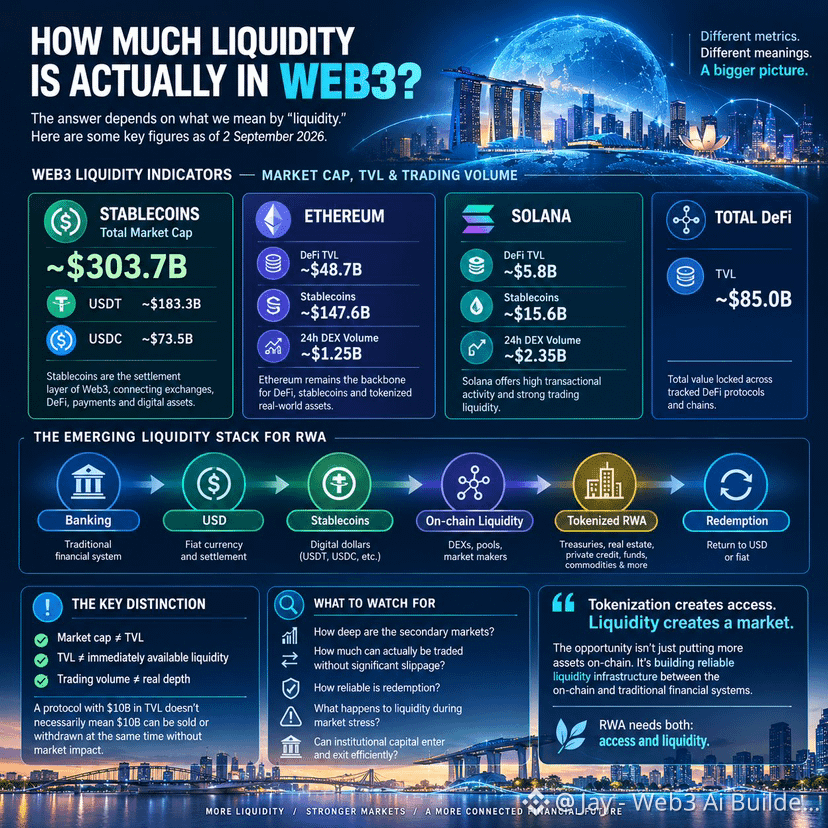
💵 Stablecoins: ~$303.7B market cap
USDT: ~$183.3B
USDC: ~$73.5B
🔷 Ethereum
~$48.7B DeFi TVL
~$147.6B stablecoins
~$1.25B 24-hour DEX volume
🟣 Solana
~$5.8B DeFi TVL
~$15.6B stablecoins
~$2.35B 24-hour DEX volume
🌐 Total DeFi TVL: ~$85B
These are significant numbers.
But there is an important distinction:
Market cap ≠ TVL ≠ trading volume ≠ immediately available liquidity.
A protocol having $10B in TVL does not necessarily mean $10B can be sold or withdrawn at the same time without market impact.
Likewise, $300B+ of stablecoins in circulation doesn't mean the entire amount is sitting available on an exchange or liquidity pool.
For me, this becomes particularly important when we discuss RWA.
The emerging liquidity stack looks something like:
Banking → USD → Stablecoins → On-chain Liquidity → Tokenized RWA → Redemption → USD
Stablecoins can provide a settlement layer.
DeFi can help distribute and deploy liquidity.
RWA can connect that capital with real-world economic assets.
But the strength of this system will depend on more than how much value gets tokenized.
We also need to understand:
→ How deep are the secondary markets?
→ How much can actually be traded without significant slippage?
→ How reliable is redemption?
→ What happens to liquidity during market stress?
→ Can institutional capital enter and exit efficiently?
This is why I think liquidity—not simply tokenization—is one of the more important areas to watch in the next phase of Web3 and RWA.
Tokenization creates access.
Liquidity creates a market.
#Web3 #Liquidity #Stablecoins #RWA #Tokenization #DeFi #DigitalAssets #CapitalMarkets
The answer depends on what we mean by “liquidity.”
As of 2 September 2026, some useful indicators are:
💵 Stablecoins: ~$303.7B market cap
USDT: ~$183.3B
USDC: ~$73.5B
🔷 Ethereum
~$48.7B DeFi TVL
~$147.6B stablecoins
~$1.25B 24-hour DEX volume
🟣 Solana
~$5.8B DeFi TVL
~$15.6B stablecoins
~$2.35B 24-hour DEX volume
🌐 Total DeFi TVL: ~$85B
These are significant numbers.
But there is an important distinction:
Market cap ≠ TVL ≠ trading volume ≠ immediately available liquidity.
A protocol having $10B in TVL does not necessarily mean $10B can be sold or withdrawn at the same time without market impact.
Likewise, $300B+ of stablecoins in circulation doesn't mean the entire amount is sitting available on an exchange or liquidity pool.
For me, this becomes particularly important when we discuss RWA.
The emerging liquidity stack looks something like:
Banking → USD → Stablecoins → On-chain Liquidity → Tokenized RWA → Redemption → USD
Stablecoins can provide a settlement layer.
DeFi can help distribute and deploy liquidity.
RWA can connect that capital with real-world economic assets.
But the strength of this system will depend on more than how much value gets tokenized.
We also need to understand:
→ How deep are the secondary markets?
→ How much can actually be traded without significant slippage?
→ How reliable is redemption?
→ What happens to liquidity during market stress?
→ Can institutional capital enter and exit efficiently?
This is why I think liquidity—not simply tokenization—is one of the more important areas to watch in the next phase of Web3 and RWA.
Tokenization creates access.
Liquidity creates a market.
#Web3 #Liquidity #Stablecoins #RWA #Tokenization #DeFi #DigitalAssets #CapitalMarkets