
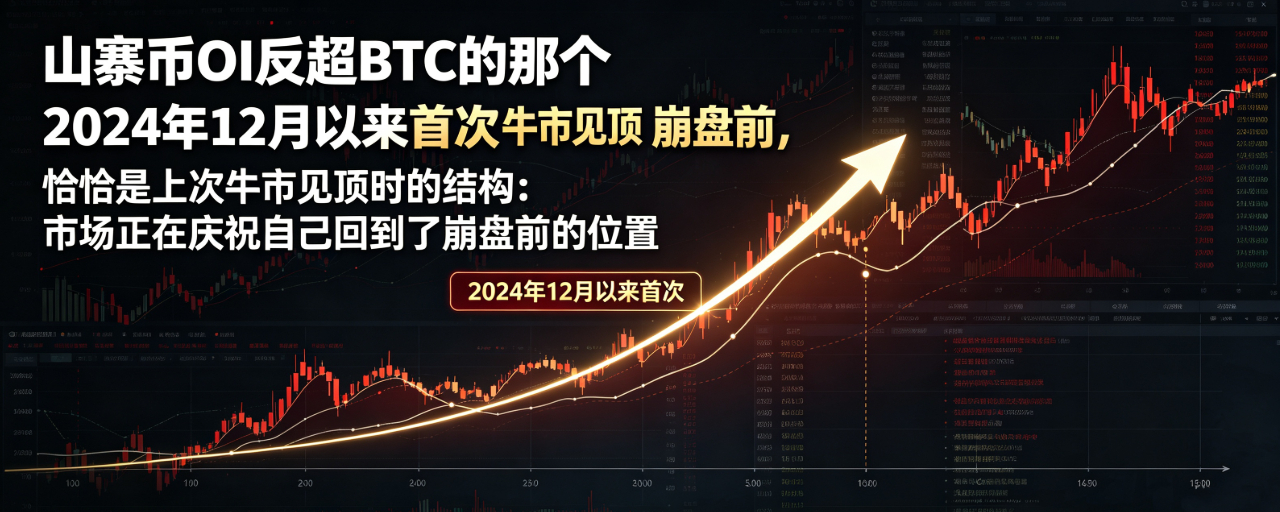

The most talked-about data point today is this: altcoin futures open interest has overtaken Bitcoin’s, the first time since December 2024.
The market interpreted it as “capital rotating sectors,” “risk appetite improving,” and “a rotation underway.” Analysts said this was a “typical early sign of a bull market entering its middle-to-late stage,” and then immediately gave buy recommendations: pick AI, pick L2/DEX, pick sectors with catalysts.
But if you stop and ask the simplest question: what was December 2024?
The answer will send a chill down your spine. December 2024 was when the last crypto bull market peaked. Bitcoin hit an all-time high that month, and then in the months that followed, what the altcoin market went through is something every trader who survived would rather not remember.
The market is cheering the return to “the same structure as before the last crash.” And the word it uses is “opportunity.”
Swap the subject to “that celebrated ‘overtaking’ moment.”
If the subject is “sh*tcoin,” the story is “capital rotation.” If the subject is “BTC dominance rate,” the story is “a topping signal.” But if the subject is switched to that “overtaking” moment—the moment a structural position change is captured in real time, and then written into a bullish report—the entire narrative becomes unsettlingly strange.
What does overtaking mean? It doesn’t mean altcoins got stronger. It means Bitcoin’s leverage is pulling back, while altcoin leverage is piling up. These two actions happen at the same time, in opposite directions. Bitcoin’s OI is falling—when BTC is moving sideways, funding rates and OI data have already been contracting. Meanwhile altcoin OI is rising.
This is called “rotation.” But the other side of rotation is this: the smartest leveraged capital is withdrawing from the market with the deepest—and hardest-to-manipulate—liquidity, and flooding into smaller markets that are shallower and more easily amplified by emotion.
This has never been a signal that a bull market is starting. This is a signal that “smart money is looking for an exit.” And exits are usually opened where liquidity is most crowded.
After that “overtaking” in December 2024, what happened?
This is a question that all bullish reports tacitly avoid.
In December 2024, altcoin OI overtook BTC. What did the market say back then? It said, “Altseason is here.” It said, “Money is overflowing from Bitcoin, and the bull market is entering its second half.” It said, “There are more opportunities outside the top ten coins.”
So what happens next? Then the market tops within the following few weeks. Bitcoin collapses first; altcoins collapse after it—and collapse deeper, faster, and with no survivors. Those who rushed in under the “altseason” narrative became the final round of bag-holders in that bull cycle.
This is not a random event. It’s structural inevitability: when the leverage of altcoins exceeds that of Bitcoin, the market’s overall leverage structure becomes top-heavy and bottom-light. Bitcoin’s OI is the ballast; altcoin OI is the wave. When the wave rises higher than the stone, the ship should tip over.
And today, the market took this structure and wrote a bullish report.
ZEC went from “top ten by market cap” to “the biggest liquidation target,” in just one day.
There’s a detail in the material that almost nobody elaborates on: today’s biggest liquidation coin isn’t BTC, it’s ZEC—about 50 million dollars.
And just the day before, ZEC was still being celebrated for “entering the top ten by market cap,” “a privacy coin legalization frenzy,” and “breaking $1,200.” Within a day, it went from “the protagonist” to “the biggest corpse.”
This is exactly the storyline that the market repeats after altcoin OI overtakes BTC: the coins with the biggest gains become the coins with the worst liquidations. A 50 million liquidation in the BTC market is just a splash of a wave. In the ZEC market, it’s a bomb.
Because altcoin liquidity depth can’t possibly support the leverage that builds up during the narrative peak. When prices rise, leverage pushes them about three times faster than fundamentals. When prices fall, leverage smashes them about five times harder than fundamentals. And the “altseason” narrative is precisely the missing foot that keeps topping up the oil for these leverages.
Out of Meme, into AI and L2: this isn’t a “rational choice”—it’s “changing the gambling table.”
Capital flowed out of the Meme sector, moving into AI and L2/DEX. PONS fell 15%, MARSCOIN fell 33%. TAO rose 10%. This is interpreted as “capital selectively going long.”
But look closely: in the AI sector, TAO is up 10%; in L2/DEX, HYPE is up 2% to 4%. Are these “catalyst-driven” coins structurally fundamentally different from those Meme coins that have dropped 30%?
No. They’re still altcoins. Same shallow liquidity. Same pile-up of leverage. Same “narrative-driven” dynamic. Capital exiting Meme and flowing into AI isn’t a shift from “speculation” to “investment”—it’s jumping from “one hot pot” to “another pot just set on fire.”
When the pot cools and the fire goes out—when altcoin OI overall overtakes BTC OI—then all the pots are on the same stove. When the stove tips, AI and L2 will fall right along with Meme, simply because they all belong to that label: “altcoins.”
Let me make a bold call: this “overtaking” isn’t the start of rotation—it’s the reappearance of the topping structure.
Here’s my next judgment: unless BTC dominance rate climbs back above 60% and holds steady within the next two weeks, this structure of “altcoin OI overtaking BTC” will bring a retracement in the next four to six weeks that’s deeper than what most people expect. The starting point of the retracement is that moment when the AI sector takes over and market sentiment is at its most euphoric.
There are three reasons:
First, the repeatability of historical structure. The same signal from December 2024 corresponds to the previous top. This isn’t a coincidence—it’s a structural law of leverage distribution: when market leverage overflows from the “deep pool” into the “shallow pool,” systemic risk rises, not falls.
Second, Bitcoin itself is stalling. BTC keeps tugging at around 80,000; the ETF has seen 3.8 billion in inflows over three weeks but still can’t move the price. This indicates that the main market is already running into a supply wall at high levels. When even Bitcoin can’t rise, what can keep the “independent行情” of altcoins going? Only leverage. And the end of leverage is a liquidation like ZEC’s 50 million.
Third, the misalignment of sentiment. The Fear & Greed Index is 74—greed territory. The market celebrates “rotation” while in “greed,” and rotation itself is the most typical crowd behavior in the top area of the market. When everyone feels that “opportunity is shrinking for the smaller coins,” the top of big coins is usually not far off.
The biggest problem is that it keeps people up at night.
Altcoin OI overtakes BTC OI—first time since December 2024. The market calls it “an opportunity.” I call it “the collective deletion of memory.”
What truly keeps people up is this: why would a structural signal exactly identical to the one before the last crash be written, by the same market, with the same language, into the same kind of bullish report?
Is nobody remembering what happened after December 2024? Or, if they do remember, have they all learned to hand over their positions to the newcomers in the “altseason” narrative?
That moment of “overtaking,” in the data is merely a crossing point. But in human terms, it’s a fork in the road: one path is “this time is different,” and the other is “last time was right here.”
And yesterday ZEC was still in the top ten—today it blew up by 50 million. It already chose.