


Recently, many people opening their trading apps have done a double take: that old coin Zcash (ZEC), which had been criticized for seven or eight years, had actually climbed above $1,200, with its market cap back in the global top 10 and annual gains approaching 2,780%.
What’s even more outrageous is that the bearish voices never stopped—"privacy coins have no future," "one round of regulation and it goes to zero," "the Zcash team will eventually fall apart because of internal fighting."
And the result? It kept rising from the teens to four digits while everyone kept talking it down.
Today’s article will explain three things for people who don’t know this coin: what it is, why it has risen so sharply, and where the risks lie.
1. What exactly is ZEC?
Zcash was born in 2016 and is a long-standing project in the privacy coin sector. It uses a technology called zero-knowledge proofs (zk-SNARKs): transactions can be conducted on a public blockchain, but the amount and both sender and receiver are completely hidden from outsiders.
Its biggest difference from Monero (XMR) is that privacy is "optional." ZEC has transparent addresses (publicly traceable like Bitcoin) and shielded addresses (fully private). Users choose for themselves, and the official team provides a "viewing key" mechanism — when necessary, transaction records can be shown to auditors or regulators.
This optional-privacy design is exactly the core logic behind its explosive rally this cycle, which I’ll explain in detail later.
2. Why is it rising so fast and so violently?
1. Regulatory attitudes have seen a historic reversal
In the past, the biggest fatal flaw for privacy coins was regulation. But things have changed over the past two years:
• In January 2026, the U.S. SEC ended its nearly two-year investigation into the Zcash Foundation and took no enforcement action, removing the regulatory sword hanging over institutions. After the news was announced, ZEC jumped about 17% in a single day.
• The U.S. digital asset market structure bill currently moving forward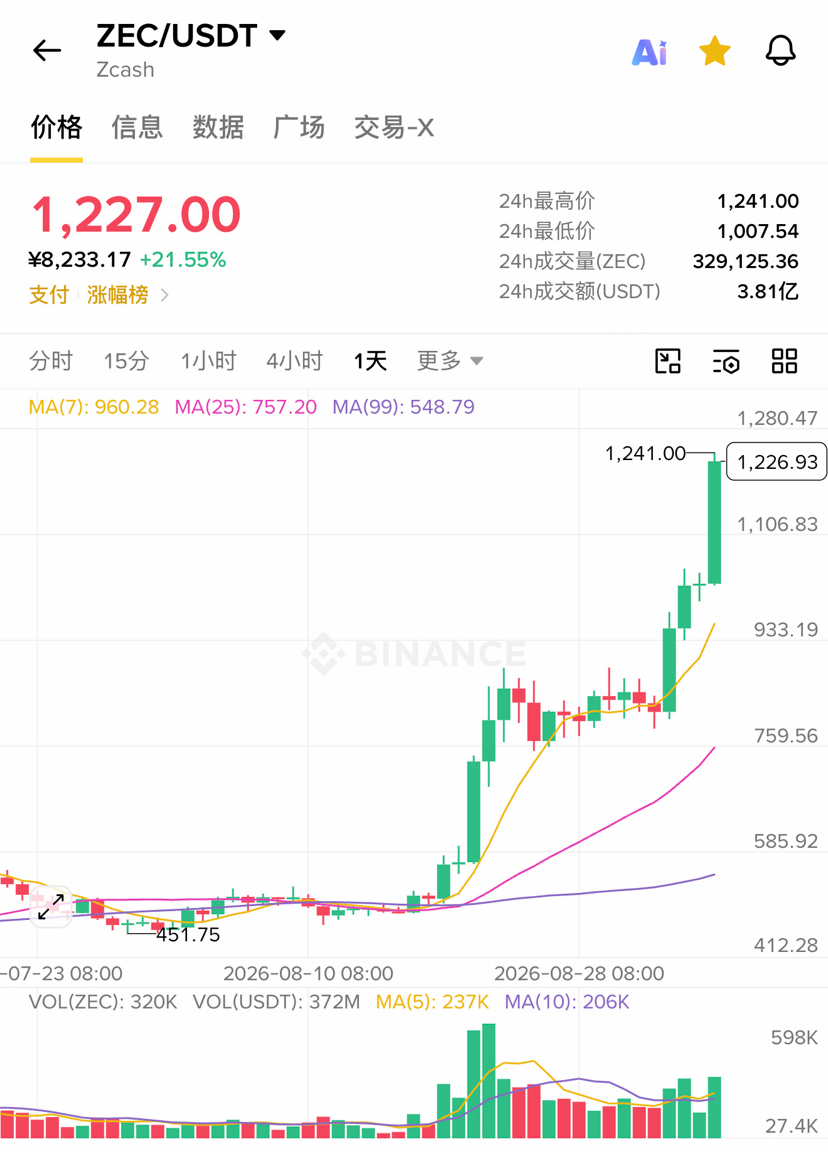 has reserved a compliance path for privacy assets that support selective disclosure — this is almost written exactly for Zcash’s Viewing Key model.
2. Institutions are entering with real money, not just talking
• Well-known crypto fund Multicoin Capital publicly disclosed that it has been continuously increasing its ZEC holdings since February 2026. Its partner Tushar Jain’s explanation was blunt: in the era of wealth taxes, investors need a "private and scarce store of value," and ZEC could become a mainstream private store-of-value asset.
• Grayscale has already filed plans to convert its Zcash Trust into the first U.S. spot ETF for a privacy coin. If approved, it will open the door for institutional capital to enter.
3. The demand is real, and on-chain data can verify it
To determine whether a privacy coin is pure speculation, the industry only looks at one metric: the shielded-pool ratio — what percentage of ZEC is actually being put into shielded addresses.
Currently, about 30% of circulating ZEC is shielded, the highest level in history and still rising. From 8% at the start of 2025 to 23%, and now to 30%, this shows real users are actually using the privacy function, not just speculators.
4. Technical upgrades + an ultra-scarce model
• The Ironwood hard fork (July 2026): it shut down the risky old shielded pool and, for the first time, made the network’s total supply publicly auditable — essentially giving institutions peace of mind about "supply certainty."
• ZEC is like Bitcoin: hard-capped at 21 million coins, with a four-year halving schedule. The current circulating supply is about 80%, and as large amounts of coins accumulate in the shielded pool, the actual float on the secondary market is getting thinner, making it easier to see a "supply squeeze"-style rally.
5. Narrative-level "handoff"
A remark from Silicon Valley investor Naval Ravikant ignited this rally: "Bitcoin is insurance against fiat, Zcash is insurance against Bitcoin." Arthur Hayes then publicly listed ZEC as the second-largest liquid holding in his fund. As "financial privacy" becomes a global issue, ZEC is being revalued as "private Bitcoin."
3. So why are so many people still bearish on it?
The bearish arguments are not without merit, and you need to know this:
6. Regulation remains the biggest landmine. Privacy coins are naturally at odds with anti-money-laundering regulation. In July 2026, Russia just banned professional institutions from handling ZEC; new EU rules also leave platforms room to delist it. Historically, ZEC has repeatedly plunged on rumors of exchange delistings.
7. Team governance once hit a crisis. In early 2026, the ECC team triggered panic over governance and funding issues, and the coin price was cut in half from its peak — when it rises hard, it can also fall hard without hesitation.
8. After a 13x gain in one year, there is no valuation cushion. RSI has already entered overbought territory, and chasing the price carries enormous risk. After every parabolic surge, ZEC has given back most of its gains.
9. Certainty is still up in the air. Whether ETFs get approved and how regulators in different countries move are both double-edged swords: approval is a major positive, rejection is a major negative.
4. Summary
This round of ZEC’s rally is different from the pure sentiment-driven bull run of 2021: it has five logics resonating at the same time — a regulatory turn, institutional accumulation, real on-chain demand, technical upgrades, and a scarcity model. The more the market criticizes it, the more it rises; fundamentally, that is because the market is criticizing its old narrative while capital is buying into its new one.
But note: parabolic rallies never move in a straight line; volatility and pullbacks are the norm.
⚠️ This article is for information sharing only and does not constitute investment advice. DYOR