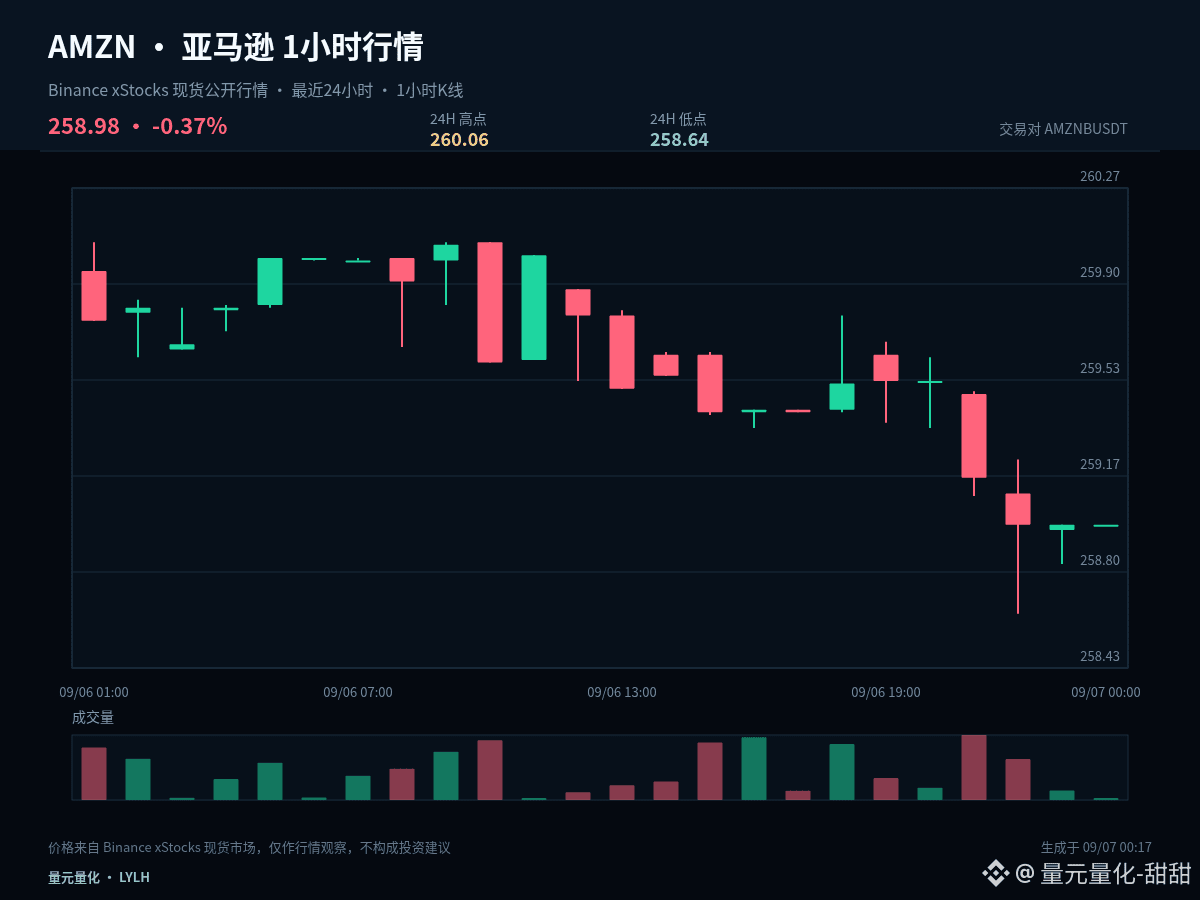
$AMZNB #AMZN If I had to keep only one reference price in this round, I would choose 259.35. The current price is 258.98, with 1-hour at 0.00% and 24-hour at -0.37%. Whether the midpoint is held or lost can help filter out a lot of intraday noise.
If the price stays above 259.35, it means the pullback is still being controlled by the bulls, and the next target is to test the resistance at 260.06; if it falls back below the midpoint, the earlier strength will be discounted, and further decline back toward 258.64 should be guarded against.
The current 1-hour 0.00% and 24-hour -0.37% readings show that the two timeframes have not yet formed a sufficiently clear alignment in the same direction. In a range-bound market, chasing rallies or selling into weakness has a lower margin for error. It is better to use the upper boundary to confirm direction, the lower boundary to confirm support, and the midpoint only as the dividing line between strength and weakness.
In execution, set clear conditions: after breaking above 260.06, confirmation is needed rather than chasing an instant surge; after dipping below 258.64, watch whether it can quickly recover instead of blindly buying the drop; when the middle zone does not offer enough risk-reward, waiting itself is part of the strategy.
Existing positions can be managed in stages according to key levels to avoid making one all-or-nothing decision at once; those with no positions should wait for breakout confirmation or for a pullback to stabilize. For U.S. stock instruments, also pay attention to volatility caused by trading session changes. The plan should be based on price conditions, not emotions.
The market will ultimately validate the view with price. Do you think the most critical level right now is the break above 260.06, or the defense of 258.64? Let’s track the follow-up results together.
#USAugustJobGrowthNearlyTriplesForecast
If the price stays above 259.35, it means the pullback is still being controlled by the bulls, and the next target is to test the resistance at 260.06; if it falls back below the midpoint, the earlier strength will be discounted, and further decline back toward 258.64 should be guarded against.
The current 1-hour 0.00% and 24-hour -0.37% readings show that the two timeframes have not yet formed a sufficiently clear alignment in the same direction. In a range-bound market, chasing rallies or selling into weakness has a lower margin for error. It is better to use the upper boundary to confirm direction, the lower boundary to confirm support, and the midpoint only as the dividing line between strength and weakness.
In execution, set clear conditions: after breaking above 260.06, confirmation is needed rather than chasing an instant surge; after dipping below 258.64, watch whether it can quickly recover instead of blindly buying the drop; when the middle zone does not offer enough risk-reward, waiting itself is part of the strategy.
Existing positions can be managed in stages according to key levels to avoid making one all-or-nothing decision at once; those with no positions should wait for breakout confirmation or for a pullback to stabilize. For U.S. stock instruments, also pay attention to volatility caused by trading session changes. The plan should be based on price conditions, not emotions.
The market will ultimately validate the view with price. Do you think the most critical level right now is the break above 260.06, or the defense of 258.64? Let’s track the follow-up results together.
#USAugustJobGrowthNearlyTriplesForecast