Just a few years ago, asset tokenization was seen as an experiment. Today, this field is increasingly being called one of the key trends shaping the development of the financial industry.
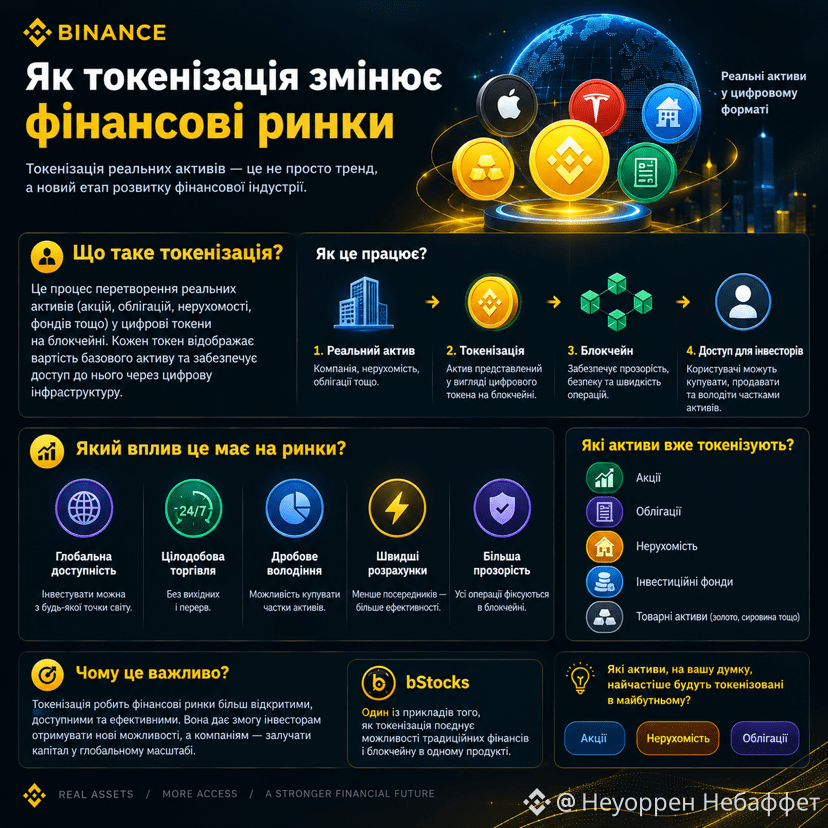
The idea is simple: a real-world asset can be represented as a digital token on a blockchain. This applies not only to stocks, but also to bonds, real estate, funds, and other financial instruments.
This approach helps make investing more accessible. Investors gain the ability to buy fractions of assets, conduct transactions faster, and interact with global markets through digital infrastructure.
That is why large financial companies and technology platforms are actively exploring the potential of tokenization. Many experts believe that in the future, more and more traditional assets will have digital equivalents.
bStocks is one example of how tokenization can combine the capabilities of traditional finance and blockchain in a single product.
In your opinion, which assets will be tokenized most often in the future: stocks, real estate, or bonds?
The idea is simple: a real-world asset can be represented as a digital token on a blockchain. This applies not only to stocks, but also to bonds, real estate, funds, and other financial instruments.
This approach helps make investing more accessible. Investors gain the ability to buy fractions of assets, conduct transactions faster, and interact with global markets through digital infrastructure.
That is why large financial companies and technology platforms are actively exploring the potential of tokenization. Many experts believe that in the future, more and more traditional assets will have digital equivalents.
bStocks is one example of how tokenization can combine the capabilities of traditional finance and blockchain in a single product.
In your opinion, which assets will be tokenized most often in the future: stocks, real estate, or bonds?