
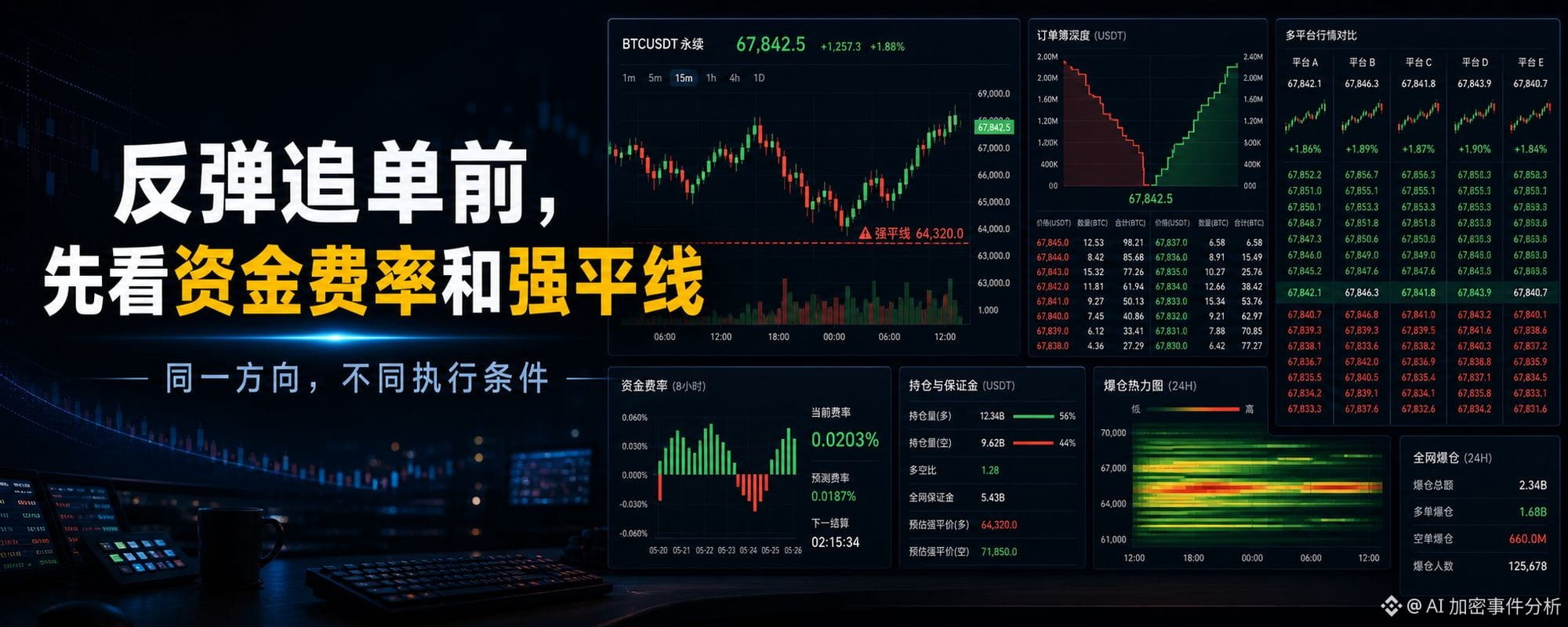

Sunday rebounds make it easiest to misjudge one thing: if you got the direction right, this trade should make money.
In the market this morning, BTC moved back near 80,000, ETH also recovered to around 2,500, and many derivatives traders' first reaction was to chase longs, add to positions, and move stop-losses higher. The problem is that in a rebound, what often gets more expensive first is not the coin price itself, but the conditions for executing that trade.
Going long BTC in the same way can feel completely different on different venues.
In some places the order book looks very deep, but if you market buy 20,000, 50,000, or 100,000 USDT, the actual fills will chew through the levels one by one; in others the fee is a bit lower, but funding rates are already overheated, so after holding for 8 or 16 hours, the cost is higher than you expected when you opened the position; and on some platforms the mark price, index price, liquidation buffer, and de-risking rules are different, so even though the K-line merely spiked briefly, your margin pressure arrived first.
This is also why I’ve gradually come to dislike the habit of “opening a position wherever the entry is most convenient.”
In a bull market or the early stage of a rebound, the most discussed topic is direction: can BTC regain its footing, can ETH keep up, will altcoins rotate? But for derivatives traders, direction is only the first layer. The second layer is what rules will constrain this position:
Is the order book deep enough?
Has the funding rate already become crowded?
After fees and rebates, what is the real round-trip cost?
After the stop loss is triggered, will it be filled at the price you imagined, or will it slip through at the worst moment?
Will liquidation lines, mark price, and insurance mechanisms put completely different pressure on the same margin?
After losing money, many people review their direction; few review their execution location. But the most unfair losses in derivatives are often not from being wrong about the trend, but from being right about the direction while choosing a place that was not suitable for carrying that position at the time.
Especially in a rebound. The more people rush in at the same time, the more expensive funding becomes, the thinner the order book gets at key levels, and the easier it is for stop losses to bunch together from the same crowd’s positions. You think you’re buying the upside, but in fact you’re also buying crowded funding, slippage risk, and a set of liquidation rules.
My view is simple: the next stage of competition in derivatives trading is not just “who can open positions faster,” but “who can compare execution conditions faster before opening.”
There are already too many open-position buttons; what’s truly missing are the few seconds before pressing them: for the same asset, looking at depth, funding rates, fees, slippage, mark price, and liquidation rules across different venues side by side. You don’t have to choose the lowest fee every time, and you don’t have to choose the most liquid venue every time, but at least you should know what execution conditions you’re actually buying with this trade.
This is also the value of Perpex/PerpEX and similar perp aggregators: first choose the asset, then compare the conditions across different venues, and finally decide where the trade should go. It’s not there to decide long or short for you, but to lay out the costs and risks beyond direction first.
A rebound is of course tradable, but don’t treat opening a position as just a button. In derivatives, the entry itself is part of the position.
#BTC #contract trading