

The crypto market never lacks hot topics, but very few projects can, in just over sixty days, go from an unnoticed nobody to a top name discussed across the entire market.
It is PONS.
Launched only two months ago, the token saw a maximum gain of 18,000%; the platform's daily trading volume surpassed 400 million dollars, with total trading volume breaking through the 5 billion dollar mark; daily protocol revenue reached as high as 950,000 dollars, surpassing many long-established DeFi protocols; hundreds of thousands of users swarmed in, with tens of thousands of new tokens created on the platform every day, major exchanges consecutively opening trading, social media feeds flooded, and communities celebrating through the night.
No one could have imagined that this super-hot phenomenon that set the entire internet ablaze was born on a newly launched public chain, Robinhood Chain, created by an anonymous team, with no luxurious financing backers and no famous figures endorsing it—yet it managed, with a simple mechanism, to shake up the entire crypto landscape.
Today, we will deeply dissect the underlying logic behind PONS’s explosive rise: is it a fleeting bubble, or a revolution in the new generation of on-chain traffic entry points? What exactly did it do to capture the hearts of millions of users? And behind the madness, what invisible traps and opportunities are hidden?
I. A thunderclap from clear skies: an anonymous project shakes up the entire public-chain ecosystem
Let’s go back to July of this year, when the Robinhood Chain mainnet had just launched.
Robinhood itself is a zero-commission stock trading platform widely known in North America, with tens of millions of retail users. When it announced the launch of a layer-2 public chain, the entire crypto community was full of anticipation: would a traditional brokerage giant entering the public-chain space bridge the boundary between U.S. stock retail investors and Web3, bringing massive incremental capital to the crypto market?
The ideal is very full, but reality is very skinny.
In the early days after the public chain launched, the ecosystem was completely quiet. The officially envisioned tokenized stock narrative did not land quickly, and there were few breakout applications on-chain. Various officially supported projects and VC-backed protocols took turns appearing, but there was still no application able to ignite retail enthusiasm.
Just when the entire chain was陷入 traffic anxiety, PONS quietly went live.
It has no launch event, no overwhelming promotion by KOLs, no grand white paper, and no celebrity team introduction. The website design is extremely plain, the team calls itself the “Pons Family,” and the founder’s identity remains anonymous to this day.
Its function is very simple: a one-click token issuance platform (a Meme coin factory).
Simply put, anyone, without understanding Solidity contracts, without finding a development team, and without preparing liquidity, can create a new token on Robinhood Chain with just a very low fee. After the token is deployed, the trading pool is automatically generated, liquidity is automatically locked, and trading can begin immediately.
Before this, issuing a Meme coin was not easy. Ordinary users needed to learn contract deployment, handle liquidity pools, worry about backdoors in contracts and rug-pull risks, and also deal with gas fees, deployment failures, and all sorts of other hassles. Many people had ideas and communities, but were blocked by the technical barrier.
PONS has made this process extremely simple: to issue a token, you only need to fill in the name, token symbol, upload an image, and click confirm; it only takes a few seconds. The issuance fee is only about 0.0005 ETH, making it affordable for almost everyone.
At first, almost no one took it seriously.
There are quite a few one-click token issuance platforms on the market, and there are similar products on Ethereum, Solana, and Base. Most similar projects eventually become niche tools, with limited traffic and mediocre token performance. Many analysts assert that PONS is just another homogenized token issuance gadget and will soon disappear amid the flood of projects.
But the market狠狠 slapped everyone in the face.
Starting at the end of July, traffic began to flow in slowly. At that time, another token issuance platform on Robinhood Chain, Noxa, paused new token issuance, leaving a huge traffic gap. Massive numbers of users had nowhere else to go and surged toward the newly launched PONS like a tide.
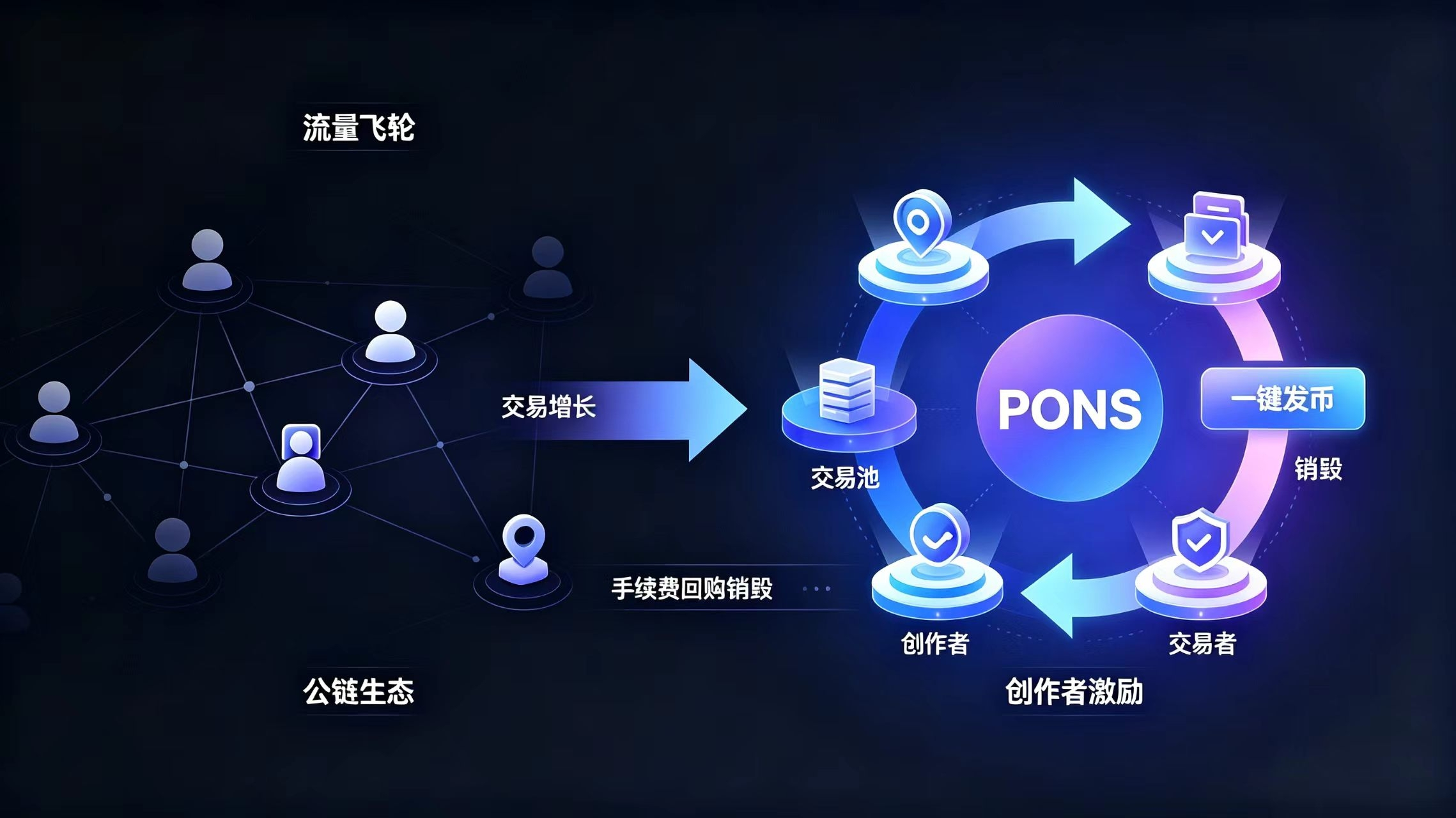
Once traffic forms, a powerful positive cycle begins.
When token creators arrive, traders follow; when traders arrive, trading volume rises; when trading volume rises, platform fee revenue increases; when platform revenue improves, the value narrative of PONS becomes more convincing; and when the token price rises, it attracts even more speculators, influencers, and community users to join, issue tokens on this chain, and trade coins.
The data is the most shocking proof:
At its peak on a single day, the number of new tokens on the platform approached 25,000;
The cumulative number of tokens created surpassed 646,000, and the number of independent creator addresses exceeded 167,000;
More than 63% of the launchpad trading volume on Robinhood Chain was contributed by PONS;
With a single-day peak trading volume of $544 million and single-day protocol revenue of $950,000, it ranked among the top revenue-generating protocols across the entire network.
In just two months, the PONS token surged as much as 18,000% from its low, the number of holder addresses surpassed 64,000, and a large number of major exchanges gradually listed trading pairs, pushing its popularity fully beyond the crypto bubble.
An anonymous small project accomplished what countless well-known institutions failed to do: it fully activated the ecosystem of a new public chain. Now, when people mention Robinhood Chain, the first thing that comes to mind is no longer the brokerage giant, but PONS, the Meme coin factory.
II. The secret to becoming legendary: a sophisticated economic model that gives everyone a reason to expect profits
If it were only “one-click token issuance,” PONS would still not be legendary. What truly created a powerful consensus around it was a multi-party win fee distribution and burn mechanism, precisely hitting the core psychology of crypto retail investors.
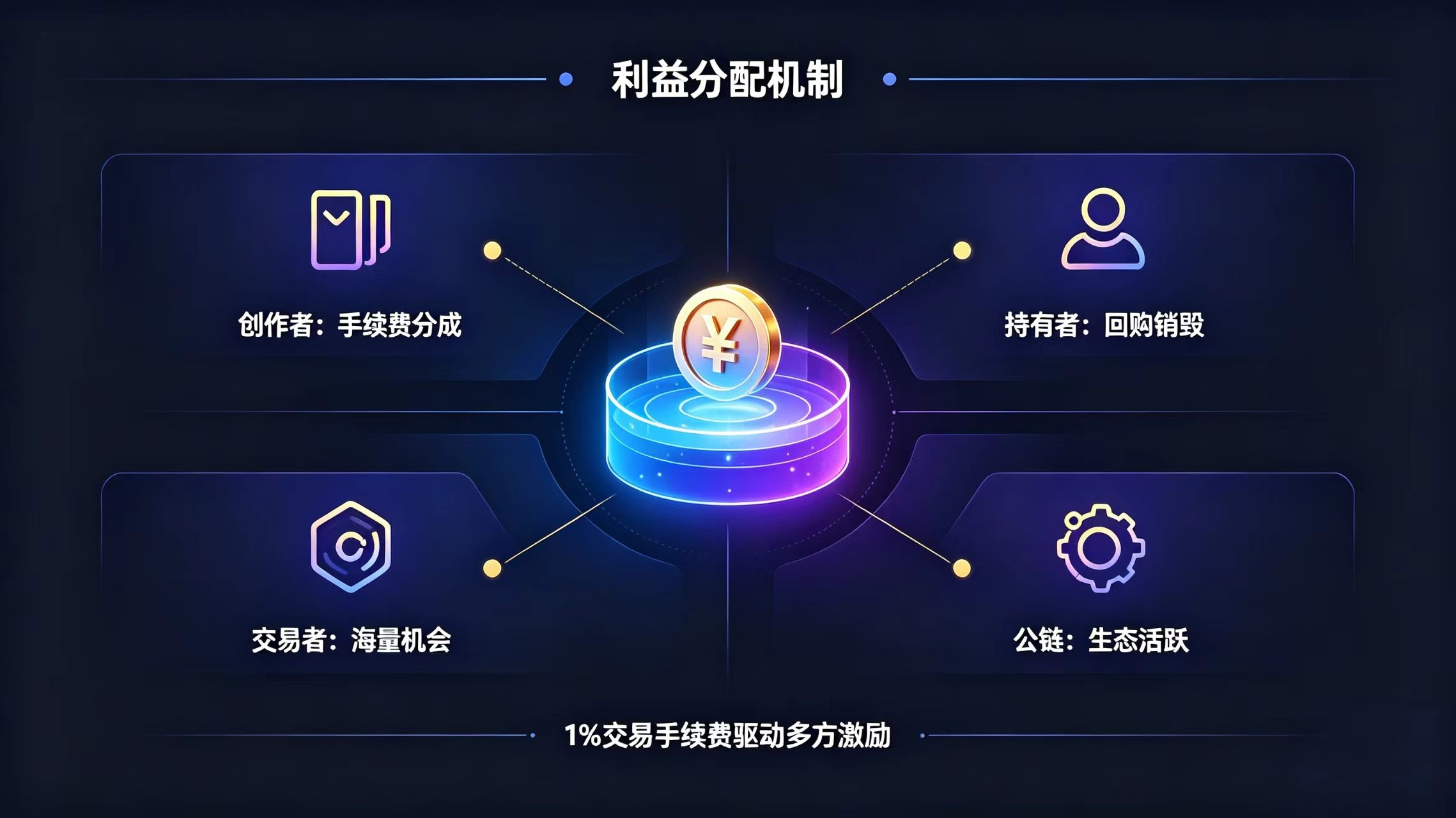
The platform charges a 1% transaction fee on every token trade.
The fee-sharing rules are clear and transparent:
70% fee: directly given to the token creator. Whoever issued this Meme coin can continue to earn from every buy and sell. The hotter the token becomes, the greater the trading volume, and the more the founder earns.
30% fee: belongs to the PONS protocol itself. Of this 30%, 80% is used to buy back PONS tokens and then permanently burn them; the remaining 20% is used for project operations and development.
This design can be called brilliant; we can break down the return expectations of each type of participant involved.
Category one: token-issuing creators.
In the past, Meme coin founders who wanted to make money could only buy a large amount of tokens early, pump the price, and then sell and leave. Once the founder dumped the coins, the price would collapse immediately, community trust would be shattered, and the project would die. This is also the fundamental reason why most Meme coins have such short lifespans.
PONS changed the rules of the game.
The founder does not need to hoard a huge amount of tokens. As long as the token you issue is traded, you can continuously receive fee sharing. The longer the token lives, the more active the trading, and the higher the long-term returns.
This gives creators a brand-new choice: there is no need to rush into a dump-and-exit; instead, they can properly operate the community, maintain hype, build a long-term IP, and earn a steady stream of revenue sharing. Of course, this does not mean there will be no more sell-offs, but the platform provides a new and healthier path to profit.
Countless influencers, community leaders, and Meme players saw the opportunity. No need for strong capital, no need for powerful technology: as long as you have creativity and know how to run a community, you can issue a token, build your own small IP, and have a source of passive income. The huge incentive has caused countless creators to pour into the platform continuously.
Second category: PONS token holders.
The bulk of protocol income is used to buy back and burn tokens. The larger the platform’s trading volume, the more fees it collects, and the stronger the buyback-and-burn effort becomes.
PONS has a fixed total supply of 1 billion tokens, with no additional issuance. As of now, about 288 million tokens have been burned, with the burn ratio approaching 29%, and the circulating supply continues to decline.
This creates a very intuitive narrative: the hotter the platform, the higher the trading volume; the more burns, the stronger the deflation expectation; the more valuable the token becomes.
This is a very simple, very easy-to-spread story. No complex DeFi mathematical model is needed, no obscure zero-knowledge proof is required; retail investors can understand it at a glance: the money the platform earns is used to buy coins and burn them, the circulating supply decreases, and if demand continues, the price has upward momentum.
Third category: traders.
Traders have a huge number of choices here. Every day, tens of thousands of new tokens go live, and every day there may be a new 100x coin. The enormous wealth effect attracts countless treasure hunters to the chain. Although the vast majority of new coins eventually go to zero, even if only one super dark horse appears occasionally, it is enough to sustain everyone’s fantasies.
Fourth category: the public chain itself, Robinhood Chain.
PONS brings massive transactions, massive gas consumption, and massive new users. The public chain does not need to burn money on huge subsidies or spend money to invite projects to join. A breakout application spontaneously brings ecosystem prosperity. On-chain activity, TVL, and the number of new addresses all rise together.
A mechanism that allows creators, PONS holders, traders, and the public chain itself to all find their own points of interest. That is the powerful magic of PONS.
Of course, this mechanism is not perfect. It essentially builds the entire ecosystem on the speculative activity of Meme coins. As long as the hype remains, the flywheel keeps turning; once market sentiment cools and trading volume declines, the entire positive cycle slows down.
III. Traffic is king: why PONS caught the biggest trend in today’s crypto market
Looking back at the changes in the crypto market over the past two years, we can clearly see a trend: the DeFi narrative has faded, Meme culture has risen, and retail traffic has once again become the most important scarce resource in the market.
A few years ago, the market was obsessed with grand narratives: public-chain battles, cross-chain bridges, derivatives, tokenizing real-world assets, AI + blockchain. Huge amounts of VC money poured in, and project white papers were written to sound astonishingly grand, with extremely complex technical architectures.
But ordinary retail investors do not understand it. Many protocols have extremely high user barriers, expensive gas fees, cumbersome operations, and huge risks. Projects are dominated by institutions, with chips concentrated in the hands of early investors, and ordinary users often can only take over at the top.
The market began to suffer from aesthetic fatigue. People grew tired of the layer upon layer of packaged “grand narrative air projects.”
So the trend began to reverse: the simple, transparent, entertaining, and highly participatory Meme sector began to become the center of traffic.
Starting with Dogecoin and Shiba Inu, Meme is no longer just a joke. It represents a kind of decentralized spirit, a kind of community culture, and a wealth-creation game in which everyone can participate. The explosion of Meme coins on the Base chain has already proven that if a public chain wants to scale up quickly, a breakout Meme ecosystem is a very effective path.
PONS precisely hit the wind of this era.
It does not hype AI, it does not hype RWA, it does not hype zero-knowledge proofs. It does not promise to change the financial system, nor does it promise to upend the world. It does only one thing: it takes the Meme coin production line to the extreme.
It turned token issuance into mass entertainment. Like a short-video platform, everyone can publish videos; most content may go unnoticed, but occasionally a huge hit is born. The platform does not need to be responsible for every single work; it only needs to provide the tools and then collect fees from the overall prosperity.
PONS is the “short-video platform” of the crypto world.
Creators are short-video bloggers, and issuing tokens is equivalent to publishing a piece of content; traders are the audience, tipping, speculating, and hunting for hits; the platform takes a share of traffic, then uses the revenue to buy back and burn the platform token. The analogy is very apt.
In the past, this model was despised by many. Many old-school crypto participants believed that one-click token issuance platforms were just air-coin assembly lines, mass-producing junk projects and fueling speculative bubbles.
But business logic does not disappear because of moral judgment. The history of internet development tells us: tools themselves are neutral. Short-video platforms can produce vulgar content, but they can also give rise to high-quality creators; one-click token issuance platforms can mass-produce air coins, but they may also give birth to great community projects.
The explosive rise of PONS is, at its core, a decentralization of power: it returns the right to issue tokens from institutions, VCs, and professional development teams to every ordinary on-chain user.
Of course, decentralizing power also decentralizes risk. With no review, no project due diligence, and no barriers to entry, more than 99% of newly issued tokens will eventually go to zero. That is a brutal reality all participants must clearly recognize.
IV. Behind the prosperity: under the frenzy, the enormous risks hanging overhead

When the whole internet is frantically discussing the myth of hundredfold returns, we must calmly see the huge uncertainty beneath the prosperity.
The biggest risk: heavy dependence on market speculation sentiment.
The entire PONS economic flywheel is built entirely on Meme coin trading hype. The crypto market switches between bull and bear very quickly. In a bull market atmosphere, people are willing to chase new tokens and trading volume surges; once the broader market turns bearish, speculation cools, players leave, and platform trading volume quickly shrinks.
As trading volume declines, fee revenue falls, and the scale of buybacks and burns shrinks accordingly. Then the core narrative supporting the price of PONS weakens. It has no stable business income, no cash flow from the traditional world, and all revenue comes from on-chain speculative fees. Once traffic fades, the platform cools down quickly.
The second major risk: uncertainty brought by the anonymous team.
So far, the real identities of PONS’s core team have not been made public. Anonymity is not uncommon in the crypto world; Bitcoin founder Satoshi Nakamoto is also anonymous. But anonymity is a double-edged sword.
Anonymity can keep you away from regulatory pressure, but it also means no entity can take responsibility. If disagreements arise within the team in the future, developers stop maintaining the project, servers shut down, or the contract has a major vulnerability, there is no company users can hold accountable. The prosperity of the entire ecosystem is built on trust in the team’s continuous development.
The third major risk: fierce competition within the sector.
The barrier to entering the one-click token issuance sector is not high. After PONS proved that the business model works, a large number of competitors will definitely enter quickly.
On other public chains and layer-2 networks, there are already many similar platforms. Within Robinhood Chain itself, imitators will certainly appear in the future. New competitors can set lower fees, friendlier revenue-sharing models, and new incentive玩法 to compete for creators and traders. Traffic in the crypto market is the most fickle thing. Today’s top star can be replaced by a new platform tomorrow.
The fourth major risk: regulatory risk.
A one-click token issuance platform is essentially an unaudited token factory. Global regulators are becoming increasingly strict toward the unrestricted issuance of crypto assets. Robinhood itself is a U.S.-regulated, publicly listed financial company.
Although PONS is a decentralized protocol, it runs on Robinhood Chain. If regulators in the future determine that a large number of unaudited token issuances on-chain violate securities regulations, then both the public chain and the platform may face enormous regulatory pressure. This is the biggest black swan hanging over the entire ecosystem.
The fifth major risk: the token price has already fully priced in optimistic expectations.
The token price rose by more than ten thousand times in a short period. During the rally, countless early participants gained huge profits. Once a large number of early holders choose to take profits, enormous selling pressure may arrive at any time.
Many people easily fall into a thinking trap: if platform trading volume is still rising, the token must also rise. But market prices trade on future expectations. Once all the favorable stories have already been fully hyped by the market, even if fundamentals continue to improve, the price may still fall because the good news has been priced in.
All of the above risks are not a prediction that PONS will definitely fail. Rather, they are a reminder to everyone: while wealth-creation myths are exciting, extremely high returns always come with extremely high risk.
V. Revelation: what PONS leaves for the Web3 industry to think about
Setting aside speculation, the explosive rise of PONS has left several issues worthy of deep thought for the entire Web3 industry.
First, grand narratives versus simple products: which one captures users better?
Over the past few years, countless teams have spent huge effort building extremely complex protocols and chasing the most cutting-edge technology. But they often overlook one thing: what users want may not be more complex technology, but lower barriers to entry, more interesting experiences, and fairer opportunities.
PONS has almost no technological innovation. It has no new consensus algorithm and no revolutionary breakthrough in cryptography. It takes the existing one-click token issuance model, optimizes the user experience, designs a clever fee-sharing mechanism, and seizes the traffic window of a new public chain to achieve great success.
This reminds entrepreneurs: sometimes, a great product does not necessarily come from technological disruption, but from innovation in business models and user experience.
Second, Meme culture is not a byproduct of the crypto market; it is, in itself, mainstream demand.
For a long time, mainstream voices in the industry treated Meme coins as a side branch, a joke, a bubble. But wave after wave of market cycles has kept proving one thing: Meme is one of the biggest traffic entry points in the crypto market.
It represents community, identity, and internet subculture. Web3 should not only serve professional traders and institutional investors. It can also serve ordinary internet users, providing a new vehicle for social interaction, gaming, and wealth fantasies.
Third, ecosystem growth does not necessarily rely on massive subsidies.
Countless public chains spend over a hundred million dollars each year on incentives and subsidies to attract projects to join. Once the subsidies are burned through, users leave. This kind of growth is fake.
PONS did not offer huge subsidies. Instead, it relied on an economic incentive mechanism that let creators subsidize themselves. Every person who issued a token proactively promoted their own project and proactively brought traffic to the platform. This endogenous growth is often more durable than monetary subsidies.
Of course, endogenous growth also has a price, and that price is massive speculation, bubbles, and zeroed-out projects. There is no perfect solution in the world.
Fourth, anonymous teams still have huge opportunities.
In today’s market environment, many projects believe they must have a glamorous list of investors, celebrity advisors, and a public CEO in order to gain trust. PONS has proven with facts that as long as the product is easy to use, the mechanism is transparent, and the community approves, an anonymous team can still build an application that attracts attention across the entire internet.
Of course, the price of anonymity is higher trust costs and greater risk.
6. Conclusion: Seeing the tide within the bubble
PONS is a very contradictory existence.
In the eyes of critics, it is a machine for making air coins, mass-producing speculative bubbles, amplifying market frenzy, and creating wave after wave of wealth extraction.
In the eyes of supporters, it is a decentralized revolution. It returns the right to issue assets to ordinary people, breaks institutional monopolies, and creates a brand-new internet economic model.
Both views make sense in their own way.
History tells us that every wave of the internet brings a large amount of bubble formation. Inside the bubbles, countless speculators leave with losses; but after the bubbles dissipate, sometimes new platforms, new habits, and new business models remain.
No one can precisely predict whether PONS will still be the market leader a year from now. It may continue to evolve, iterate, and become a new-generation on-chain traffic giant; or its hype may quickly fade, becoming yet another short-lived and疯狂 legend in crypto history.
But regardless of the final outcome, it has already left a vivid mark. It has proven to the entire industry that in the Web3 world, the scarcest resources may not be top-tier technology or elite financing, but product design that understands human nature, the luck to catch the wind of the times, and an incentive mechanism that makes countless ordinary people willing to participate.
Frenzy is forever the unchanging background of the crypto market. Myths keep being born, and myths keep collapsing. As observers, we do not need to be blindly fanatic, nor do we need to sneer arrogantly. We can remain independent thinkers in this wave, seeing opportunity and also seeing risk.
The crypto world never lacks the next hot trend. But a story like PONS, which used a simple product to shake up the entire industry landscape in just two months, is destined to be discussed repeatedly.
The tide is surging, and bubbles fill the sky. Truly clear-headed people always know: myths can be admired, but do not blindly leap into the vortex.#pons #BTC