Perhaps the greatest financial transformation of our generation is not happening before our eyes in the way we imagine.
There is no siren announcing: “money is changing.”
There will not necessarily be a day when we wake up and banknotes have disappeared. The transformation is much quieter. It happens when someone stops withdrawing cash because they pay for everything on their phone. When a company prefers an instant transfer to receiving a note. When a bank begins to turn deposits into digital assets. When major financial institutions begin to study stablecoins, tokenization, and blockchain-based infrastructure.
And precisely because it is a gradual transformation, many people may notice it too late.
Today, in September 2026, we are facing a change that may seem small when viewed individually, but gigantic when viewed at scale.
In Brazil, for example, the Central Bank recorded 78.4 billion payment transactions in the second half of 2025, moving R$ 68.2 trillion. At the same time, traditional withdrawals fell 13.8% in number year over year, while Pix Saque grew 20.9%. ([Banco Central do Brasil])
That does not mean that physical cash is "dead."
But it does mean something important:
money is increasingly being moved without needing to physically exist.
And that may perhaps be one of the biggest financial changes of this century.
The money you hold can stop being the most important money
For decades, wealth meant owning money.
Money in the wallet.
Money in the bank.
Money in investments.
But the next financial generation may see money in a different way:
whoever controls the digital asset controls part of the new financial infrastructure.
Blockchain, tokenization, stablecoins, digital assets, instant payments, and digital currencies are creating a financial layer that operates 24 hours a day.
Recently, for example, a group made up of 21 major financial institutions, including Goldman Sachs, Bank of America, Citi, and Deutsche Bank, announced plans to create a company intended to issue a dollar-backed stablecoin, with an initial target for 2027. ([Reuters])
That is extremely relevant.
Because when traditional banks start looking at blockchain, the discussion stops being simply:
“Will cryptocurrency exist?”
And it starts to be:
“How will the traditional financial system use cryptocurrency technology?”
That is a completely different question.
And this is where the word WHALE comes in
In the cryptocurrency market there is a well-known expression:
Whale.
It is the investor or entity that holds a sufficiently large amount of a given asset to represent a meaningful position in that market.
But there is an important difference:
You do not need to be a billionaire to build a position that is meaningful for a small project.
Imagine two situations.
A person buys R$ 1 million in Bitcoin.
That is a lot of money.
But, in proportion to Bitcoin’s size, that position does not automatically make that person a major whale capable of dominating the market.
Now imagine someone accumulating an extremely large amount of a token whose market capitalization is only a few million dollars.
The same amount of money can represent a much larger share of that ecosystem.
That is why small caps attract so much attention.
Not necessarily because all of them will rise.
But because a small market cap has a much greater asymmetry between current size and potential size.
And that is exactly where projects like these appear:
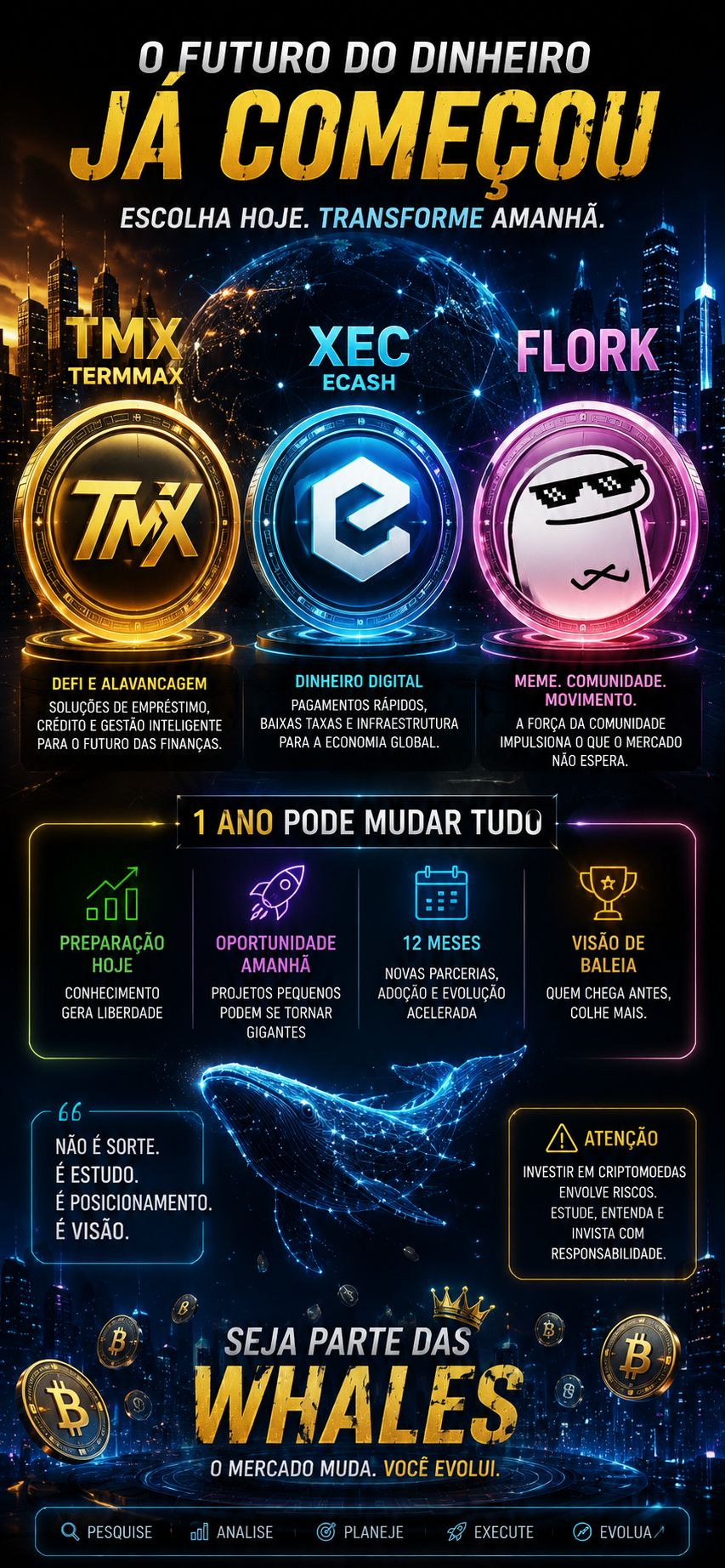
**TMX — TermMax**
**XEC — eCash**
**FLORK**
Each one represents a completely different thesis.
And that detail is fundamental.
# TMX: when DeFi meets a small market cap
**TermMax (TMX)** is an interesting example to observe because it is not simply a crypto.
The project is related to DeFi, with features involving loans, credit, and leverage management.
In September 2026, available data show a market capitalization in the range of US$ 13–14 million, with approximately 150–153 million TMX in circulation, while the maximum supply is 1 billion. ([CoinMarketCap])
And there is an even more interesting piece of data:
TMX recorded an all-time high of approximately **US$ 0.2009 on August 26, 2026**, according to data aggregated by CryptoRank. ([CryptoRank])
After that, the asset pulled back significantly.
This shows a fundamental characteristic of the market: when the price falls, whales buy thousands of dollars of this cryptocurrency, leveraging again
And one more small project can quickly multiply in value — and it can also lose a large part of that value quickly; it all depends on the market.
That is exactly why looking only at a coin’s price is a mistake.
A coin costing US$ 0.000001 does not necessarily mean it is "cheap."
A coin costing US$ 0.10 does not necessarily mean it is "expensive."
What really matters is:
**market capitalization + supply + liquidity + demand + utility + adoption + token distribution.**
Yes, I understand it is a bit complicated to understand...
We cited examples such as:
XEC: a different project
**eCash (XEC)** represents a completely different thesis.
The project’s objective is related to using blockchain for payments and digital money.
The ecosystem continues to develop its infrastructure. In July 2026, for example, the project reported progress on Cashtab, implementation of CashFusion for ALP tokens, and Bitcoin ABC updates, as well as data related to the eCash Avalanche network. ([eCash])
XEC also draws attention precisely because of its unit price, which proved progressively satisfactory over the last week.
But here there is a psychological detail.
Many people look at a coin costing fractions of a cent and think:
**“If it reaches US$ 1, I’ll be a millionaire.”**
It does not work like that.
It is necessary to look at the total supply and the capitalization that would be needed to reach that price.
That is the difference between dreaming about a price and analyzing a mathematical possibility
FLORK: the other side of the revolution
And then we have the world of memecoins.
This is where **FLORK** comes in.
FLORK is a perfect example of how cryptocurrency dynamics can be completely different from those of a traditional company.
According to recent CoinMarketCap data, FLORK had approximately US$ 29 million in market cap, about 1 billion tokens in circulation, and reached an all-time high in September 2026. ([CoinMarketCap])
Look at how big this is.
A traditional company valued at hundreds of millions can take years to multiply several times in size.
In the crypto market, depending on liquidity and demand, this can happen in much shorter periods.
But there is another side.
The same speed that creates opportunities also creates capital destruction.
A memecoin can rise 500%, 1,000% or more and then lose a large part of its value.
Therefore, when someone says:
“I want to be a whale.”
The right question should not be:
“Which coin will make me rich?”
The question should be:
“Which project has the fundamentals, liquidity, community, distribution, and potential sufficient to justify a meaningful position?”
This shift in mindset is gigantic.
JUST ONE YEAR CAN CHANGE EVERYTHING!