

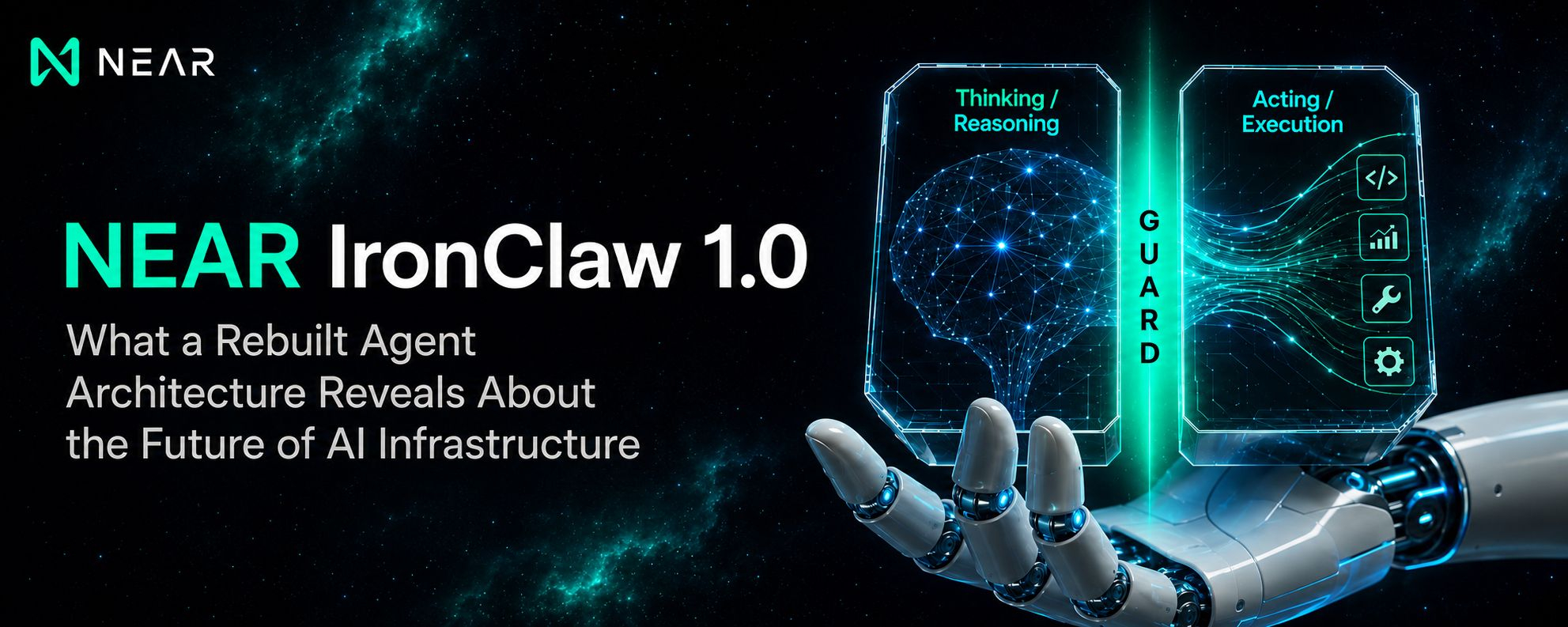

Imagine a company where anyone can propose a wire transfer. Marketing can request one, engineering can request one, HR can request one. But no matter who initiates it, the money does not move until it passes through a single approvals desk that applies the same checks every time. No department gets a side door. That is the basic idea behind NEAR AI's IronClaw 1.0: the agent can reason about what it wants to do, but the action itself must pass through a single coordination layer before it can execute.
That distinction matters because AI agents are moving beyond generating text and answering questions. They can browse websites, manipulate files, interact with external services, use credentials, send messages, and complete multi-step tasks on a user’s behalf. Once an agent can act in the real world, the challenge is no longer simply whether its underlying model is intelligent enough. It is whether the infrastructure surrounding that model can reliably control what it is allowed to do.
The Architecture: Separating Thinking from Acting
#IronClaw 1.0 takes a fundamentally different architectural approach. Rather than allowing reasoning, execution, memory, secrets, and tools to operate as tightly coupled components, it separates the reasoning layer from the execution layer and places a single coordination point called the “guard” between them. Every action, regardless of which capability initiated it, must pass through that checkpoint before execution.
The significance of that design is easy to underestimate. When safeguards are implemented independently across different tools and capabilities, every new feature creates another place where those controls have to be implemented correctly. A centralized guard creates a common enforcement path instead, allowing the same permission and safety logic to govern actions across the system. In practical terms, the architecture is closer to Think ➔ Guard ➔ Act than the conventional Think ➔ Act model.
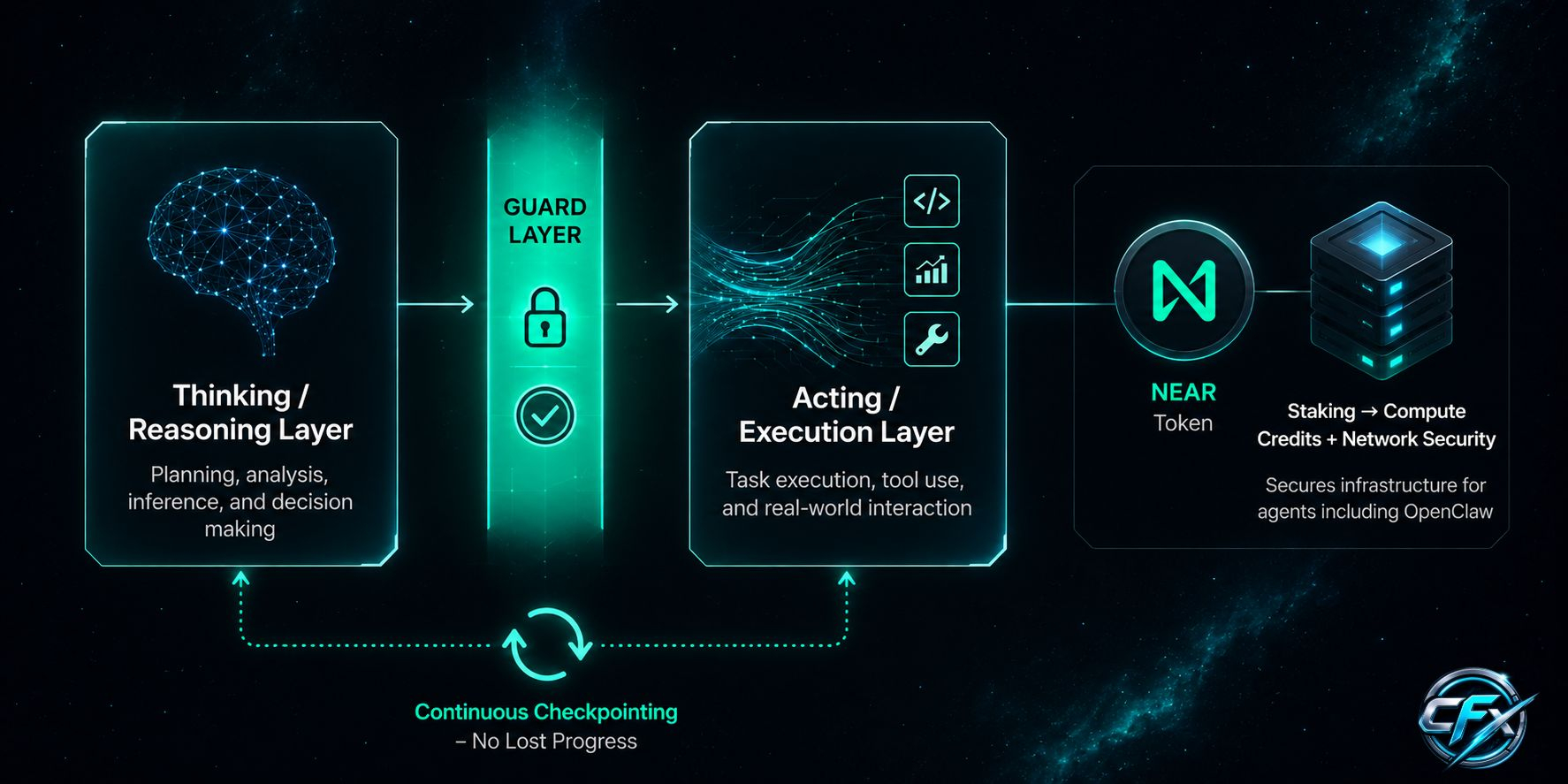
The architecture also addresses a less obvious problem: continuity. IronClaw uses continuous checkpointing so an interrupted task can resume from its previous state rather than forcing the agent to start over. If a workflow pauses while waiting for approval, encounters a restart, or is interrupted midway through execution, the progress already made can be preserved and the task resumed from its last checkpoint.
Benchmarks: Performance Across Different Failure Surfaces
Architecture alone is not enough. An agent can be extremely cautious and still be practically useless if it cannot complete the tasks it is given. Using the same deepseek-v4-flash base model across the comparisons, #IronClaw currently leads three different agent benchmarks, each testing a different dimension of real-world performance.
On PinchBench, #IronClaw scores 93.5% across 147 practical tasks covering scheduling, email triage, coding, research, and file management. On ClawBench, which evaluates multi-step interactions across more than 140 live production websites, it records 88.6%. OfficeQA tests grounded reasoning over a large corpus of U.S. Treasury Bulletins spanning nearly a century, 89,000 pages, and more than 26 million numerical values; IronClaw scores 76.4%.
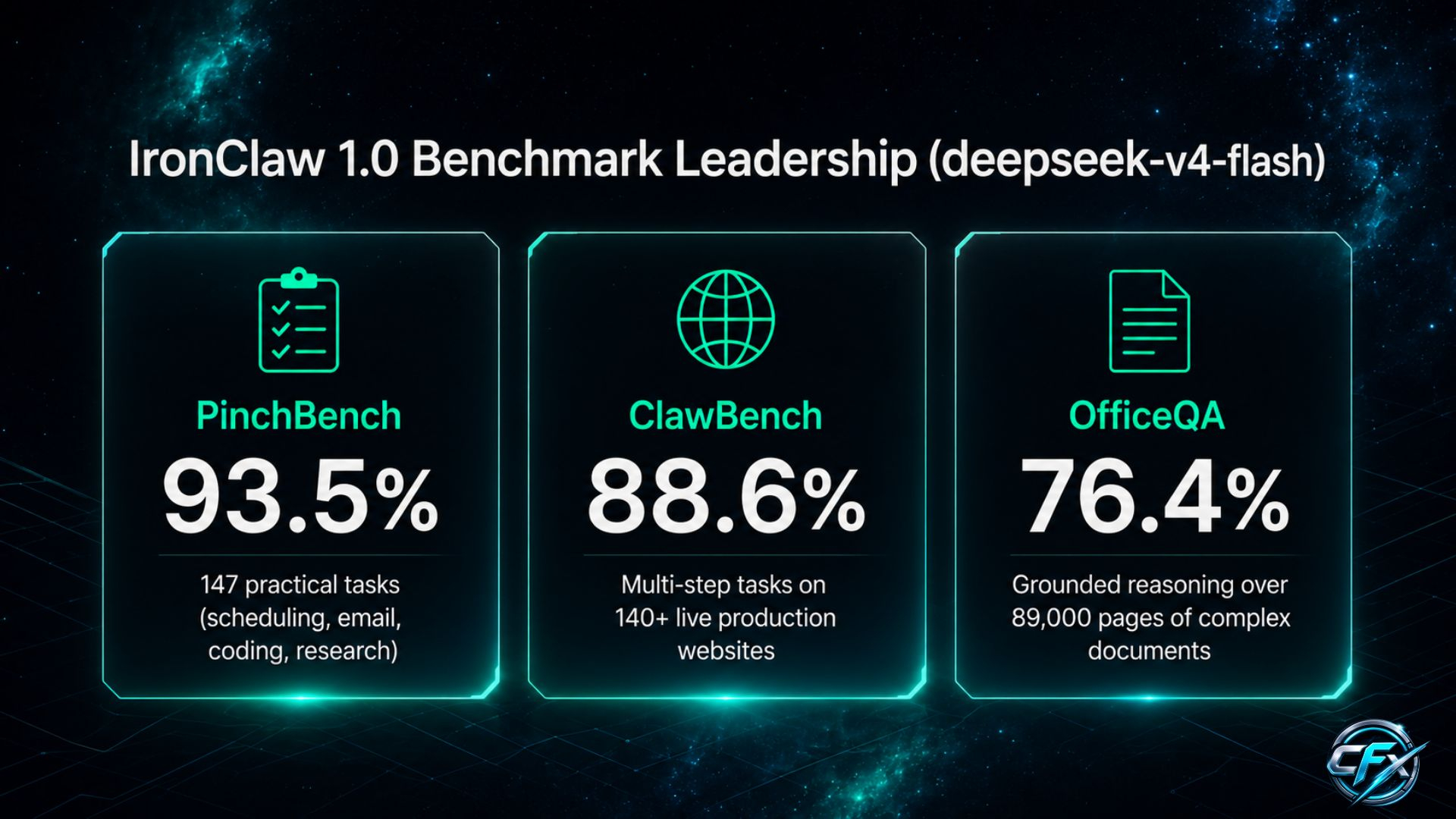
These benchmarks stress different capabilities: PinchBench emphasizes practical task completion, ClawBench introduces the unpredictability of live web environments, and OfficeQA tests reasoning over complex documents and numerical information. Leading across all three suggests that performance is not solely a function of the underlying model; the agent harness and architecture surrounding it are contributing meaningfully as well.
From a Demo to a System People Can Actually Use
The architecture becomes more compelling when paired with the controls designed for real-world use. IronClaw can require explicit approval before sensitive actions execute, rather than allowing an agent to act first and explain itself afterward. It also supports single-use secrets that can be scrubbed from logs after use, reducing the amount of sensitive information that persists within the system.
The same philosophy extends to memory and collaboration. IronClaw maintains consistent memory and safety rules across CLI, web, Slack, and Telegram rather than treating each interface as an isolated assistant. For organizations, team isolation allows tools and skills to be shared while keeping individual workspaces private by default, alongside a fully isolated single-tenant option for teams that require stronger separation. @NEAR Protocol and #NEARAI are already running IronClaw internally across their teams, giving these design choices a practical testing ground beyond a product demonstration.
Where NEARAI and Staking Fit
A capable agent still needs inference, compute, and reliable infrastructure to operate continuously. This is where #NEARAI enters the picture. Rather than treating AI compute as an entirely separate service paid for through conventional infrastructure contracts, NEAR AI connects access to AI services with participation in the NEAR ecosystem through its staking model.
For agent hosting, the structure uses a fixed ratio: staked NEAR ÷ 100 equals the monthly credit budget in dollars. Stake 500 NEAR and you receive $5 in credits every month for as long as the tokens remain staked. The Starter tier begins at 50 NEAR and activates the first IronClaw agent, while higher tiers unlock larger credit allocations and additional parallel agents. The underlying NEAR is not consumed; it remains the user’s asset.
Confidential inference works differently. Here, the staking rewards generated by the user’s position (current network APY sits around 4.5–4.7%) are directed toward NEAR AI in exchange for compute credits rather than being paid out as income. The principal stays under the user’s control and can be unstaked through the normal protocol process. The broader infrastructure also provides access to models from providers including Anthropic, OpenAI, and Google.
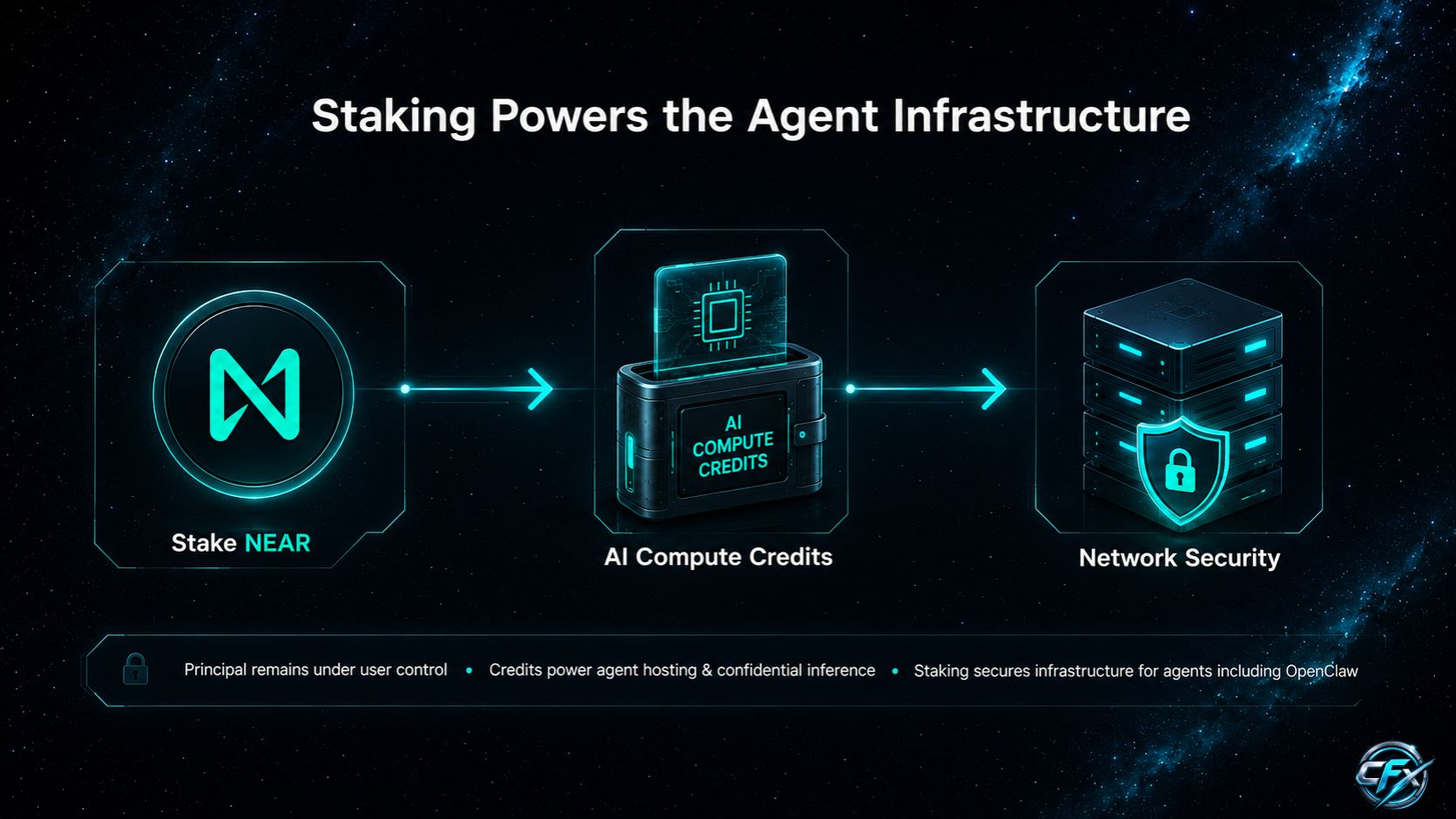
Importantly, staking on NEAR is not just about yields. It secures the underlying decentralized infrastructure that these AI agents, including the upcoming OpenClaw will rely on. By tying access to compute with network participation, #NEARAI creates a tighter relationship between securing the network and powering the applications that run on it.
The Bigger Picture
This is ultimately why #IronClaw 1.0 is more interesting than another announcement about a more capable AI agent. The important shift in autonomous AI is not simply that models are learning to do more. It is that the infrastructure around those models is beginning to treat autonomy as a systems problem involving permissions, execution, memory, recovery, isolation, and compute rather than intelligence alone.
IronClaw addresses that problem at the execution layer by separating reasoning from action, routing actions through a centralized guard, preserving state through interruptions, controlling sensitive operations, and maintaining consistent safety rules across different interfaces. #NEARAI addresses another part of the stack by connecting AI compute access to decentralized network participation and providing infrastructure that agents can actually run on.
Taken together, these pieces point toward a broader direction for AI infrastructure. The future of autonomous agents may not be determined simply by how much a model can accomplish without human intervention, but by how reliably the systems around that model can constrain its actions, recover when something goes wrong, preserve context over time, and provide the infrastructure required to keep it running.
Smarter agents are only one part of the equation. The more consequential challenge may be building the infrastructure that makes those agents trustworthy enough to act.
You can read on this on 𝕏: https://x.com/Cryptfancier/status/2096337705550434561
Sources
╰─➤ Introducing IronClaw 1.0 (NEAR AI Blog): https://near.ai/blog/introducing-ironclaw-1-0
╰─➤ Staking for NEAR AI (NEAR AI Blog): https://near.ai/blog/staking-for-near-ai
╰─➤ NEAR Protocol official announcement: https://x.com/NEARProtocol/status/2082875217995796606
╰─➤ IronClaw GitHub repository: https://github.com/nearai/ironclaw
╰─➤ NEAR AI Private Inference documentation: https://docs.near.ai/cloud/private-inference
╰─➤ Staking Rewards – NEAR live yield data: https://www.stakingrewards.com/asset/near-protocol