


I’ve been looking at what happens when AI moves beyond giving answers and starts taking actions.
That is where the real challenge begins. An agent can be capable, but can it act within clear boundaries, preserve its work, and handle sensitive tasks safely?
That is what makes IronClaw 1.0 from @NEAR Protocol worth examining.
#NEARAI Cloud provides the infrastructure behind this direction, giving developers a way to run AI workloads with stronger privacy and verifiable security. Its confidential computing approach uses Trusted Execution Environments (TEEs) to isolate sensitive AI workloads, while cryptographic attestation can provide evidence about where and how the computation was performed.
#ironclaw sits on the agent side of that infrastructure. Its purpose is to give autonomous agents a controlled environment for reasoning, using tools and carrying out tasks without giving the model unrestricted access to everything around it.
Architecture: Decision-Making vs Execution:
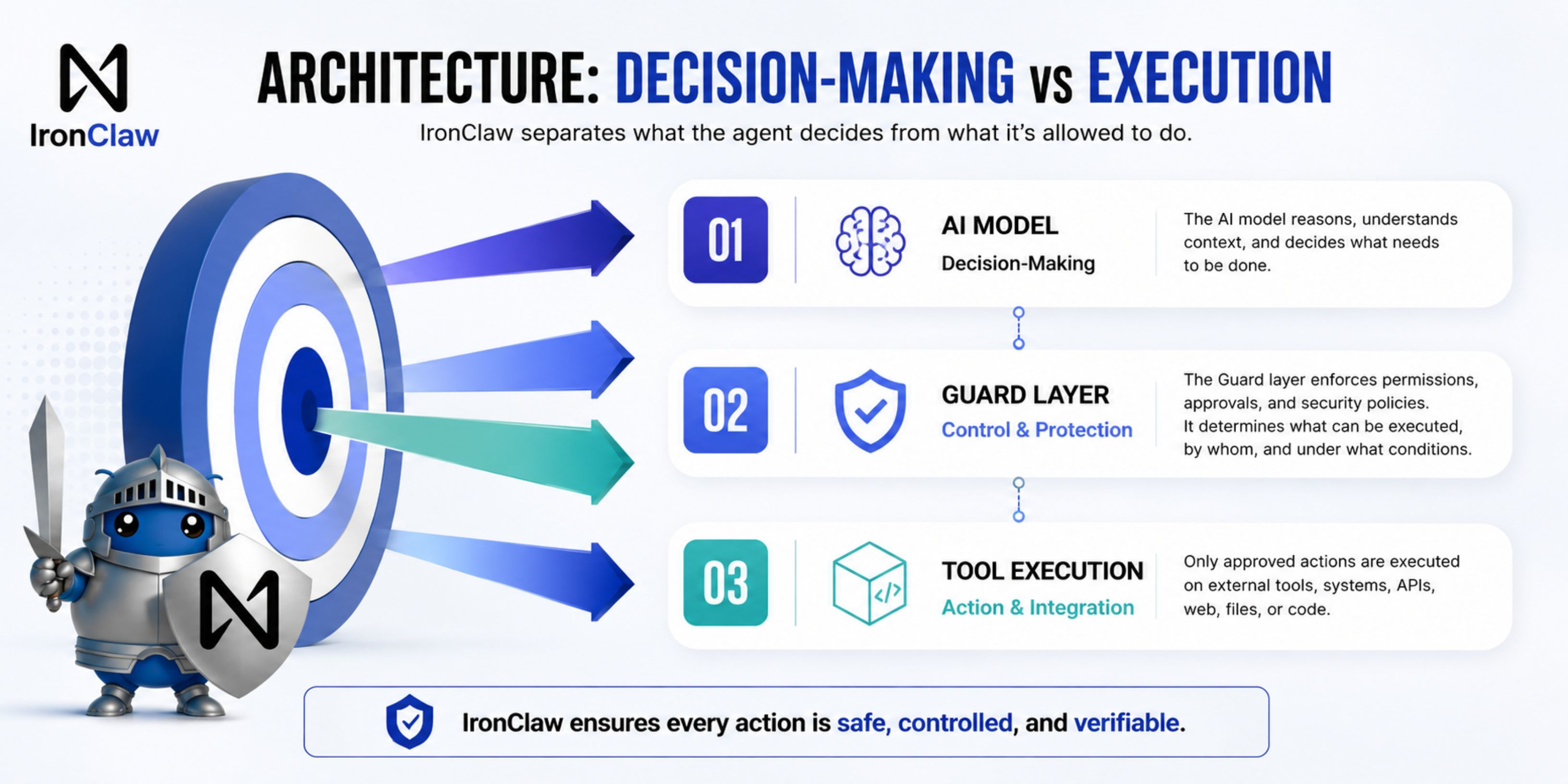
#IronClaw separates the AI model from the tools it controls through a guard layer.
The model makes the decision. The guard controls whether and how that decision becomes an action, with permissions, approvals and security controls in between.
That is a much more practical approach to agent security than simply relying on the model to follow instructions.
Benchmark Performance:
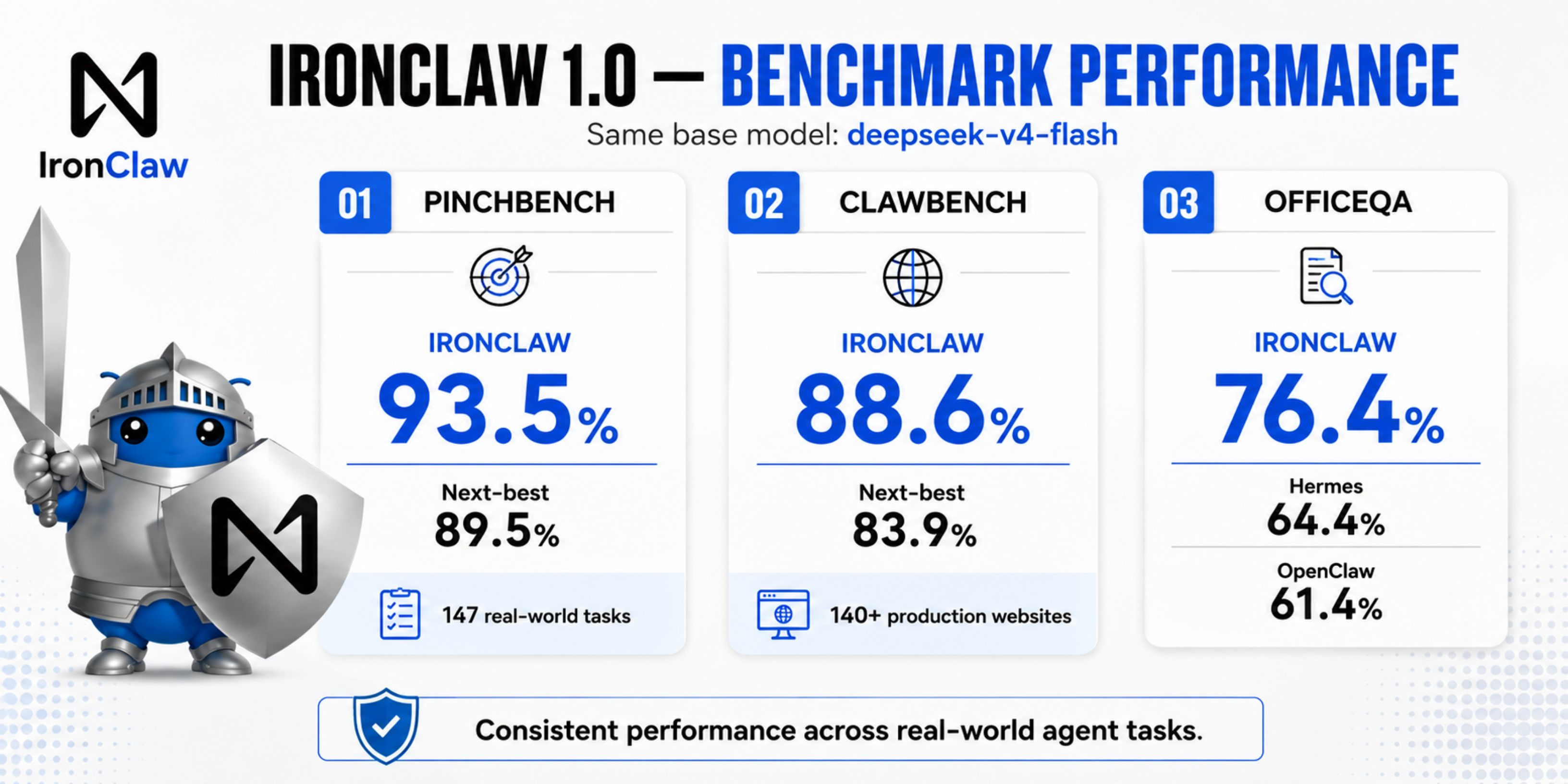
Using deepseek v4 flash as the base model, IronClaw leads across the three highlighted benchmarks:
• PinchBench — 93.5%
• ClawBench — 88.6%
• OfficeQA — 76.4%
The consistency across different types of tasks is what stands out to me.
Built for Real Work
The other part I find important is what happens when things don't go perfectly.
IronClaw supports explicit approvals, continuous checkpoints, and persistent state, allowing interrupted work to resume rather than being lost.
Its memory also works across CLI, Web, Slack and Telegram, while team isolation helps maintain individual permissions and workspace boundaries.
NEAR AI & Staking
NEAR AI extends this into the infrastructure layer, with confidential computing and TEE-based environments for AI workloads.
Its staking model connects NEAR staking to AI compute credits, meaning staking is not simply about yield. It helps support the infrastructure required to run agents and confidential inference.
My Take
For me, the interesting part isn't just that IronClaw scores well.
It is the decision to treat security, permissions and execution as part of the agent architecture itself.
If AI agents are going to handle serious business tasks, that distinction between what an agent wants to do and what it is actually allowed to do could become increasingly important.
Check out more LinkedIn article for more insights:
https://www.linkedin.com/pulse/ironclaw-10-secure-agent-harness-redefining-trust-autonomous-mary-xklle