



Quick summary
Bitcoin is facing a rather notable signal from the group of large investors. According to a new analysis by …
According to a new analysis by CryptoQuant, whales still see Bitcoin as not expensive enough to start taking profits aggressively, even though BTC has gone through a…
Whales not taking profits is a notable signal CryptoQuant’s main point is quite simple but highly significant: these investors…
Bitcoin is facing a rather notable signal from the group of large investors. According to a new analysis by CryptoQuant, whales still see Bitcoin as not expensive enough to start taking profits aggressively, even though BTC has seen a significant rally and is trading at elevated levels.

Whales not taking profits is a notable signal
CryptoQuant’s core argument is quite simple but significant: large investors still do not see the current price level as attractive enough to realize profits. This suggests that the expectations of large capital holders may still be tilted toward further Bitcoin upside.

Source: CryptoQuant
In a bull market, whales not selling often benefits the bulls. If a large amount of BTC continues to stay in wallets instead of moving onto exchanges, the actual circulating supply may be constrained. When demand returns, a supply shortage could make prices react more strongly.
Some other data also show that whales have tended to accumulate Bitcoin in 2026. CryptoQuant previously recorded the amount of Bitcoin held by whale wallets, excluding exchanges and mining pools, rising to about 3.06 million BTC this year. Notably, holdings increased during periods of price correction.
Earlier, another CryptoQuant analysis also showed that wallets holding 100–1,000 BTC had raised their net accumulation over 60 days to about 66,700 BTC, close to the 68,000 BTC recorded in mid-June.
If whales simply do not sell, the signal will be fairly neutral. But if BTC holdings in large wallets also increase at the same time, that shows that a segment of large capital is truly looking to hold or increase its exposure to Bitcoin.
DataNotable levelMeaningWhale holdings~3.06 million BTCWhales’ BTC holdings remain at a high levelWhale accumulation 60 days~66,700 BTCShows accumulation activityCurrent behaviorNo strong profit-takingSupply pressure from whales is not yet too largeBTC priceHigh zoneNeeds further confirmation from capital inflows
However, this is still not a signal that Bitcoin can rise straight up. The higher the price goes, the greater whales’ unrealized profits become and the stronger the incentive to take profits will be. Therefore, their not selling right now may be a bullish signal, but it could also change very quickly if the price structure deteriorates.
Bitcoin is still facing supply pressure
A bull market not only needs buyers, but also needs to absorb the BTC that sellers want to put out there. This is why traders should not be overly optimistic just because whales have not taken profits.
CryptoQuant recently recorded a sharp increase in Bitcoin on Binance, from about 617,000 BTC at the end of April to about 685,000 BTC. BTC returning to exchanges often increases the supply that could be sold, although not every BTC deposited to exchanges immediately becomes a sell order.
One side shows that whales are not yet eager to realize strong profits, but the other side shows that the amount of Bitcoin held on exchanges is increasing. These two data points do not necessarily conflict, because Bitcoin on exchanges can come from many different groups of holders.
What people need to watch is whether the BTC flowing onto exchanges actually turns into selling pressure. If exchange inflows rise but price still holds up well, the market may be absorbing supply quite effectively. Conversely, if inflows rise together with selling volume and BTC loses support, that would be a clearer warning signal.
Bitcoin is in a price zone where buyers need to prove their strength
Technically, Bitcoin is still within a structure that can sustain an uptrend, but it is no longer in as easy a buying position as it was at the start of the rebound.
According to Reuters, on 3/9, 71,781 USD was identified as an important support zone. Above that, the 82,793 USD area is playing the role of notable resistance, coinciding with the 61.8% Fibonacci level and the May peak zone. If BTC breaks above this area, the next target could move toward 90,000 USD and further to the 2026 peak around 97,867 USD. On the other hand, if 71,781 USD is lost, the risk of a decline to the 62,677 USD zone will increase.
Whales not taking profits helps reinforce the bullish narrative, but price still needs to break through the overhead supply zone. If Bitcoin keeps getting rejected around 82,000–83,000 USD, whales not selling will still not be enough to create a new uptrend.
Conversely, if BTC breaks 82,793 USD with good volume while whale data remains positive, the two sets of signals will begin to confirm each other. At that point, the likelihood of Bitcoin continuing to expand its uptrend will be much more convincing.
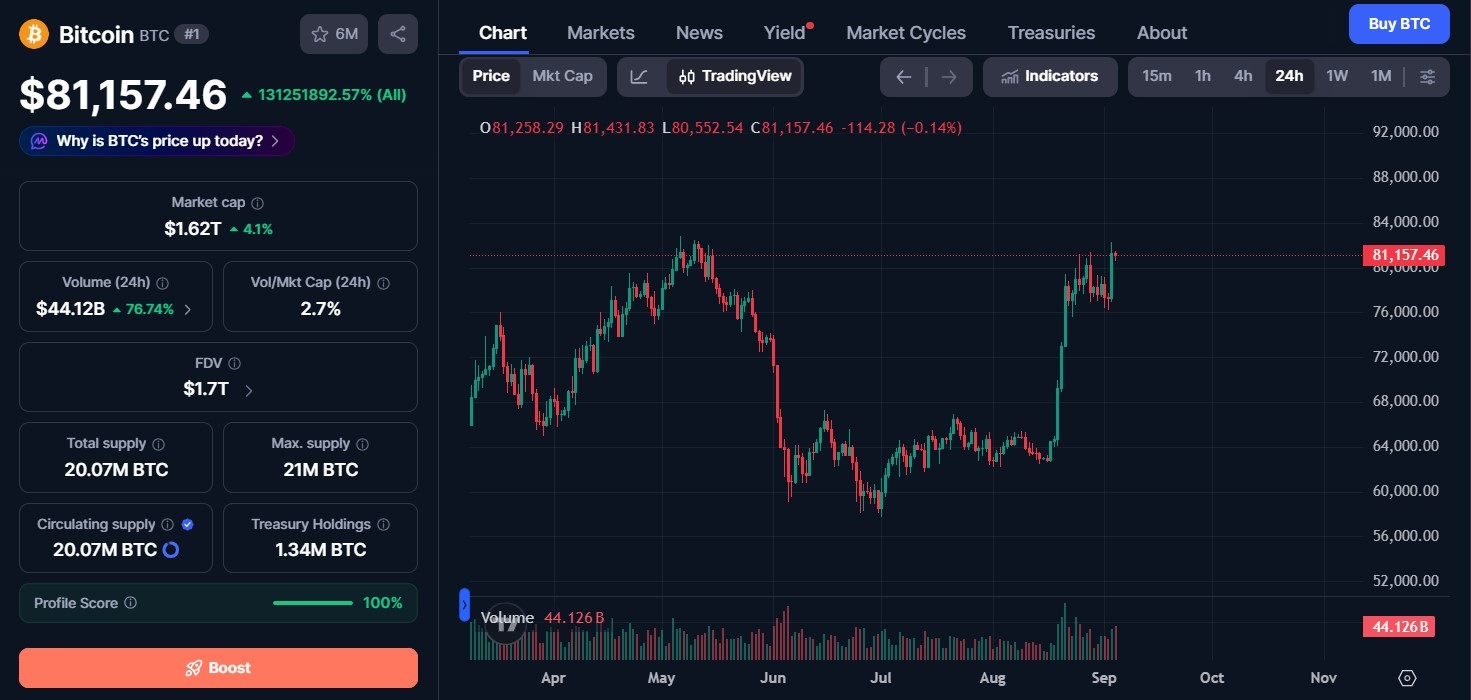
Bitcoin price chart on 4/9
Source: https://emacrypto.com/ca-voi-van-chua-muon-chot-loi-bitcoin-btc-con-du-dia-tang/