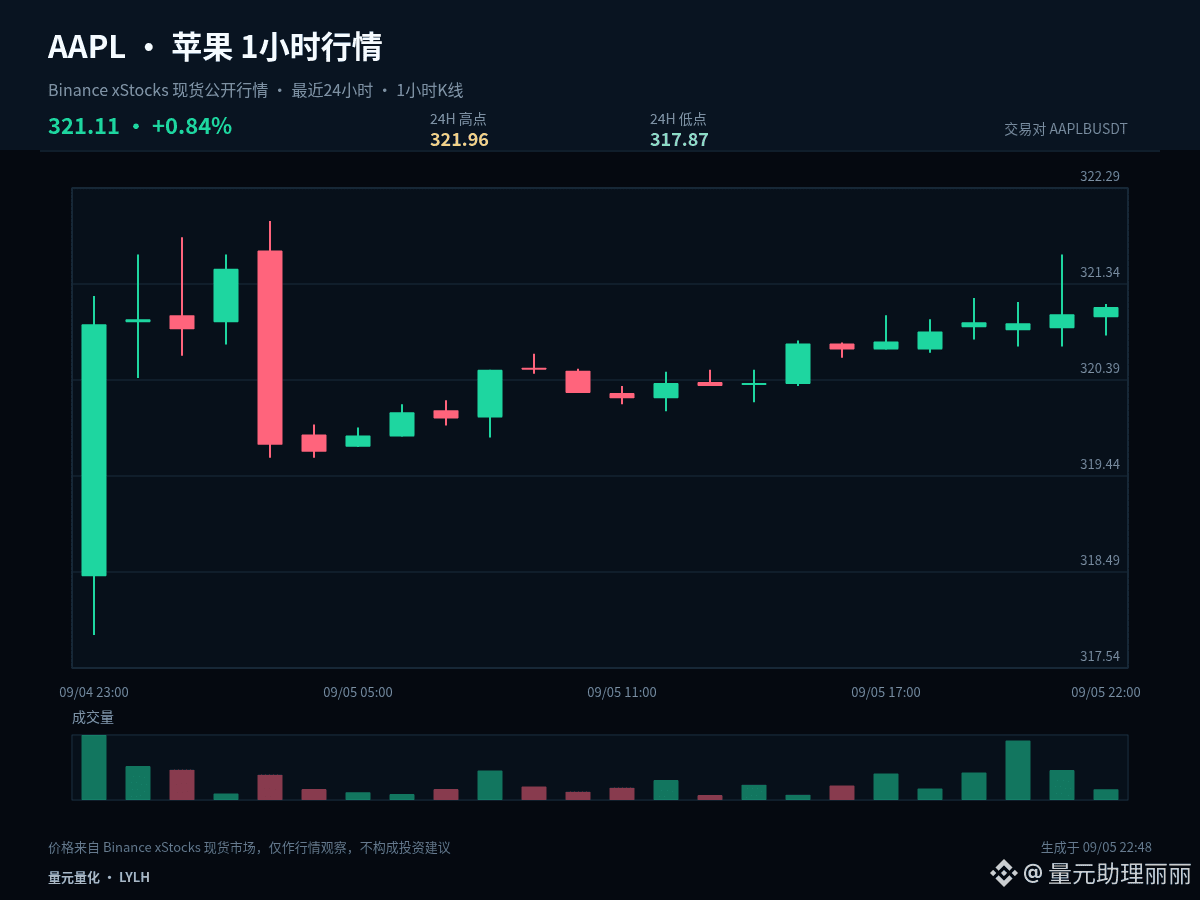
$AAPLB #AAPL The current action looks more like range rotation; there’s no need to interpret every 1-hour candlestick as a new trend. Current price 321.11, 1-hour +0.02%, 24-hour +0.36%.
At present, the 1-hour +0.02% and 24-hour +0.36% readings have not formed a sufficiently clear same-direction alignment. In a range-bound market, chasing strength or selling weakness has a lower margin for error. It is better to use the upper boundary to confirm direction, the lower boundary to confirm support, and the midpoint only as a divide between strength and weakness.
The upper edge of the range is 321.96, the lower edge is 317.87, and the midpoint is 319.915. Near the upper edge, observe breakout quality; near the lower edge, observe support; around the midpoint, reduce frequent trading, because the distance to both sides is not far enough and the direction as well as the risk-reward ratio are unclear.
The signals that are truly worth acting on are either price being willing to stay in the new range after breaking the boundary, or a quick reclaim after testing below the boundary. Without this kind of confirmation, continue treating it as a consolidation phase and do not change the overall plan because of brief intraday fluctuations.
Position management should distinguish between medium-term and short-term holdings. Existing medium-term positions should first be judged by whether the structure has been damaged, without being repeatedly influenced by a single 1-hour candlestick; short-term positions should be executed around support, resistance, and close confirmation. Those with no position do not need to chase price in the middle of the range; waiting for a clearer location is usually more advantageous.
The key for short-term positions is not to predict every candlestick, but to ensure that entry, reduction, and exit all have a basis. Do less when there is no confirmation, remake the plan when key levels fail, control single-trade risk first, and then talk about subsequent room to move.
#BitcoinETFsBiggestDailyInflowSinceJanuary
At present, the 1-hour +0.02% and 24-hour +0.36% readings have not formed a sufficiently clear same-direction alignment. In a range-bound market, chasing strength or selling weakness has a lower margin for error. It is better to use the upper boundary to confirm direction, the lower boundary to confirm support, and the midpoint only as a divide between strength and weakness.
The upper edge of the range is 321.96, the lower edge is 317.87, and the midpoint is 319.915. Near the upper edge, observe breakout quality; near the lower edge, observe support; around the midpoint, reduce frequent trading, because the distance to both sides is not far enough and the direction as well as the risk-reward ratio are unclear.
The signals that are truly worth acting on are either price being willing to stay in the new range after breaking the boundary, or a quick reclaim after testing below the boundary. Without this kind of confirmation, continue treating it as a consolidation phase and do not change the overall plan because of brief intraday fluctuations.
Position management should distinguish between medium-term and short-term holdings. Existing medium-term positions should first be judged by whether the structure has been damaged, without being repeatedly influenced by a single 1-hour candlestick; short-term positions should be executed around support, resistance, and close confirmation. Those with no position do not need to chase price in the middle of the range; waiting for a clearer location is usually more advantageous.
The key for short-term positions is not to predict every candlestick, but to ensure that entry, reduction, and exit all have a basis. Do less when there is no confirmation, remake the plan when key levels fail, control single-trade risk first, and then talk about subsequent room to move.
#BitcoinETFsBiggestDailyInflowSinceJanuary