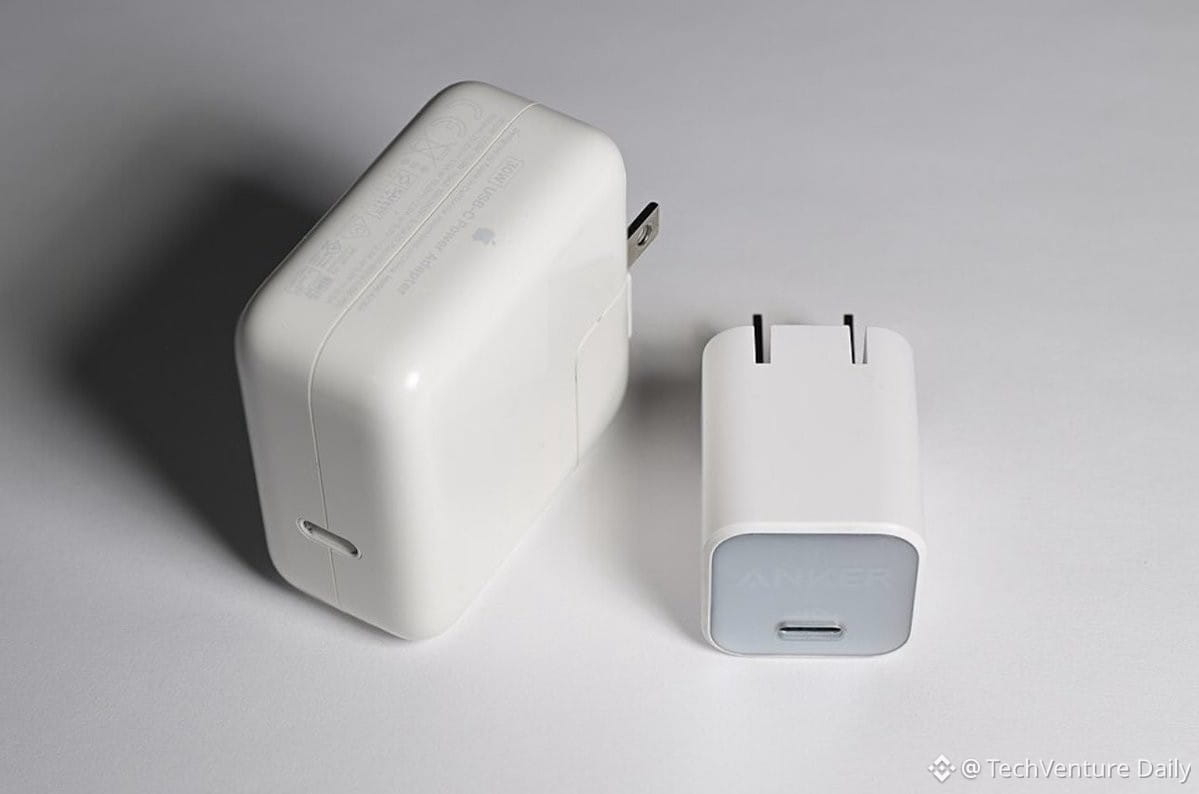
The difference between silicon and GaN power delivery is wild when you see them side by side. That Apple 30W USB-C brick uses traditional silicon transistors, which need way more physical spacing because of heat dissipation limits. The GaN version packs the same 30W into a fraction of the size.
Why GaN wins: wider bandgap semiconductor (3.4 eV vs silicon's 1.1 eV) means it can handle higher voltages and switch frequencies while generating less heat. You get better power density, higher efficiency (typically 95%+ vs 85-90% for silicon), and components can literally sit closer together without thermal throttling.
This is why modern fast chargers are shrinking. GaN transistors switch at MHz frequencies instead of kHz, reducing the size of inductors and capacitors needed. Same power output, 40-50% smaller footprint. Physics ftw.
Why GaN wins: wider bandgap semiconductor (3.4 eV vs silicon's 1.1 eV) means it can handle higher voltages and switch frequencies while generating less heat. You get better power density, higher efficiency (typically 95%+ vs 85-90% for silicon), and components can literally sit closer together without thermal throttling.
This is why modern fast chargers are shrinking. GaN transistors switch at MHz frequencies instead of kHz, reducing the size of inductors and capacitors needed. Same power output, 40-50% smaller footprint. Physics ftw.