


PancakeSwap is not just a normal application on BNB Chain. It is the ecosystem’s open market.
If BNB Chain is a city, then PancakeSwap is the trading hall, the token listing platform, the yield layer, and often the first place where a new token gets its market price.
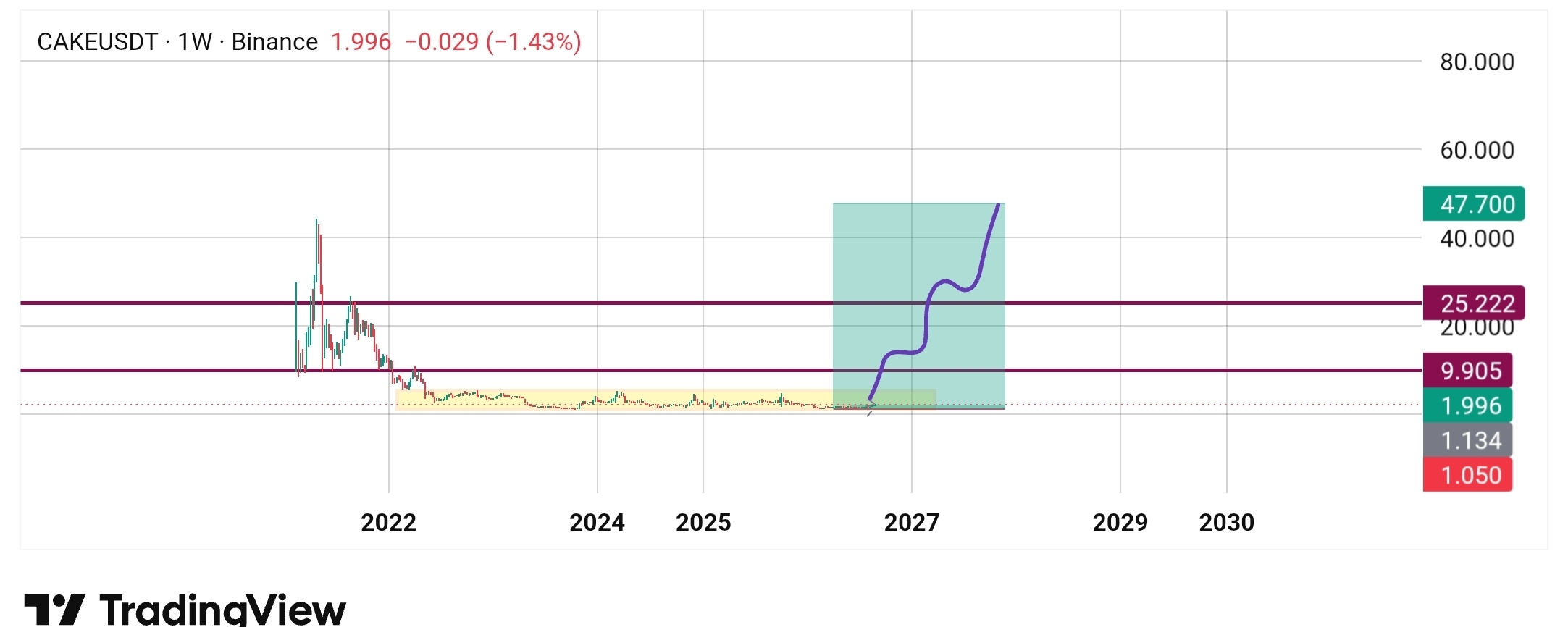
The all-time high set in April 2021 was about $44, while the current price is around $2, leaving about 95% upside to the ATH. At first glance, that gap seems almost impossibly large. But if you separate the two facts, everything makes sense: the 2021 peak belonged to a period of market mania, while PancakeSwap in 2025–2026 is a much larger business, and the token itself is far more constrained.
That is exactly why I believe CAKE’s structural importance is far above what its current market valuation reflects. If the whole market enters a full bull-cycle repricing, CAKE could absolutely get much closer to that ATH than it is now.
1. BNB Chain needs a default DEX, and PancakeSwap is that default choice
A smart contract chain without a dominant AMM is incomplete.
Users need a place to trade BNB, stablecoins, Wrapped BTC, LSTs, newly launched meme coins, and increasingly tokenized assets.
Developers need a token trading and liquidity entry point.
Market makers need enough liquidity and depth.
PancakeSwap happens to play those roles.
On BNB Chain, it still captures a large share of major trading pairs. Pairs like USDT-WBNB and BTCB-USDT often route most on-chain trading volume through PancakeSwap’s liquidity pools.
When a token launches on four.meme, a Farm starts running, or a stablecoin needs to exit liquidity, PancakeSwap is often the most direct venue.
Messari’s Q4 2025 BNB Chain report still lists PancakeSwap as one of the network’s largest DeFi protocols, with TVL of about $2.2 billion, accounting for roughly one-third of the chain’s total on-chain DeFi TVL, even in a quarter when risk appetite was lower.
This is no longer a protocol that exists by relying on short-term hype.
This is infrastructure.
BNB Chain’s core strengths have always been low-cost blockspace and massive retail user distribution.
And PancakeSwap is the key that turns those advantages into a usable market.
Without PancakeSwap, BNB is just a high-speed ledger.
With PancakeSwap, BNB truly becomes a market.
2. It is the liquidity center that keeps the entire ecosystem moving
DeFi is fundamentally a loop:
Stablecoins need liquidity pools.
Lending protocols need liquid collateral.
Launchpads need a secondary market.
Perpetual contracts and prediction markets need spot prices.
RWA needs a 24/7 exit channel.
And on BNB Chain, PancakeSwap sits right at the center of that loop.
Stablecoin scale on BNB Chain has already hit tens of billions at its peak, and capital turnover is very fast.
High trading volume itself means nothing unless there is a market capable of absorbing those trades.
PancakeSwap is that market.
Lending protocols like Venus and Lista can rely on deep nearby spot markets to determine collateral prices.
New tokens can graduate from Launchpad and then enter CAKE-incentivized liquidity pools.
The tokenized stocks, gold, and other RWA products that PancakeSwap is pushing can only truly work if someone is willing to provide market liquidity.
And that liquidity provider is, more often than not, PancakeSwap’s LP.
PancakeSwap in 2026 is no longer just a simple AMM.
It has V2, V3, Infinity, as well as Farms, IFO, Prediction, Lottery, routing systems, and a constantly expanding RWA infrastructure.
As BNB Chain increasingly moves toward consumer finance and large-scale user applications, more activity will ultimately need to pass through this infrastructure.
3. Low gas is an advantage, and PancakeSwap is how BNB turns that advantage into volume
Ethereum won high-end liquidity.
BNB won high throughput.
For a DEX, this is extremely important.
High-frequency retail trading, meme coin rotation, stablecoin trading, and small-ticket transactions are all constrained if gas costs are too high.
But on BNB Chain, those transactions can be done at low cost.
PancakeSwap has turned this advantage into huge trading volume, a scale that many so-called “mainstream” DEXs still underestimate.
Official data shows:
Full-year 2025 trading volume is about $2.36 trillion.
As of the end of 2025, cumulative trading volume has reached about $3.33 trillion.
By mid-2026, cumulative trading volume had already exceeded $4.2 trillion.
Even using DeFiLlama’s stricter DEX methodology, PancakeSwap still processes tens of billions of dollars in volume every month, and cumulative trading volume has already exceeded $2 trillion, with BNB Chain still its core market.
Of course, volume is not the same as token price.
But volume is the raw material of fees, and fees are the important basis for CAKE buybacks and burns.
If BNB Chain continues to be the low-cost retail crypto trading hub, then PancakeSwap will continue to be the core infrastructure that captures that trading activity.
4. CAKE is no longer the high-inflation token it was in 2021
When CAKE hit its all-time high in 2021, the whole ecosystem was still in a stage where large token emissions were used to stimulate farming.
That version of CAKE should deserve a lower valuation.
But now it is completely different.
Maximum supply reduced to 400 million tokens.
The circulating supply is about 321 million tokens.
Net burns have continued since late 2023.
The buyback mechanism is tied to real trading activity and fees.
It no longer relies on the old unlimited-emission incentive model.
CAKE is currently trading near $2, giving it a circulating market cap of about $640 million.
Since the circulating supply is already very close to the 400 million cap, the fully diluted valuation would not be much higher than the circulating market cap.
Based on the current circulating supply, if CAKE returns to its $44 all-time high, that would imply a circulating market cap of about $14.1 billion.
That is indeed a very large number.
But if you remember one thing, you won’t think it is completely impossible:
CAKE once reached a similar valuation in an era when the product was smaller and the tokenomics were worse.
The real bull market logic is not:
“CAKE will go up because Pancake is cute.”
The real logic is:
The protocol has massive real usage, supply is shrinking, and yet the market is still pricing it like an old farm token.
When a protocol has billions of dollars in TVL and processes tens of billions of dollars or more in monthly volume, yet still has only a few hundred million dollars in token market cap, that is worth thinking about.
The point of Tokenomics 3.0 is to make the market re-recognize CAKE’s value-capture ability from these real economic activities.
5. Why might CAKE break its all-time high?
A new all-time high is ultimately a market cap event, not a nostalgia event.
If CAKE wants to break its roughly $44 ATH, then based on the current circulating supply of about 321 million tokens, it would need a circulating market cap of about $14.1 billion.
That requires a full risk-on cycle, plus the market beginning to view CAKE as a high-beta asset for BNB Chain DeFi.
And this is already gradually happening on BNB Chain.
The path that makes this target seem less crazy is:
BNB Beta
If BNB Chain’s TVL, stablecoin scale, and number of on-chain users grow again, then the default DEX often gets the valuation uplift first.
PancakeSwap is one of the most liquid core assets in this ecosystem, and therefore also the most direct Beta beneficiary.
Fees → buybacks → burns
More volume means more fees.
More fees mean more CAKE bought back and burned.
Lower supply facing the same or even growing demand creates a tighter supply-demand structure.
This mechanism was not as mature in 2021 as it is now.
Valuation multiple expansion
Uniswap, as the representative DEX of the Ethereum ecosystem, still has a market cap in the billions of dollars.
And CAKE currently has only about $640 million in circulating market cap, yet it has an enormous historical trading volume and a strong market position within its own ecosystem.
If, in the future, the market starts valuing DEX tokens based on real usage rather than 2021 sentiment, then CAKE does not need to reach Uniswap’s valuation multiple to still have huge upside.
Product expansion continues
Infinity, multichain deployment, RWA, and more products aimed at everyday users mean CAKE no longer has only a single narrative.
In a bull market, different narratives can keep stacking on top of one another.
Supply logic
PancakeSwap no longer needs to rely on the kind of high-inflation token emissions seen in 2021 to drive growth.
A 400M supply cap, combined with an ongoing burn mechanism, means that when new market demand enters, it meets a much tighter and cleaner circulating float.
That is why I think $CAKE challenging, and even breaking, its all-time high is not a crazy idea.
CAKE in 2021 was a high-emission DeFi farm token.
CAKE in 2026 looks more like a DeFi infrastructure token that already has trillions of dollars in historical trading volume, sits at the core of BNB Chain, and has a clearly improved supply structure.
When the market is willing to reprice it may be the most important question.
$BULLA $B $DASH $ZEN $4 $ETH $BTC
#ZECHitsANewAllTimeHigh #BitcoinETFsBiggestDailyInflowSinceJanuary #USAugustJobGrowthNearlyTriplesForecast #USAugustNonfarmPayrollsDueToday