


On September 3, Robinhood’s share price closed up 16.57%, hitting a new intra-year high. Morgan Stanley raised its price target from $124 to $150; Piper Sandler to $145; and Bernstein reiterated $160.
On the same day, Robinhood Chain generated about $4.01 million in on-chain revenue in a single day. DeFiLlama ranked it #1 among public chains, with revenue 13.9 times that of the combined totals from Base, Solana, Ethereum, and BSC.
These two facts were put into the same story and framed as a “two-wheel drive of traditional brokerage + on-chain infrastructure.” But if you ask who paid the $4.01 million, why they paid, and what they got after paying, the story falls apart.
Almost all of that $4.01 million comes from memecoin trading and issuance fees. And the essence of memecoin trading is that retail traders exchange with one another the illusion of “I think I can get rich today.” The fee from that illusion is counted as “platform growth,” and then written into Morgan Stanley’s rating report.

This is the most off thing about this news.
Replace the subject with “That $4.01 million’s prior life.”
If the subject is “Robinhood,” the story is “revaluation of value.” If the subject is “on-chain revenue,” the story is “topping the public chain.” But if you change the subject to the form that $4.01 million was in before it flowed from retail traders’ pockets into the Robinhood Chain protocol, the whole narrative becomes brutal.
Before this $4.01 million becomes “income from being No. 1 public chain,” what is it?
It’s the fee from someone buying a memecoin that went live only 20 minutes earlier at 3 a.m. It’s the extra gas fee another person paid just to hit the buy button before the robot. It’s those countless moments of “I heard this will go up,” priced as a single number recorded on-chain.
Wall Street calls it “revenue.” Morgan Stanley calls it “evidence of platform expansion.” But fundamentally, it’s a giant suction machine extracting water out of retailers’ hopes.
And the people truly being milked, and the people buying HOOD stock, are likely the same crowd. Retail traders lost on-chain fees, but made 16% on stocks—they think they’re investing in “the future financial infrastructure.” In reality, they’re contributing twice to the same system: once by losing money, once by chasing the rally.

95% of DEX volume, 100% narrative packaging
There’s a number combination in the material that’s quite interesting: on Robinhood Chain, over 95% of DEX trading volume comes from memecoins, while on-chain revenue mainly comes from “Meme coins, launchpads, and trading terminals.”
But what’s the rating logic from the big banks? Morgan Stanley talks about “platform expansion capability,” “diversification from stocks to crypto to prediction markets.” Piper Sandler talks about “growth in the prediction market business.” Bernstein talks about the “long-term value of the crypto business.”
No one says the most straightforward word: memecoin. These analysts use terms like “crypto,” “platform,” and “prediction markets” to wrap revenue that is largely driven by “retail traders exchanging air tokens with each other” into a grand fintech narrative.
This isn’t an analyst’s oversight. It’s narrative’s necessary disguise. If Morgan Stanley’s report says, “We upgraded Robinhood because its memecoin casino business is doing well,” then that report loses credibility. So they must call it “platform expansion,” “increased digital asset participation,” “enhanced user stickiness.”
But numbers don’t lie: in the $4.01 million daily revenue, how much comes from tokenized securities? The answer in the material is—almost none. There isn’t enough inventory of freely tradable security tokens, and the RWA network is still in its build phase. What’s truly making money is that “never says it, but is honest with its body” memecoin on-ramp.
13.9x versus the sum of four public chains, but the gold content is about zero.
$4.01 million is 13.9 times the combined totals of Base, Solana, Ethereum, and BSC. This number is used to prove Robinhood Chain’s “dominance.”
But the comparison of 13.9x is exactly what shows how absurd this ranking is. On-chain income from Base, Solana, and Ethereum comes from DeFi protocols, lending, NFT trading, stablecoin transfers—activities supported by real assets and real user demand. Their revenue may be lower, but behind every dollar is someone borrowing, buying assets, and moving funds.
And Robinhood Chain’s $4.01 million is backed by a group of people buying tokens released only 20 minutes ago, with names featuring frogs or dogs. These people’s “demand” isn’t financial demand—it’s excitement demand. Excitement doesn’t have a retention curve—only a hype curve. When hype cools, revenue turns to zero.
So translating the “No. 1 public chain” title into plain human language, it means: “At this specific moment when Meme heat is stoking everything, this chain has the greatest number of speculative exchange behaviors happening on-chain.” Between this “first place” and “infrastructure value” there’s a memecoin fee corridor running from Pons to Flap.
The RWA story is still being told, but the Meme bills have already arrived.
Robinhood Chain’s vision is “tokenized securities.” How much is that vision worth? It might be worth a $150 target price—because that’s how big firms value the “RWA narrative.”
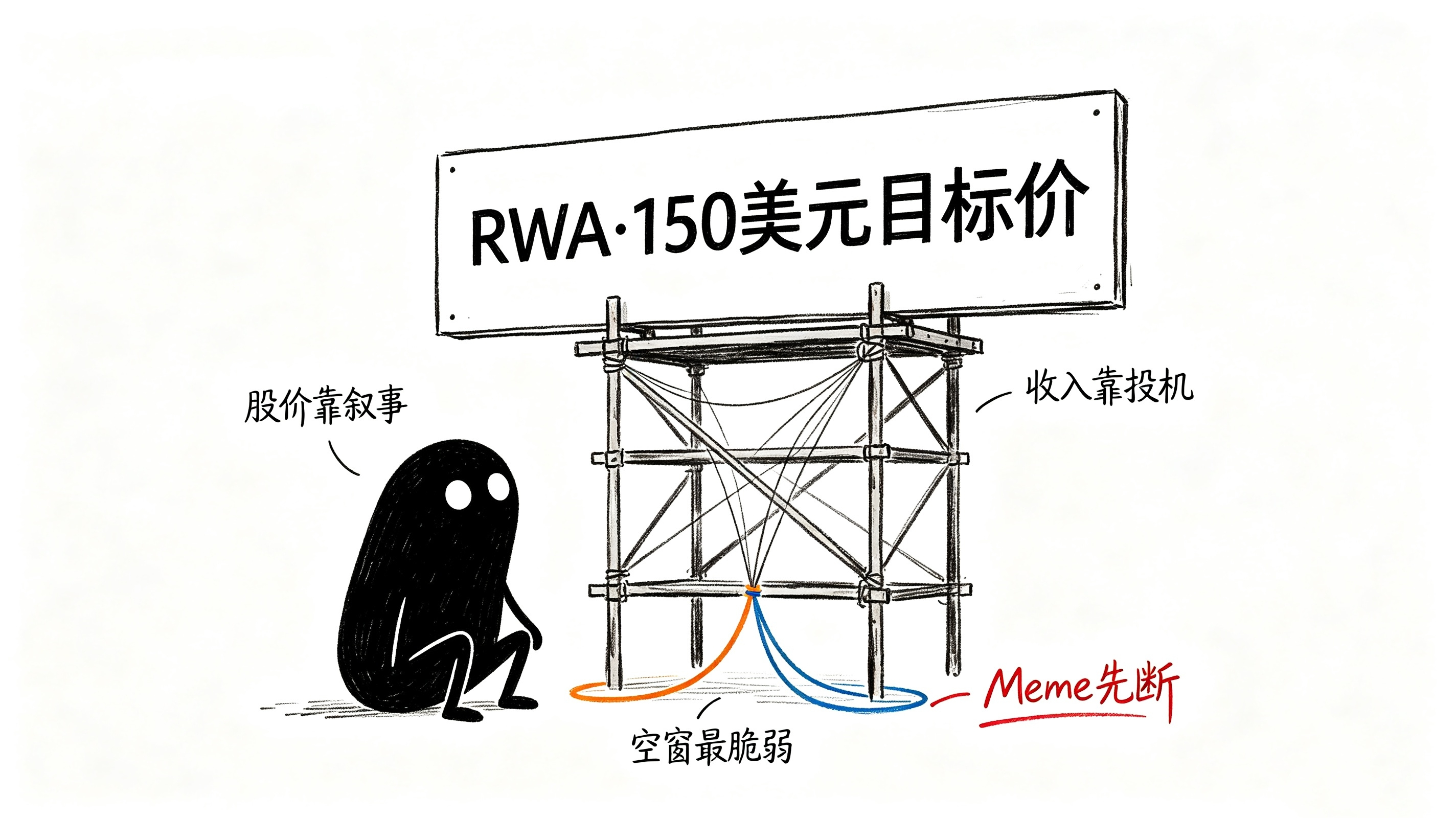
But the actual revenue structure is this: Meme makes up almost everything. RWA props up a story.
There’s a dangerous mismatch here: the stock price rises driven by narrative, while the price of the narrative can be translated from the future; on-chain revenue is driven by speculation, and speculative revenue can evaporate at any moment. When these two forces are tied together, the market may believe for a while that “Meme’s money can fund the RWA dream.” But Meme’s cycle is far shorter than the RWA construction cycle.
The Meme retreat period will very likely come earlier than the time when RWA is implemented. The gap in between is when the HOOD stock price is most fragile. By then, the market will ask again the question that was put aside: are you a broker or a casino? Is this financial infrastructure or a Meme-fee toll road?
The $1.3 million Arbitrum gets is silent collusion.
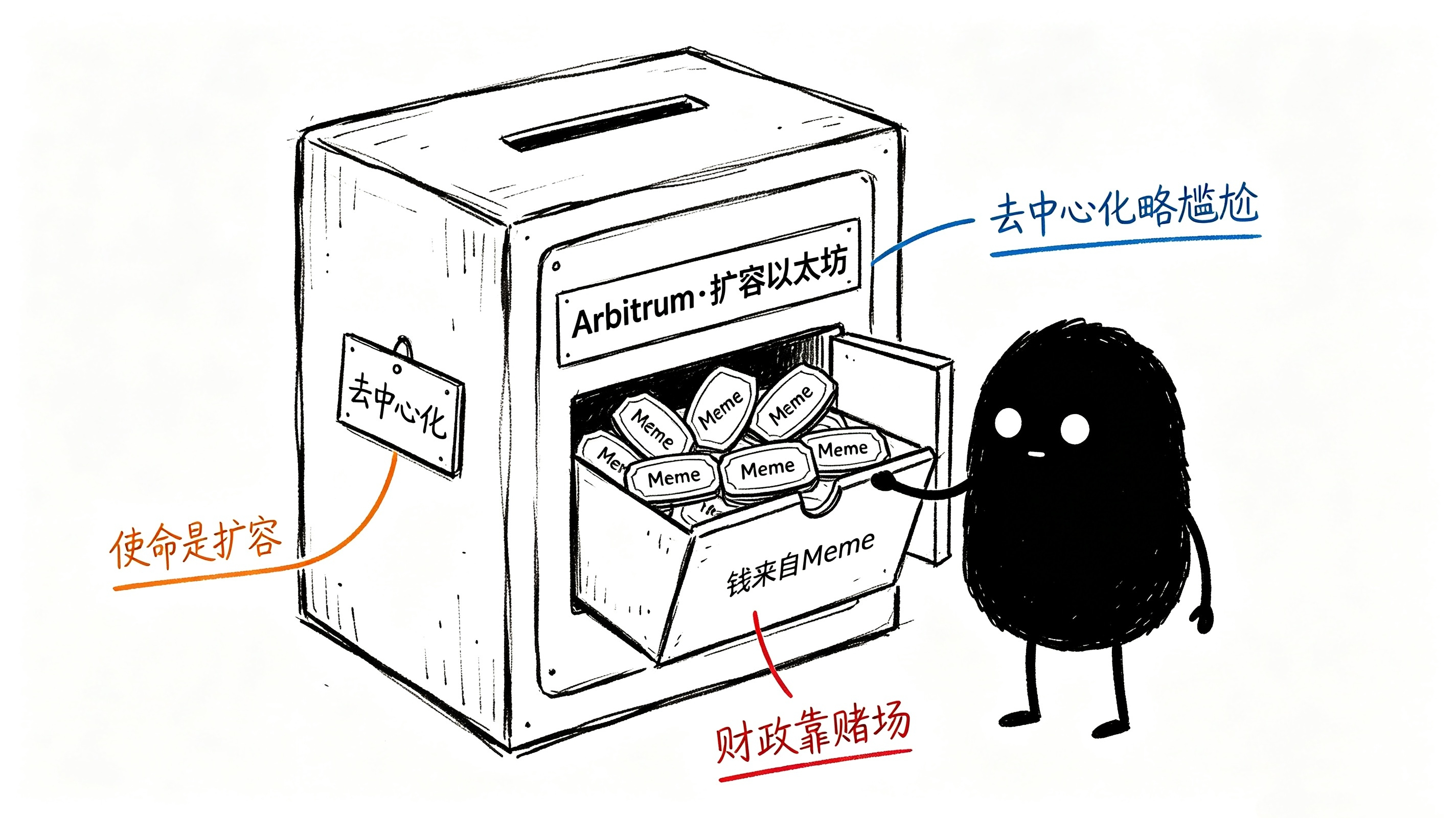
There’s one more detail in the material: Robinhood Chain returns 10% of its Chain income to the Arbitrum ecosystem, totaling about $1.3 million. ARB has risen 46.7% in two weeks.
This looks like a neutral fact of “the tech stack benefiting.” But go one layer deeper: Arbitrum’s DAO treasury is using income generated by memecoin speculation to replenish its fiscal reserves. A Layer 2 with a mission to “scale Ethereum” splits its revenue from a chain whose main cash flow is “Meme.”
This isn’t Arbitrum’s fault. It’s only natural for the tech stack to make money. But it reveals an ecosystem-level fact: in the crypto world of 2026, the most stable and sustainable source of revenue has shifted from “building infrastructure” to “providing a pipeline for speculation.” And when the infrastructure’s fiscal dependence relies on speculative hot money, the ecosystem’s “decentralization” narrative starts to feel a bit awkward.
The most sleep-inducing problem
What keeps you up most isn’t that Robinhood is up 16%, or the title of “No. 1 public chain.” It’s that the boundary between “revaluation of value” and “Meme lifting the sedan” has blurred to the point of being indistinguishable.
A company devoted to the mission of “financial democratization” currently has its most profitable business: enabling users to trade on-chain tokens that may be worth zero tomorrow. Its revenue comes from an activity that is, in essence, “cutting each other’s throats.” Wall Street repackages this revenue with the language of “platform expansion,” turning it into a rating report, into a target price, into fuel for the stock price.
How long can “harvesting” last? When Meme heat fades and on-chain revenue drops from $4.01 million back to $400,000, what words will the analysts who set a $150 target price use to explain it? They probably won’t explain. They’ll just quietly lower ratings, just as they did when they upgraded—using a respectable term to package “Meme retreat” as “growth normalization.”
And retail traders—losing money on-chain in fees, chasing higher prices in stocks—become, in the analysts’ mouths, an epilogue of “digital asset engagement.” They participated end-to-end in this story, yet they were never told: that $4 million daily first place is their loss—dressed in a suit and walking into a Morgan Stanley report.