
I will not take sides with Hu Xijin, nor with Jing Tian. Instead, I will break down the core arguments that Sun Yuchen has publicly expressed and respond to them one by one. At the same time, I will distinguish between confirmed facts, the parties’ one-sided claims, what the media reports, and speculation on X, so as to avoid treating viral online content as facts.
What Sun Yuchen truly lost is not the RMB 30 million betrothal gifts, but the way he himself defined this “war.”
On August 27, 2026, Sun Yuchen suddenly posted a long article on X (“My girlfriend, Jing Tian”).
This article quickly became one of the most controversial private-relationship events in the Chinese internet.
According to publicly available information from Sun Yuchen’s side, he has already sued Jing Tian and her parents, demanding the return of more than RMB 30 million. His attorney said the money is “betrothal gifts” paid for the purpose of marriage. The case has been filed, and he has applied for property preservation; however, Jing Tian’s side has raised an objection to jurisdiction. As the case has not yet entered the merits of the trial and there is no final ruling, it remains undecided.
At the same time, Sun Yuchen published a long article of several thousand characters, detailing the process from acquaintance, dating, talking about marriage, to the breakdown of the relationship.
What truly triggered the huge controversy was not “whether the 30 million should be repaid.”
Rather:
Since you have already handed the case to the court, why turn a property dispute into a public narrative war against an ex-partner?
Hu Xijin then published several consecutive posts criticizing Sun Yuchen, believing that his core problem was not “whether to recover bride price,” but bringing a large amount of his ex’s private information into the public opinion arena.
Sun Yuchen, meanwhile, responded on X, further elevating the issue to larger social themes such as bride price, men’s marriage costs, childbirth responsibilities, young people’s marriage difficulties, and even “algorithms and human feelings.”
This response is very clever.
But being smart does not mean it stands.
On the contrary, if one breaks Sun Yuchen’s view down line by line, one will find:
The place where he truly makes sense is precisely the one he did not need such a long article to prove; and the question he most needed to answer has never been answered head-on.
One, the first layer of controversy: is the 30 million really “bride price”?
First, the conclusion:
Of course Sun Yuchen has the right to recover money he believes should be returned through legal procedures.
Even Hu Xijin did not deny this point.
The current Supreme People’s Court judicial interpretation on bride price clearly provides that where bride price is given for the purpose of marriage according to custom and a return dispute arises, it can be handled according to law; if both sides did not register the marriage, that is also an important circumstance for judicial review.
But the key is:
“I paid 30 million” ≠ “this 30 million is legally and necessarily bride price” ≠ “the other party must return it in full.”
These three concepts must be separated.
The Supreme Court stipulates that the court needs to comprehensively consider factors such as the purpose, time, method, value, local customs, and the giver and receiver when determining the scope of bride price. For situations where the marriage was not registered but the couple already lived together, it is not simply a blunt “full return in all cases”; instead, the court must judge whether return is required and in what proportion based on cohabitation, actual use, pregnancy/childbearing, the fault of both sides, and other factors.
So if Sun Yuchen believes:
I paid 30 million for marriage, and now we didn’t get married, so it should be returned.
Absolutely yes.
This falls under a normal judicial claim.
But the problem is that his expressions in the public sphere easily create another illusion:
“We didn’t get married, so the 30 million should of course be returned.”
This conclusion is not that simple.
Because the law is not dealing with “who looks more wronged,” but rather:
What exactly is this money in nature? Why was it given? To whom was it given? How was it given? Did the two sides already live together? Were there other property arrangements? What exactly is the evidence?
These should ultimately all be left to the court.
So on this point, I instead think the most important thing Sun Yuchen should do is very simple:
Submit transfer records, agreements, chat records, the purpose of payment, and the parties’ agreements to the court.
Rather than handing it over to netizens.
Two, the second layer of controversy: did Hu Xijin really deny Sun Yuchen’s right to recover bride price?
No.
This is precisely the easiest place for a “straw man” to appear in Sun Yuchen’s response.
Hu Xijin’s later response was very clear:
If the man and woman did not marry, and the man requests return of the bride price, that is valid in most cases.
He even said directly:
“So if you sue over this, there will be no criticism.”
This sentence is very important.
Because it means:
What Hu Xijin was truly criticizing was not Sun Yuchen’s lawsuit.
Rather:
You have already sued, so why do you still write the privacy of your ex-girlfriend into a long public article?
Hu Xijin’s original critical core has always been here as well: the lawsuit is the lawsuit, exposing privacy is another matter.
So if Sun Yuchen answers:
“Do men have the right to recover bride price after a breakup?”
It actually did not really hit the core issue Hu Xijin raised.
Because the answer has always been:
There might be.
The real question is:
Does the right to recover bride price also include the right to publicly expose an ex-partner’s private life?
This is the real target of the whole controversy.
Three, the third layer of controversy: if one has the right to protect one’s rights, does one also have the right to expose privacy?
This is the question Sun Yuchen’s entire argument system most needs to answer, yet it is also the hardest to answer.
China’s Civil Code provisions on privacy rights are very clear:
Natural persons enjoy privacy rights, and no organization or individual may infringe upon others’ privacy rights by means of spying on, intruding on, leaking, or publicly disclosing them.
And the scope of legal protection includes private life tranquility, private spaces, private activities, and private information.
For personal information processing, it also requires adherence to the principles of legality, propriety, and necessity.
Therefore, the issue has never been:
“Does Sun Yuchen have the right to tell his own story?”
Of course there are.
He could very well say:
I once dated a certain Ms.
We discussed marriage.
I paid the other party 30 million yuan.
The two sides later did not marry.
I believe this money should be returned, so I have already filed a lawsuit.
These are all expressions around one’s own rights.
But if a large amount of private details about their relationship, life details, bodily-related information, private relationships, specific scenes, and so on are further put before the public, then the nature begins to change.
Because:
“Talking about your own experience” and “publicly exposing another person’s private life” are not the same thing.
This is also why even if Sun Yuchen ultimately wins the 30 million lawsuit, it still cannot automatically lead to:
“So everything I disclosed publicly back then was reasonable.”
These two questions are fundamentally not the same legal issue.
Four, the fourth layer of controversy: “I’m just telling my own story” — why is there still a problem?
This is a very elegant move in Sun Yuchen’s narrative.
Turning a real dispute into a literary work.
And the article even adds a sentence at the end:
“This article is purely fictional; any resemblance is purely coincidental.”
And that’s where the problem arises.
If it really is pure literary creation, then of course there is creative freedom.
But if the article’s characters, relationships, and events highly correspond to the real dispute, and on the same day a lawyer also confirms a lawsuit of more than 30 million yuan against the relevant real people, then the public will naturally ask:
Is this a novel, or reality dispute expressed in novel form?
Current media reports show that Sun Yuchen’s article and the real lawsuit overlapped heavily in time; his lawyer confirmed on the same day that he had sued Jing Tian and her parents.
More importantly, Sun Yuchen later explained that “fictional” did not mean all the content was false, but that every detail could not be guaranteed to be 100% accurate.
If this claim is true, then the issue is actually even more complicated:
Since you yourself admitted that the article corresponds to reality, then “purely fictional” is hard to become a universal get-out-of-jail-free card.
The law will not simply look only at the last eight characters of the article.
In the end, one still has to look at the specific content, the target, the means of dissemination, whether harm was caused, and whether there is a lawful and reasonable basis.
In other words:
“This is a literary work” is not an automatic exemption clause for privacy-right issues.
Five, the fifth layer of controversy: does Sun Yuchen’s elevation of a personal dispute to “200 million men” stand?
This is, in my view, the smartest, and at the same time most worth warning about, step in Sun Yuchen’s public-opinion operation this time.
Because this step is very internet-savvy.
The original question was:
Sun Yuchen vs Jing Tian.
It suddenly became:
Do men have the right to recover bride price?
Then it continues to become:
Are Chinese men’s marriage costs really getting higher and higher?
Then it continues to become:
Who bears women’s childbirth costs?
In the end it even extends to:
What exactly went wrong with young people’s marriage system?
These questions are all real.
And it is worth discussing.
But:
A question being real does not mean the person raising it automatically has moral correctness.
It is like an entrepreneur who has a contract dispute with a partner, and then stands up to discuss “why Chinese entrepreneurs are always deceived by their partners.”
You can discuss this issue.
But others can still ask:
Why did you post all of your private chat records with your partner?
The two issues can absolutely both be true at the same time.
Six: There is a huge gulf between “men have the right to recover bride price” and “men have the right to publicly expose an ex’s privacy”
This is the most core point of the whole incident.
Sun Yuchen is actually making a logical leap:
First step:
I paid the money.
Second step:
We were not married.
Third step:
So I have the right to recover it.
This logic can basically go to court.
But the fourth step:
Because the other party did not return it, I have the right to tell the whole internet about our private relationship.
Here it suddenly breaks off.
Because:
Property rights ≠ privacy rights.
Right to protect one’s rights ≠ right to judge public opinion.
Right to sue ≠ right to punish on the internet.
Freedom of expression ≠ freedom to infinitely disclose other people’s private lives.
This is the problem Sun Yuchen has never truly solved.
Seven, the sixth layer of controversy: Sun Yuchen says he is “speaking for men,” is that really the case?
I have very strong doubts about this.
It is not to say he cannot talk about men’s rights.
Rather:
There are only two concrete parties to this matter from beginning to end.
One is Sun Yuchen.
One is Jing Tian.
Why did it suddenly become a problem for “all Chinese men”?
Because from the perspective of communication studies, this is an extremely clever issue escalation.
“A billionaire recovering 30 million” is hard to trigger emotional resonance among ordinary men.
But:
“A man works hard to earn money—can the bride price still be recovered in the end?”
Then it immediately becomes different.
Because it connects to ordinary people’s marriage anxiety.
This is the “generalization” of the issue.
After a private dispute is packaged as a public issue, Sun Yuchen’s identity changes:
From:
A party currently in litigation
It becomes:
A person speaking up on behalf of men.
This would greatly change the position of public opinion.
But the problem still remains:
If you are really discussing men’s rights, then why must so much private information about your ex be used as evidence?
Men’s rights can also be discussed completely apart from Jing Tian.
The bride price system can be discussed completely apart from Jing Tian.
Childbirth costs can also be discussed completely apart from Jing Tian.
The marriage system can also be discussed completely apart from Jing Tian.
So stuffing all these grand issues into this specific dispute actually does not automatically prove that his behavior is reasonable.
Eight, the seventh layer of controversy: Sun Yuchen says “I was wronged; is it endurance or rights protection?”
The question itself is not wrong.
Of course one should protect one’s rights.
But it creates a false either-or:
Not exposing privacy ≠ enduring it.
There is also a third path:
The court.
And Sun Yuchen in fact has already chosen this path.
The lawyer has already sued.
The case has already been filed.
Applied for property preservation.
Then from the perspective of rule of law, this is actually the most normal path to resolution.
The Supreme People’s Court has already established relatively clear adjudication rules regarding bride-price disputes.
Therefore, what is truly worth asking is:
Since the court has already begun handling it, why is there still a need to establish a “public jury” outside the court?
The court judges evidence.
The internet judges by emotion.
The court requires both sides to present evidence.
The internet only needs one story.
The court finally delivers the judgment.
But the internet may complete a “social judgment” before the verdict.
This is precisely a problem all public figures should be vigilant about.
Nine, the eighth layer of controversy: Sun Yuchen says “I’m just expressing my own views” — is that really just expression?
Here we must distinguish:
The content of the expression.
And
The way it is expressed.
If Sun Yuchen were to post:
“I once dated a certain Ms., and during the period when we were talking about marriage I paid 30 million yuan to the other party’s family. The two sides later broke up. I believe this money counts as bride price, so I have already filed a lawsuit according to law and hope the court will make a fair judgment.”
This is a very standard expression.
But if the expression is further expanded into a large number of private stories, details, and highly dramatic plots, then the social effect it produces is no longer just:
“Tell everyone I am in litigation.”
And it becomes:
“Tell everyone how I hope they understand this person.”
This is the key difference.
A person says:
“I sued him.”
And to a person saying:
“I sued him, and I want to tell the whole world what he is like in private.”
These are completely two different things.
Ten, the ninth layer of controversy: why did Zhao Changpeng’s attitude become worth noting instead?
This point is very interesting.
Zhao Changpeng is not Hu Xijin.
He is an insider in the crypto industry.
Therefore, his attitude has a different meaning in this controversy.
The publicly circulated information currently shows that Zhao Changpeng’s core view is also:
Marketing can be aggressive, but there is no need to escalate it to personal attacks, and it should not harm another person’s professional development; if there is a dispute, one should go straight to court.
Sun Yuchen later responded, acknowledging this point. Related content was also widely paraphrased by domestic media.
Why is this point worth paying attention to?
Because this is not “traditional media criticizing the crypto circle.”
Rather:
People in the crypto circle were also reminding: marketing and hurting others are two different things.
This actually touches on the most core issue of Sun Yuchen’s business persona:
His advantage is extremely strong dissemination capability.
But the stronger the dissemination power, the greater the responsibility.
An ordinary person posts a WeChat Moments post and maybe only a few hundred people see it.
A billionaire with huge international social-media influence posting can instantly generate global dissemination.
Therefore:
Ordinary people’s emotional venting and a super public figure’s public-opinion attack cannot be judged by exactly the same standard.
Eleven, the tenth layer of controversy: why did public opinion eventually start to backfire on Sun Yuchen this time?
Because Sun Yuchen made the easiest mistake for a dissemination expert to make:
He successfully controlled the first act, but he did not control the second.
Act One:
Sun Yuchen tells his own story.
Public opinion began discussing Jing Tian.
Act Two:
Hu Xijin shows up.
Everyone began discussing privacy.
Act Three:
Sun Yuchen responding to Hu Xijin.
Everyone began discussing men, bride price, marriage, and childbirth.
Act Four:
Zhao Changpeng, other crypto figures, media people, and netizens began discussing Sun Yuchen himself again.
Then something very bizarre happened:
Sun Yuchen originally wanted the public to scrutinize Jing Tian, but in the end the public began to scrutinize Sun Yuchen.
This is the most dangerous thing about the internet.
You can decide what you post.
But you cannot decide what others discuss.
Twelve, the so-called “marketing expert” biggest mistake is treating traffic as victory
Sun Yuchen is obviously very good at traffic.
There is almost no controversy about this point.
His entire career has placed great emphasis on:
topics;
celebrities;
hot topics;
controversies;
social media;
public opinion;
personal IP.
But traffic has one most basic rule:
Traffic has no direction.
You may create 10 million exposures, but that does not mean 10 million people understand it according to your script.
You can create discussion.
But he cannot control the conclusion.
It could even be said:
The bigger a story spreads, the easier it is to slip out of the author’s control.
This time is a very typical example.
Sun Yuchen’s original narrative is:
I loved deeply for many years.
I paid a lot.
I seriously talk about marriage and future plans.
I paid 30 million.
But in the end, no marriage was obtained.
But what netizens finally end up discussing becomes:
Why expose an ex’s privacy?
Why write a private dispute as a long article?
Why package it as “fiction”?
Why elevate a personal issue to the level of men as a group?
Why let the internet participate in private disputes?
This is not a loss of control of public opinion.
It is not:
Public opinion operated according to its own logic.
Thirteen, there is another very important issue: Sun Yuchen could actually win the lawsuit, yet still lose public opinion
This must be made clear.
Winning in court and winning in public opinion are completely different things.
Suppose the court ultimately finds that:
30 million yuan does indeed belong to bride price that should be returned.
Sun Yuchen wins the case.
This can only prove:
His property-rights claim received judicial support.
It cannot prove:
He was right to publicly expose his ex’s privacy.
The reverse is also true.
If the court ultimately does not support all of his claims, that also cannot automatically prove:
Jing Tian is the “marriage scammer.”
So the most rational approach is to completely separate the two issues:
Question one:
What exactly is 30 million yuan in nature?
The court resolves it.
Question two:
What exactly happened between the two sides?
Both sides submit evidence.
Question three:
Who should bear how much property responsibility?
Court judgment.
Question four:
Should private relationships be widely made public?
This is another independent ethical and legal issue.
Do not mix four things into one thing.
Fourteen, Hu Xijin actually was not completely without problems either
If one truly wants to “refute Sun Yuchen point by point,” one cannot, simply because one criticizes Sun Yuchen, automatically turn Hu Xijin into a saint.
Some of Hu Xijin’s wording is actually clearly weighted.
For example, expressions like “bringing shame to Chinese men,” “disfigurement,” or “turning off the lights for Jing Tian’s future” all carry strong value judgments and dissemination color.
Especially:
Elevating a personal dispute to the level of “Chinese men” may itself further intensify gender antagonism.
If Sun Yuchen can seize this point to counterattack, there is room.
And Hu Xijin’s later mention of political and identity-level expressions such as “returning to Beijing” further pushed a private ethical issue into a more complicated public context.
This is not the best way to discuss it.
So my judgment is not:
Everything Hu Xijin said is correct.
Rather:
The core issue Hu Xijin seized is more accurate than the issue Sun Yuchen responded to.
These two sentences can completely be true at the same time.
Fifteen, voices on X have in fact already shown obvious division
The current discussion on X and the Chinese internet is not “one-sided.”
Some people clearly support Sun Yuchen, believing:
Since the man paid a huge bride price, he has the right to recover it;
Women cannot both enjoy huge marriage benefits and then refuse to bear the consequences after a breakup;
Chinese men really do face increasingly high marriage costs;
At least Sun Yuchen dares to make the issue public.
Some also believe:
Whether bride price can be recovered should be judged by the court;
30 million yuan and the average person’s bride price are completely not the same thing;
Sun Yuchen has huge wealth and huge dissemination power; he should not turn a private dispute into an online trial;
Publicly exposing an ex’s private life has no necessary connection to recovering property.
Even within the crypto circle, voices criticizing Sun Yuchen’s approach emerged. When related X content was organized and spread by domestic media, Zhao Changpeng’s view in particular drew attention.
This shows one fact:
This is no longer a simple “men vs. women” confrontation.
It actually formed at least four camps:
People who support men recovering bride price;
People who oppose exposing women’s privacy;
People who are just watching for the drama;
People who use the incident to reassess Sun Yuchen’s business persona.
These four types of people are often mixed together.
In fact, it is completely not the same thing.
Sixteen, what is most worth警惕: do not let “bride price” become a shield for privacy infringement
This is my most core judgment on the entire incident.
Chinese society does indeed have a serious marriage-cost problem.
The bride-price issue is indeed worth discussing.
In recent years, the Supreme People’s Court has even issued special judicial interpretations to further specify bride-price identification, return ratios, and cohabitation issues, because bride-price disputes in reality have become increasingly complex.
Therefore:
Discussing bride price is not a problem.
Men discussing marriage costs is not a problem.
A man requesting the return of lawful property is not a problem.
Women discussing childbirth costs is also not a problem.
Discussing the marriage system is also not a problem.
But:
These public issues cannot become a pass to publicly disclose specific private information about a person.
Otherwise, any couple who breaks up in the future could do this:
I am discussing men’s rights.
I am discussing women’s rights.
I am discussing the marriage system.
I am discussing bride price.
I am discussing childbirth.
So I’m going to publicize my ex’s private life completely.
If this logic stands, the internet will completely become a trial ground for private relationships.
This is a very dangerous direction.
Seventeen, the five questions Sun Yuchen actually should answer
If I were Sun Yuchen’s counterpart, I would not even continue discussing with him whether “men should recover bride price.”
Because this question is too easy to answer.
I only ask him five questions:
First:
Since you have already sued, why can’t the court decide?
Second:
Why must private details unrelated to the 30 million yuan lawsuit be made public?
Third:
If the goal is to recover 30 million yuan, why is a several-thousand-word emotional narrative needed?
Fourth:
If the article is really purely fictional, then why does it highly correspond to real people and real litigation?
Fifth:
If most of the article’s content is also factual narration, then what problem is the disclaimer “purely fictional” actually supposed to solve?
As long as these five questions are not clearly answered, continuing to discuss “whether men are qualified to recover bride price” is actually just avoiding the core.
Eighteen, Sun Yuchen’s biggest misjudgment this time: thinking he was facing a “public-opinion war”
In fact, he is facing three battlefields.
The first battlefield: law
Whether the 30 million yuan is bride price or not.
This battlefield is very simple:
Evidence speaks.
The second battlefield: morality
Whether it is appropriate to publicly expose an ex-partner’s privacy.
This battlefield is not as simple as a court judgment.
But the public will have its own judgment.
The third battlefield: dissemination
Who can define the story?
This is Sun Yuchen’s strongest battlefield.
But this time, it just so happens to be the battlefield where he is most likely to lose control.
Because when Hu Xijin, Zhao Changpeng, media people, and a large number of X users entered the discussion, Sun Yuchen could no longer monopolize narrative power.
Nineteen, the most absurd thing about this matter is that a 30 million yuan lawsuit eventually turned into “who is better at writing long posts”
Originally very simple:
Two people are dating.
Talking about marriage and future plans.
Huge property transfers occurred.
Later, they broke up.
One side requests return.
The other side does not accept it.
Court proceedings.
This was originally a very standard civil dispute.
After being processed by the internet, it became:
Bride price issue;
men’s issues;
women’s issues;
Marriage issues;
Childbirth issues;
privacy issues;
A crypto-circle issue;
personal credibility issues;
media issues;
Even identity and national issues.
In the end, even a nail clipper became an internet meme.
This actually already shows:
Once a private dispute enters a super-traffic arena, it is very hard to return to the private dispute itself.
Twenty, so I do not think Sun Yuchen lost on the “30 million”
Quite the contrary.
If his evidence is sufficient, if legally it really is bride price that should be returned, then:
He absolutely should take it back.
30 million yuan is not a small amount.
No one has any reason, just because the other party is a celebrity, a woman, or a public figure, to automatically lose the right to recover property according to law.
This point should be firmly supported.
But equally:
No one can automatically obtain unlimited rights to expose another person’s private life just because they are the one who paid, a man, a billionaire, or a public figure.
This is also a bottom line that must be firmly upheld.
Final conclusion: what Sun Yuchen really should “turn off” is not Jing Tian’s future, but his own public-opinion script
As this storm has developed to the present, I instead think Hu Xijin said one sentence very accurately:
The lawsuit can be filed.
This is the first layer.
Opinions can be expressed.
This is the second layer.
But:
Do not turn a property lawsuit into a “privacy collection” of an ex.
This is the third layer.
And Sun Yuchen’s greatest cleverness, and also his greatest mistake, is that he understands too well how to package a specific event into a grand issue.
He turned “Should I recover the 30 million?” into:
Do men have dignity?
Then it becomes:
Do men have rights in love and marriage?
It then became:
Why don’t young people want to get married?
Then it becomes:
Who should bear childbirth costs?
These questions are one more grand than the last.
But grand issues cannot replace concrete issues.
Men can talk about bride price, but bride price cannot serve as a backstop for privacy.
Men can protect their rights, but protecting rights does not automatically grant the power to judge public opinion.
Sun Yuchen can sue, but suing does not automatically authorize him to publicly expose everything about his ex.
Sun Yuchen can tell his own story, but telling his own story cannot mean another person’s private life automatically becomes public property.
And for Jing Tian, she should also accept a basic principle:
If the 30 million yuan really is bride price that should be returned according to law, then the corresponding property responsibility should be borne according to law.
This is the real fairness.
It is not “men are always right.”
Nor is it “women are always right.”
It is not:
Let the court resolve what should be resolved by the court; let the public discuss what should be discussed by the public; protect the privacy that should be protected; bear the responsibility that should be borne.
If the court ultimately rules that Sun Yuchen wins, he should get back the money that belongs to him.
If the court rules that his claim cannot be fully upheld, he should also accept the result.
And what this public-opinion war should truly leave behind should not be “did Sun Yuchen win or did Jing Tian win,” and even less should it turn into another round of men and women insulting each other.
The only question truly worth leaving behind is this:
In an era where anyone can have enormous dissemination power, how much right does one person have to turn another person’s private life into public content?
This issue is far more important than 30 million yuan.
Because 30 million yuan can ultimately be sorted out by the court.
Once privacy is made public, it is very hard to take back.
Source note: The case developments cited in this article are based on currently public reports; as of now, publicly available information shows that this 30-plus million yuan dispute has been filed, but has not yet entered substantive trial and there is no final judgment, so the article does not treat any statement by either Sun Yuchen or Jing Tian that has not yet been confirmed by the judiciary as fact. The declaration by Sun Yuchen’s article that it is “purely fictional,” and its correspondence with real events, is also part of the current public controversy and cannot be directly regarded as a judicial finding. The relevant legal analysis mainly relies on the Supreme People’s Court’s current rules on bride-price disputes and the privacy-right provisions of the Civil Code.
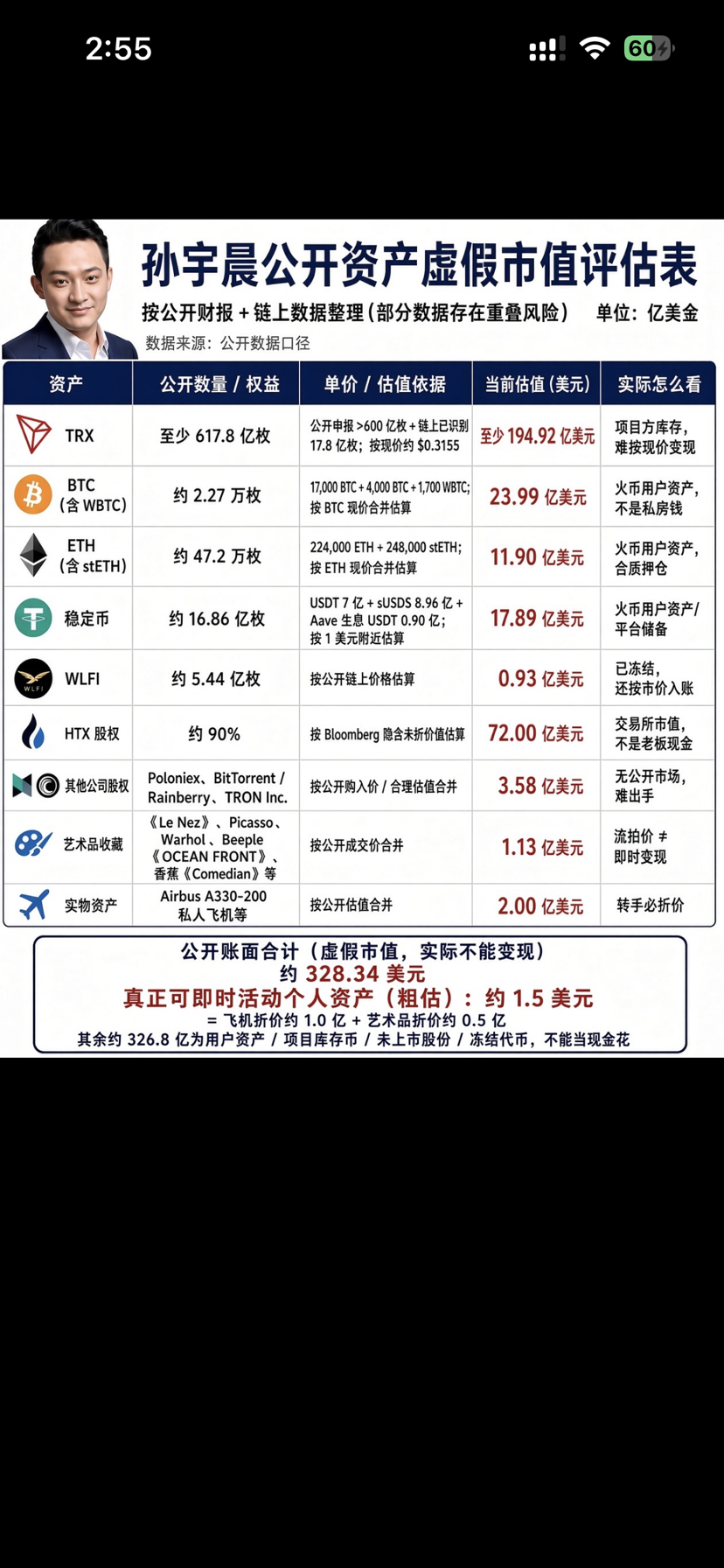
(ps: no wonder he claims to be worth 6.5 billion USD yet won’t give 50 million USD; turns out it was also packaged. In reality, the immediately available funds are only 150 million USD. Asking him for 50 million USD would be asking for his life!!!)