💥 LET'S UNRAVEL THIS $ADA : WHAT IS IT REALLY? 💥
So, folks! All good? 🚀
You know when you look up $ADA and all you find is that sea of numbers—Market Cap, 24h Volume, Billions in capitalization...? Honestly, for 99% of people, knowing whether the project is “worth” 1 billion or 300 billion doesn’t help you understand what the coin is actually used for in the real world.
So let’s get straight to the point, no beating around the bush!
💡 WHAT’S THE DIFFERENCE BETWEEN CARDANO AND ADA?
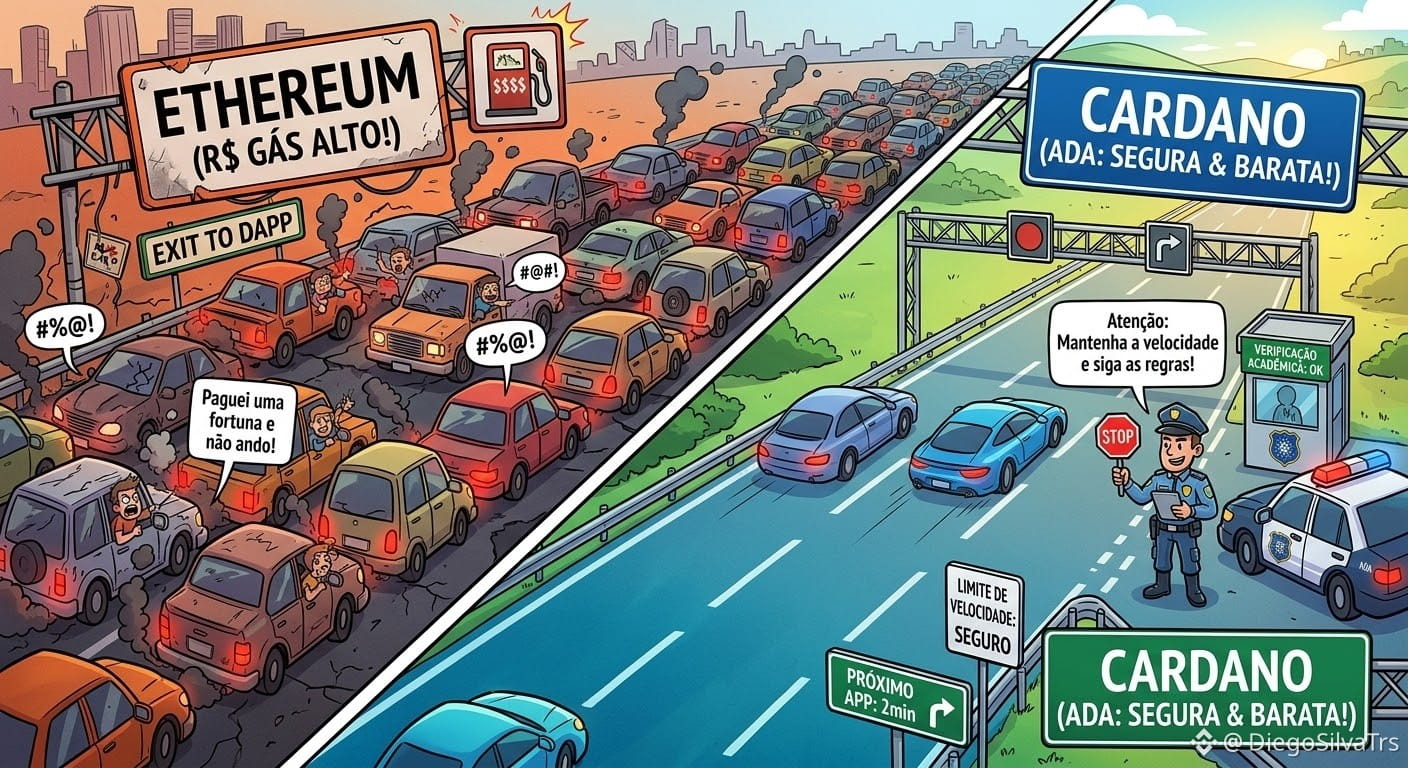
Think of Cardano like the highway or the operating system (like the Android on your phone). And $ADA is the fuel or the coin that runs inside it—you use it to pay transfer fees and to move the projects forward.
🤔 BUT WHY ARE THERE SO MANY NETWORKS? ISN’T IT ALL THE SAME?
That’s the golden question! Today, the market has multiple networks (Ethereum, Solana, Cardano...) and each one made different choices:
🌐 Ethereum ($ETH): It’s the oldest smart-contract platform and the most widely used. Since lots of people use it, it gets congested and charges very expensive fees. It’s like that main road in the city at rush hour.
⚡ Cardano ($ADA ): It was created as an alternative to fix that. Its focus isn’t to be the fastest at any cost, but to be the safest, most predictable, and with low fees.
Simple example: On Ethereum, if a transaction fails, you can lose the gas fee anyway. On Cardano, if the transaction doesn’t go through, you don’t lose your fee. Everything there is tested academically before it’s released.
💪 $ADA ’S STRONG POINTS
Security and Solidity: Built on scientific research and mathematics.
No surprises in fees: You know exactly how much you’ll pay before sending.
Loyal community: One of the most engaged audiences in the crypto market.
⚠️ WEAK POINTS
Slow development: Since they want to test everything 1,000 times, updates take longer to roll out.
Less commercial ecosystem: It still loses in volume of big applications when compared to Ethereum.
(MORE IN THE COMMENTS)
So, folks! All good? 🚀
You know when you look up $ADA and all you find is that sea of numbers—Market Cap, 24h Volume, Billions in capitalization...? Honestly, for 99% of people, knowing whether the project is “worth” 1 billion or 300 billion doesn’t help you understand what the coin is actually used for in the real world.
So let’s get straight to the point, no beating around the bush!
💡 WHAT’S THE DIFFERENCE BETWEEN CARDANO AND ADA?
Think of Cardano like the highway or the operating system (like the Android on your phone). And $ADA is the fuel or the coin that runs inside it—you use it to pay transfer fees and to move the projects forward.
🤔 BUT WHY ARE THERE SO MANY NETWORKS? ISN’T IT ALL THE SAME?
That’s the golden question! Today, the market has multiple networks (Ethereum, Solana, Cardano...) and each one made different choices:
🌐 Ethereum ($ETH): It’s the oldest smart-contract platform and the most widely used. Since lots of people use it, it gets congested and charges very expensive fees. It’s like that main road in the city at rush hour.
⚡ Cardano ($ADA ): It was created as an alternative to fix that. Its focus isn’t to be the fastest at any cost, but to be the safest, most predictable, and with low fees.
Simple example: On Ethereum, if a transaction fails, you can lose the gas fee anyway. On Cardano, if the transaction doesn’t go through, you don’t lose your fee. Everything there is tested academically before it’s released.
💪 $ADA ’S STRONG POINTS
Security and Solidity: Built on scientific research and mathematics.
No surprises in fees: You know exactly how much you’ll pay before sending.
Loyal community: One of the most engaged audiences in the crypto market.
⚠️ WEAK POINTS
Slow development: Since they want to test everything 1,000 times, updates take longer to roll out.
Less commercial ecosystem: It still loses in volume of big applications when compared to Ethereum.
(MORE IN THE COMMENTS)