
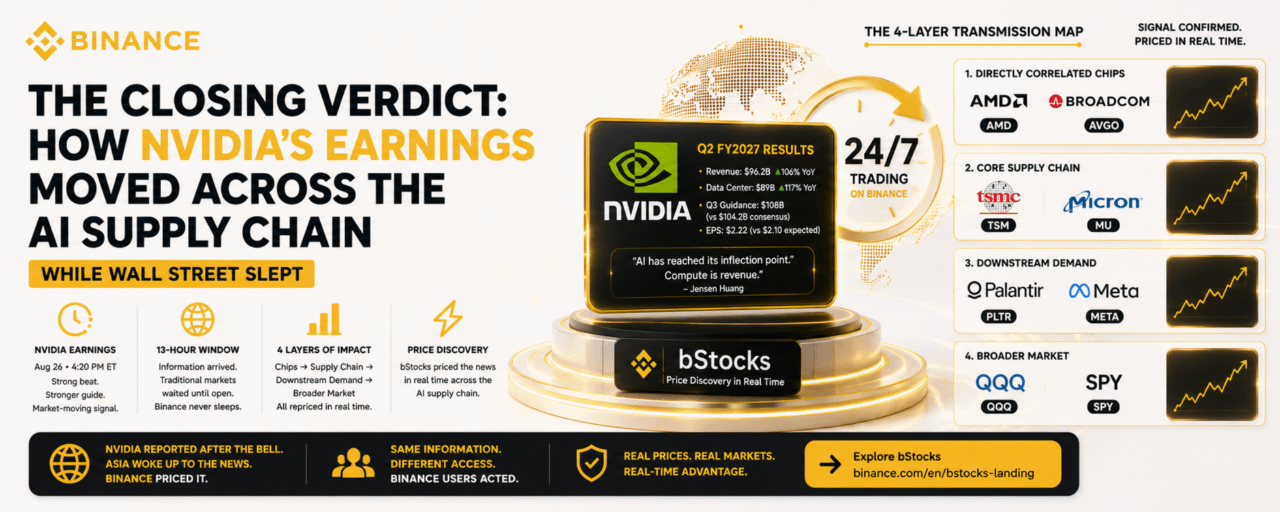

At 4:20 PM Eastern on August 26, Nvidia reported the numbers that AI earnings season had been building toward all summer.
Revenue: $96.2 billion. Up 106% year-over-year. Data Center: $89 billion, up 117%. Q3 guidance: $108 billion, ahead of the $104.2 billion consensus. EPS of $2.22 against $2.10 expected. Jensen Huang: "AI has reached its inflection point. Compute is revenue."
The print was unambiguous. Every number beat. The forward guide beat harder than the quarter just reported. NVDA stock jumped nearly 9% the following session, adding approximately $440 billion in market cap — the first post-earnings rally after four consecutive quarters of declines despite beats.
Wall Street saw that at the open on August 27. The rest of the world saw it in real time on Binance.
Why This Earnings Release Is a Binance Story
Nvidia reports after the U.S. market close. The numbers land at approximately 4:20 PM Eastern — which is 4:20 AM in Singapore, 6:20 AM in Sydney, 7:20 PM in London, and 11:20 PM in Dubai. Asian markets — the region most directly exposed to semiconductor supply chain dynamics — receive the information at the start of their trading day.
Traditional equity holders in every time zone except North America face the same structural problem: the information arrived. The market cannot respond until 9:30 AM Eastern the next morning. In the interim, the entire AI supply chain is unpriced — a 13-hour window where everyone knows the signal but nobody with access to the underlying equities can act on it through traditional channels.
Binance's bStocks — tokenized equities trading 24/7 on BNB Chain — close that window. Every asset in the AI supply chain that is available as a bStock begins repricing immediately as the Nvidia numbers are absorbed. The 13-hour gap shrinks to minutes.
The Four-Layer Transmission Map
The Nvidia earnings signal does not stay in NVDA. It propagates across four distinct layers of the AI supply chain, each with different transmission dynamics, all of which were available for live price discovery on Binance while traditional markets were shut.
Layer 1: Directly Correlated Chips (AMD, AVGO)
AMD and Broadcom are the most directly affected names outside Nvidia itself. A strong Nvidia result confirms the AI accelerator demand environment — and AMD competes in that same environment while Broadcom supplies custom silicon and networking to the same hyperscaler customers. Both names move directionally with Nvidia on a strong beat. In the hours after the August 26 release, bStock holders with AMD and AVGO exposure could reposition based on the confirmed demand signal rather than waiting for the next morning's open.
Layer 2: Core Supply Chain (TSM, MU)
Taiwan Semiconductor manufactures Nvidia's chips. Micron supplies the memory that sits alongside Nvidia's GPUs in data center configurations — a point Nvidia's CFO made explicit on the call, noting that memory scarcity is "being driven in large part by the AI buildout itself." A revenue beat and a strong forward guide confirm TSM's production ramp and signal continued HBM demand for Micron. These are not peripheral beneficiaries. They are direct suppliers whose order books are a function of Nvidia's forward revenue.
Layer 3: Downstream Demand (PLTR, META)
Palantir and Meta are on the demand side of the AI infrastructure equation. Palantir's AI platform revenue is directly tied to the availability and capability of the GPU infrastructure that Nvidia supplies. Meta is one of the hyperscalers driving the capex surge that Nvidia's data center revenue reflects — Q2 2026 combined hyperscaler capex reached $166 billion, up 87% year-over-year. A strong Nvidia result with a strong forward guide confirms that the hyperscaler AI investment thesis remains intact. META and PLTR holders receive confirmation of their own growth thesis in the hours after Nvidia's report.
Layer 4: The Broader Market (QQQ, SPY)
At the index level, Nvidia's market cap weighting in QQQ is large enough that a 9% post-earnings move is a material contributor to the index's performance. The signal from Nvidia's August 26 report was broadly positive for risk sentiment — AI infrastructure demand confirmed, forward guide above consensus, hyperscaler capex continuing to compound. The QQQ and SPY bStocks available on Binance reflected this risk-on signal in the hours after the report, while traditional index exposure remained frozen until the next morning.
What Binance Users Could Do That Traditional Holders Could Not
The 13-hour window between Nvidia's earnings release and the U.S. market open on August 27 was not dead time for Binance bStock holders. It was the most information-rich period of the quarter.
The full earnings report, the transcript of Jensen Huang's comments, the Q3 guidance, and the analyst reaction were all publicly available within an hour of the release. Any investor who read the materials and formed a view — on NVDA, on AMD, on TSM, on QQQ — had the information required to act.
Binance bStocks gave them the venue to act in. The same 24/7 infrastructure that has priced a median 92% of Monday opening gaps before U.S. markets opened across seven prior weekends was processing Nvidia's earnings transmission in real time. Each of the four supply chain layers was repricing based on the same information that traditional equity holders were reading — with the difference that bStock holders could express their view immediately rather than waiting for permission from the market's opening bell.
The Nvidia Q2 FY2027 report is the most significant single data point in AI earnings season. It landed in Asia's morning. Binance's 24/7 infrastructure was the venue where that signal became price.
👉 https://www.binance.com/en/bstocks-landing
Disclaimer: This article is for educational purposes only and does not constitute financial advice. All trading and investment activities involve risk. bStocks do not confer shareholder voting rights. Please conduct your own research before making any decisions.