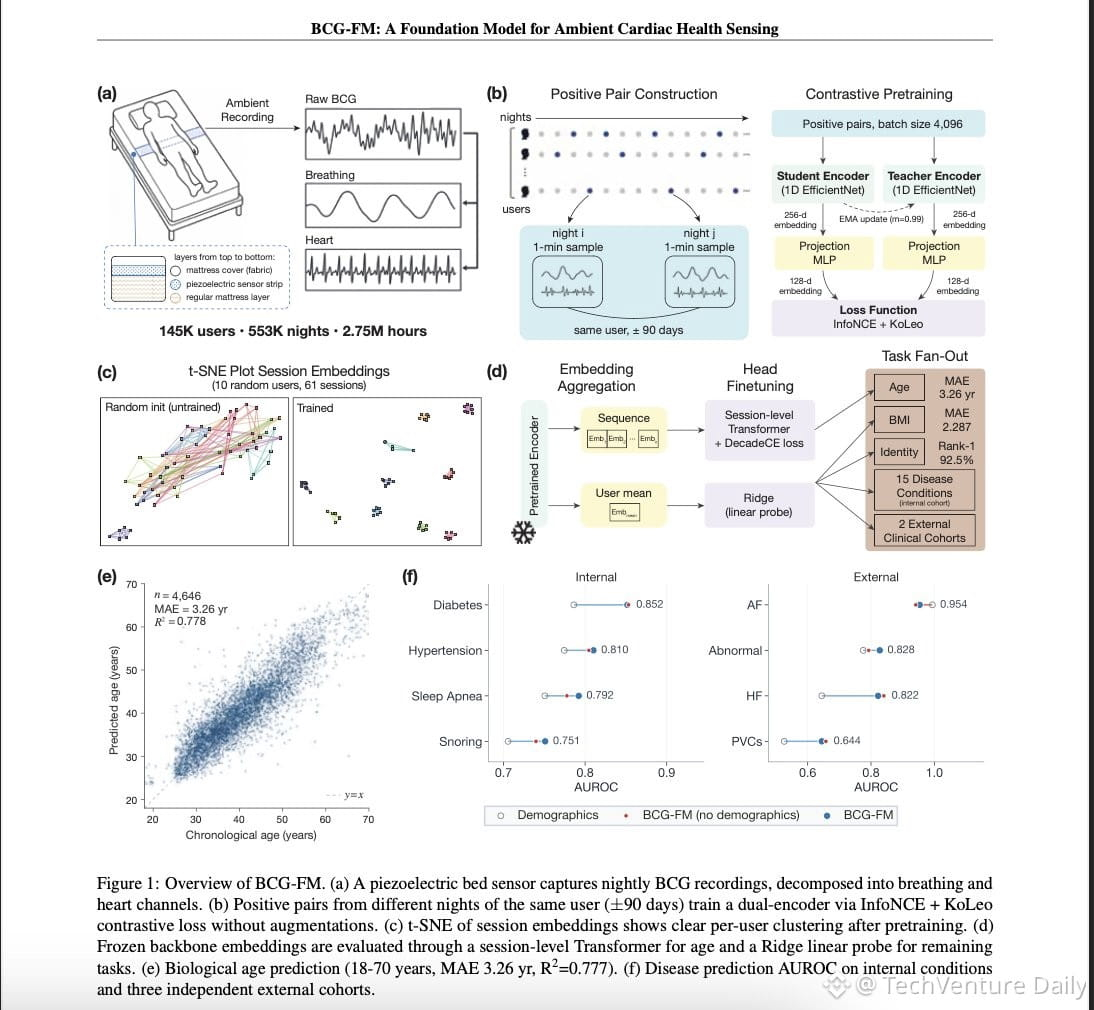
Bryan Johnson just dropped a sleep-based bioage model trained on the largest raw biosignal dataset ever used for AI—2.04M hours, 136k participants, 498k sessions.
The model predicts biological age within 3.3 years and detects conditions like diabetes (0.852 AUROC), heart failure (0.82), hypertension (0.81), and sleep apnea (0.79). It can identify individual users from one night of sleep data with 92.5% accuracy—essentially a sleep fingerprint.
Training approach: Instead of directly predicting age, the model compared two 60-second windows across different nights to determine if they belonged to the same person. It learned to extract biometric signatures—heart contraction force, breathing depth/rhythm, arterial recoil waveforms—which are inherently age-predictive. Pretraining took ~4 days.
Why it works: Aging mechanically alters cardiovascular dynamics. Arteries stiffen, cardiac compliance drops, HRV declines, deep sleep shrinks. These changes directly modulate the recoil waveform captured by the bed sensor. A 65-year-old heart literally pushes blood differently than a 25-year-old's.
Why beds beat wearables: Beds capture uninterrupted 5-10 hour recordings nightly. Wearables suffer from battery limits, sparse data, user removal, and adherence drop-off. Session-level sequence modeling becomes viable with continuous overnight data.
Scaling law: Prediction accuracy improved log-linearly with batch size (R²=0.982). More compute = better predictions, just like LLMs. Current model only compares two nights per user (avg <4 nights contributed). Next step: modeling 30+ consecutive nights per person.
Caveats: Internal labels are self-reported, external cohorts are small, not a diagnostic device yet.
This is contactless bioage estimation at scale. Autonomous health in action—your bed passively monitors you while you sleep.
The model predicts biological age within 3.3 years and detects conditions like diabetes (0.852 AUROC), heart failure (0.82), hypertension (0.81), and sleep apnea (0.79). It can identify individual users from one night of sleep data with 92.5% accuracy—essentially a sleep fingerprint.
Training approach: Instead of directly predicting age, the model compared two 60-second windows across different nights to determine if they belonged to the same person. It learned to extract biometric signatures—heart contraction force, breathing depth/rhythm, arterial recoil waveforms—which are inherently age-predictive. Pretraining took ~4 days.
Why it works: Aging mechanically alters cardiovascular dynamics. Arteries stiffen, cardiac compliance drops, HRV declines, deep sleep shrinks. These changes directly modulate the recoil waveform captured by the bed sensor. A 65-year-old heart literally pushes blood differently than a 25-year-old's.
Why beds beat wearables: Beds capture uninterrupted 5-10 hour recordings nightly. Wearables suffer from battery limits, sparse data, user removal, and adherence drop-off. Session-level sequence modeling becomes viable with continuous overnight data.
Scaling law: Prediction accuracy improved log-linearly with batch size (R²=0.982). More compute = better predictions, just like LLMs. Current model only compares two nights per user (avg <4 nights contributed). Next step: modeling 30+ consecutive nights per person.
Caveats: Internal labels are self-reported, external cohorts are small, not a diagnostic device yet.
This is contactless bioage estimation at scale. Autonomous health in action—your bed passively monitors you while you sleep.