


I sold $0G at about 0.4690 USDT.
And yes—that wasn't the top.
In the chart, it's clearly visible that after my sale the price kept falling for a while. So, in hindsight, it's very easy to say:
"You should have waited. You could have sold even higher."
But the market doesn't show the future candle.
At the time of the sale, I didn't know that #0G would eventually fall significantly lower.
Today the price is around 0.184 USDT.
And the average price at which I'm now rebuilding the position is around 0.1842.
It turns out to be a rather interesting situation.
I sold at 0.4690, and I'm rebuilding the position at about 60% cheaper.
And that's when it dawned on me:
why do we even consider only selling at the very top to be a good sale?
If the asset kept falling after you exited, you didn't need to guess the maximum price for the decision to turn out profitable.
Yes, I could have sold higher.
But I could have just not sold at all.
And then today I would be in a completely different situation.
That's why I now look at such trades a little differently.
A good exit is not necessarily a perfect exit.
Sometimes a good exit is simply the chance to wait out the further decline while being out of the position, and then re-enter much cheaper.
That's exactly what I'm doing with 0G right now.
I'm not trying to guess the exact bottom.
I'm not trying to prove that the price must definitely return upward.
I'm simply gradually rebuilding the position where the current price looks more attractive to me than the price at which I exited it.
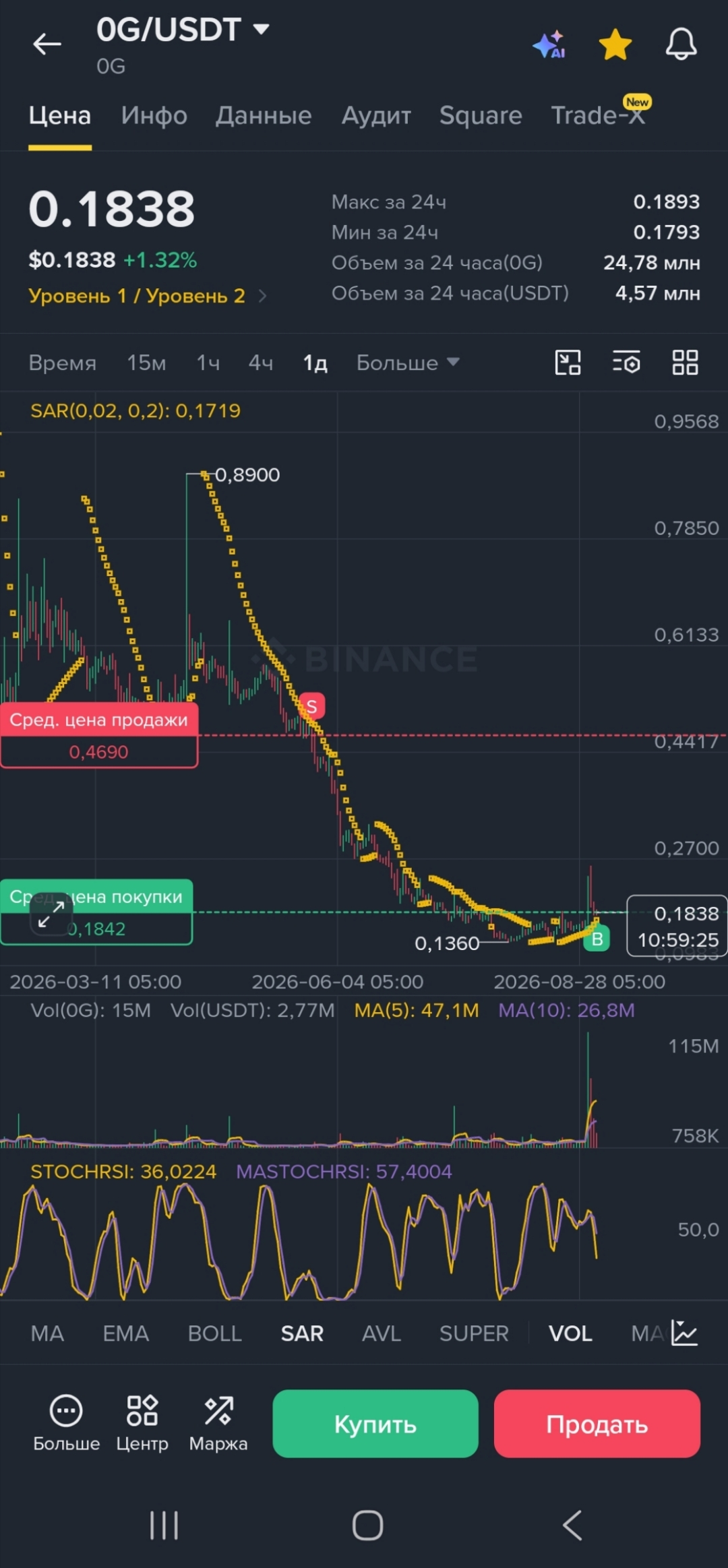
On the chart, everything seems obvious in hindsight.
But the decision has to be made when no one can yet see the future.
If you're interested in seeing where $0G is now and what the price movement looks like after this sell-off, open the chart and see for yourself.

Sometimes the chart really tells you more about a trade than any forecast.