


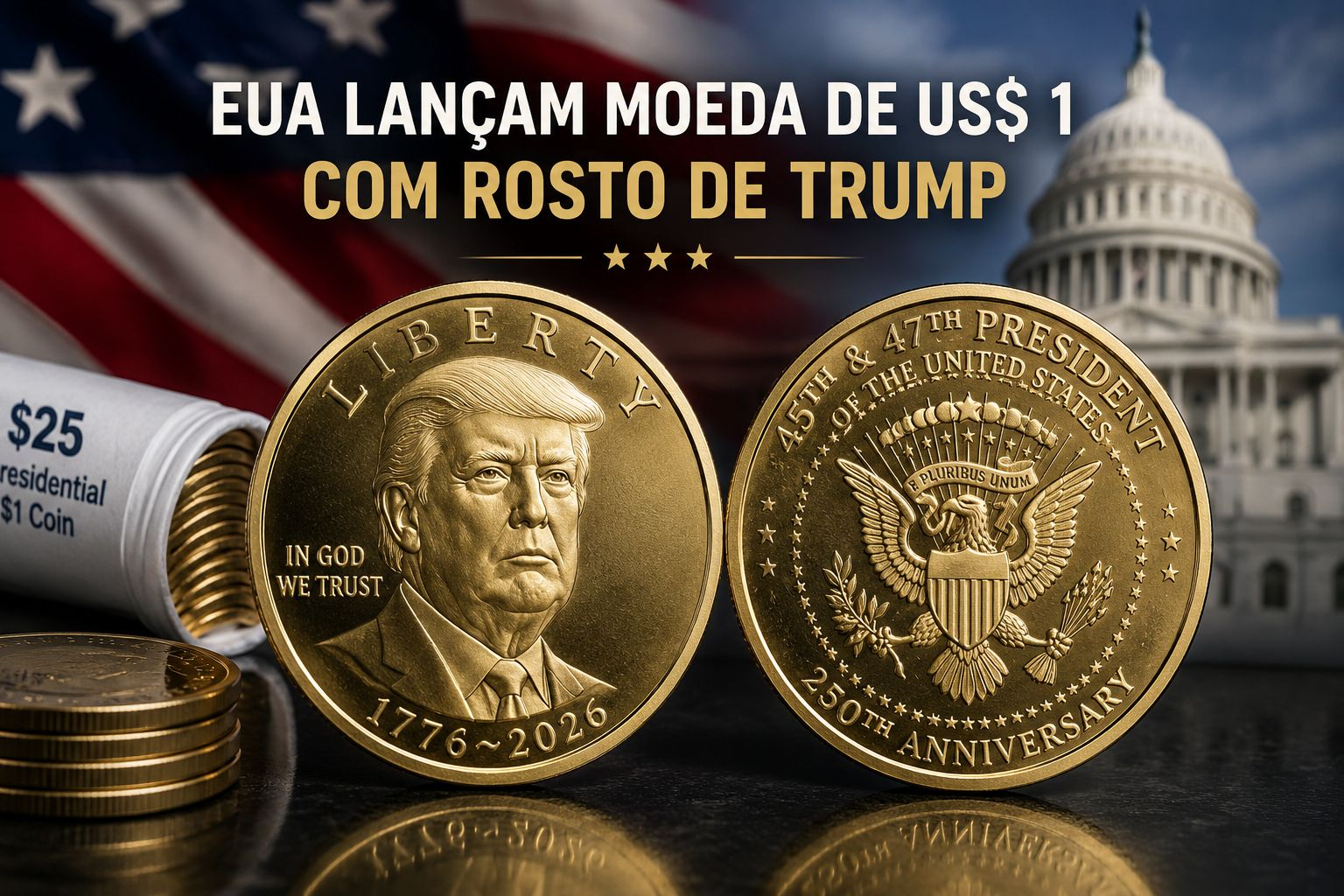
The United States has just entered a historic moment in its numismatics. On September 2, the U.S. Mint put into circulation a $1 coin bearing the face of Donald Trump, created to mark the 250th anniversary of American independence. It is only the second time in history that a sitting president appears on a U.S. coin.
The coin features Trump on the obverse, accompanied by the inscriptions “LIBERTY”, “IN GOD WE TRUST” and “1776~2026”. On the reverse, the presidential seal appears, with the eagle and the inscription “E PLURIBUS UNUM”, along with a reference to the 250th anniversary of the United States.
The detail that draws attention is the price. Although the face value is US$1, the Mint sells a roll of 25 units for US$61, while a bag with 100 coins costs US$154.50. In other words, anyone who buys directly from the Mint pays a much higher amount than the nominal value, because they are purchasing a numismatic product.
And there is no gold in the composition. The golden appearance comes from the metallic alloy used: copper, zinc, manganese, and nickel. The coin weighs 8.1 grams and was produced at the Philadelphia Mint.
The most sensitive point, however, is legal and institutional. Traditional American law prevents the depiction of living people on coins and banknotes. The Trump government argues that the specific authorization created for the Semiquincentennial commemorations allows the new design. Critics and parliamentarians challenge this interpretation.
Demand was immediate too: after sales began, the products would soon become unavailable or placed on pre-order on the Mint website.
More than a US$1 coin, the release represents a clash between institutional tradition, politics, and the symbolic power of money. The main question now isn’t just how much this coin is worth, but what it means to place the image of a president still in office on one of the main physical representations of the American state.