Recent market volatility is more favorable for DLMM liquidity providers on Sui, because when prices swing back and forth, the liquidity ranges in the main pool are repeatedly crossed, resulting in more trade volume and fees that can be captured.
Cetus’ DLMM (dynamic liquidity market maker) is a mechanism that divides liquidity into discrete price ranges, along with dynamic trading fees that automatically adjust with volatility. This allows providers to profit more efficiently from back-and-forth oscillations, which differs from traditional AMMs that mainly rely on one-directional trends.
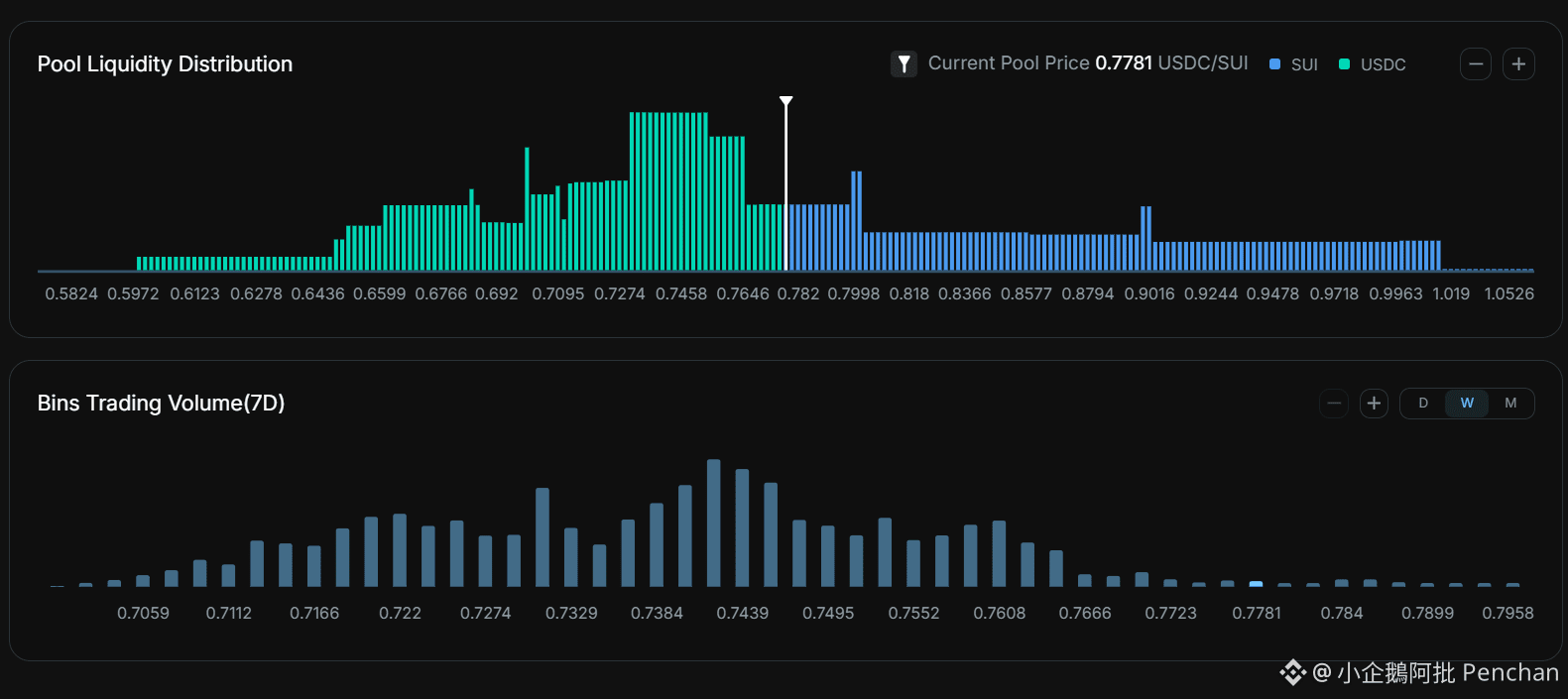
Here, we use the USDC/SUI pool as an example. The chart shows that liquidity is concentrated near the current price of about 0.7781, and that around the active range there is higher 7-day trading volume, to illustrate how volatility drives activity that repeatedly generates fees.
Cetus’ DLMM (dynamic liquidity market maker) is a mechanism that divides liquidity into discrete price ranges, along with dynamic trading fees that automatically adjust with volatility. This allows providers to profit more efficiently from back-and-forth oscillations, which differs from traditional AMMs that mainly rely on one-directional trends.
Here, we use the USDC/SUI pool as an example. The chart shows that liquidity is concentrated near the current price of about 0.7781, and that around the active range there is higher 7-day trading volume, to illustrate how volatility drives activity that repeatedly generates fees.