

Bitlayer is one of those projects I’ve been watching from the side, trying not to get too caught up in the usual crypto excitement. Bitcoin has always had this strange position in the market. It holds enormous value and has one of the strongest security records in the industry, yet when it comes to DeFi, applications, and more complicated financial activity, it can feel surprisingly limited. That gap is where Bitlayer is trying to build.
What interests me is not simply the idea of putting Bitcoin into DeFi. We have seen that story many times before. Wrapped BTC, bridges, sidechains, Layer 2s, yield products — the market has tried almost every variation of it. What I’m more curious about is whether Bitlayer can make those additional layers useful without quietly bringing back the same trust problems that Bitcoin was designed to avoid.
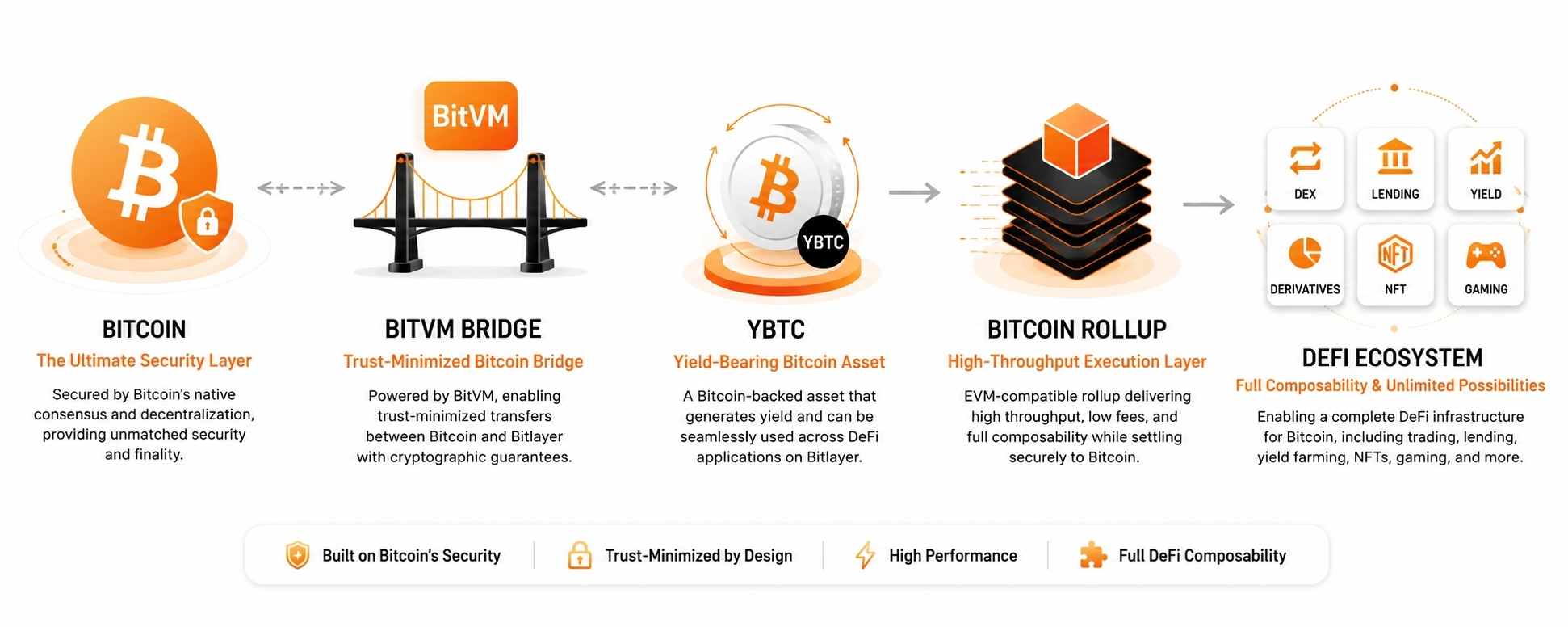
Bitlayer is built around a fairly ambitious idea: let Bitcoin remain the foundation while moving much of the computation somewhere more flexible. Its rollup architecture is designed to give developers an EVM-compatible environment, while BitVM is used as part of the mechanism for anchoring and verifying activity back to Bitcoin.
On paper, it makes sense.
Bitcoin does what Bitcoin is good at. Another layer handles the things Bitcoin was never really designed to handle.
But the more I look at systems like this, the more I think the interesting questions start after the architecture diagram.
BitVM is particularly interesting because it changes the way verification can work. Instead of asking Bitcoin to perform complicated computations directly, the system can move that work elsewhere and leave Bitcoin with a much smaller role in resolving disputes.
That sounds elegant.
Then I start thinking about the people involved.
Someone has to notice when something is wrong. Someone has to challenge an incorrect claim. Someone has to provide liquidity. Someone has to keep the system operating when the market is quiet and there is not much attention around it.
This is where crypto infrastructure becomes less about mathematics and more about incentives.
A system can be cryptographically clever and still depend heavily on participants having a reason to do their jobs.
That doesn't necessarily make the system weak. It just means the security story is bigger than the code.
Bitlayer's BitVM Bridge is a good example. The design involved brokers, attesters, and watchers, with different responsibilities around liquidity, verification, and challenging fraudulent activity. The idea was to make moving Bitcoin into a programmable environment possible without relying on a simple custodial model.
I find the watcher part especially interesting.
During a normal market, monitoring may look easy. There are transactions, activity, liquidity, and plenty of people paying attention. But what happens six months later when activity falls? Who continues watching? What happens when the economic reward for doing so becomes smaller than the cost and risk?
Those are questions that don't show up very clearly when a protocol is introduced.
They show up later.
YBTC adds another layer to the same experiment.
The idea behind YBTC is fairly straightforward: Bitcoin can be locked and represented in a form that can interact with DeFi applications. Instead of leaving BTC sitting outside programmable financial markets, it can become an asset that lending protocols, trading applications, and other systems can actually use.
There is obvious demand for that.
Bitcoin is the largest pool of crypto capital, so naturally people keep trying to make that capital productive.
But I've also become cautious around the phrase “Bitcoin-backed.”
The important question isn't only whether Bitcoin exists somewhere in the background.
The important question is whether a user can reliably get that Bitcoin back.
When markets are calm, almost every wrapped asset looks fine. Liquidity is available, prices behave, and redemption seems like a theoretical concern.
Stress changes everything.
If thousands of people want to exit at the same time, the system has to prove that its assumptions work when they are most inconvenient.
That is why Bitlayer's decision to discontinue its original BitVM Bridge is something I think deserves to be remembered rather than ignored. In 2026, Bitlayer announced that the existing bridge service would be shut down as part of an architectural transition. Bridge-in stopped in late May, followed by the end of the bridge-out grace period in early June.
I wouldn't call that a failure simply because a first version was discontinued.
Technology changes.
Sometimes a live system teaches a team things that could never have been learned from a testnet or a whitepaper. In infrastructure, replacing an early design can actually be a sign that the people building it are paying attention.
Still, it tells us something important.
Building a trust-minimized bridge isn't just about making the cryptography work.
It is also about making the entire economic machine work.
That includes liquidity, incentives, monitoring, withdrawals, user behavior, and all the uncomfortable situations that nobody wants to think about during a bull market.
Bitlayer has also been working on interoperability beyond its own environment. Its integration with Chainlink CCIP reflects a broader attempt to make Bitcoin liquidity usable across different networks.
Again, I understand the reasoning.
Liquidity doesn't like borders.
If Bitcoin is going to become more useful in DeFi, it eventually has to interact with other ecosystems. Developers aren't going to build everything in one isolated environment, and users aren't going to stop moving capital simply because a particular protocol would prefer them not to.
But interoperability also adds complexity.
You can start with Bitcoin.
Then you have the rollup.
Then YBTC.
Then another representation of that asset when it moves elsewhere.
Then an interoperability layer connecting the networks.
From the user's perspective, that could eventually become one button.
Underneath that button might be a surprisingly large collection of assumptions.
This is where I think the crypto market sometimes gets ahead of itself.
During a bull market, complexity is usually described as innovation.
A new bridge becomes a breakthrough.
A new wrapped asset becomes a liquidity primitive.
Another chain integration becomes ecosystem expansion.
TVL goes up, incentives attract users, and everything starts looking inevitable.
Then the market cools down.
The incentives become smaller.
Trading volume falls.
Liquidity becomes more expensive.
And suddenly everyone gets a much clearer view of which parts of the system people actually need.
That is the stage I'm more interested in with Bitlayer.
Not whether people will use it while there is a strong reason to speculate.
I want to know whether people will still use it when things become boring.
Will developers continue building because the infrastructure genuinely solves a problem?
Will traders choose it because the execution is good enough?
Will Bitcoin holders use YBTC because it provides useful access to DeFi rather than simply because it offers another temporary yield opportunity?
Will liquidity remain when there isn't an aggressive incentive program supporting it?
Those questions take time to answer.
Bitlayer has also attracted significant financial backing. Its $11 million Series A, announced in 2024 and led by Franklin Templeton and ABCDE, gave the project substantial resources to continue developing its infrastructure.
That matters.
Building Bitcoin infrastructure isn't cheap, and having serious investors behind a project gives a team room to experiment, hire, audit, and survive the slow parts of development.
But funding is not the same thing as demand.
Crypto has plenty of examples where capital arrived before real usage, and plenty where impressive usage disappeared once rewards disappeared.
So eventually the market has to make the decision.
Not investors.
Not announcements.
Not social media.
Users.
That's why I keep coming back to Bitcoin itself when thinking about Bitlayer.
Bitcoin became valuable partly because it is relatively simple in what it asks people to trust. You don't need to understand every application running on top of it to understand what Bitcoin is trying to do.
Bitlayer is attempting something much more complicated.
It wants Bitcoin to become the foundation for a broader financial environment while keeping Bitcoin itself largely unchanged.
That is a difficult balance.
More functionality usually means more moving parts.
More moving parts usually mean more assumptions.
And more assumptions mean more places where something can eventually go wrong.
The interesting question is whether the extra utility is worth that complexity.
Maybe it is.
Maybe this is exactly what Bitcoin needs if it is ever going to become a serious foundation for a much larger DeFi economy.
Or maybe some of the complexity will eventually prove unnecessary.
I don't think we know yet.
And honestly, that's what makes Bitlayer interesting to watch.
I'm less interested in deciding today whether it will win or lose.
I'd rather see how it behaves when the market stops being friendly.
When Bitcoin drops hard.
When liquidity gets thin.
When users want to withdraw instead of deposit.
When incentives disappear.
When someone finds a weakness and has a financial reason to exploit it.
When developers have to decide whether the infrastructure is genuinely worth building on.
Those moments tend to reveal more than any launch announcement.
Bitlayer is trying to solve a real problem. Bitcoin has enormous liquidity, but turning that liquidity into productive capital without sacrificing the properties people value about Bitcoin has always been difficult.
The project is approaching that problem through several connected pieces: a Bitcoin-focused rollup, BitVM-based verification, Bitcoin-backed assets, and cross-chain infrastructure.
It's a big experiment.
And big experiments rarely work perfectly on the first attempt.
Maybe the original bridge was one step in figuring out what the final architecture should look like. Maybe YBTC becomes a meaningful piece of Bitcoin DeFi. Maybe the rollup finds an audience among developers who want Bitcoin exposure without giving up the flexibility of an EVM environment.
Or maybe the market eventually decides that the trade-offs are too complicated.
For now, I think the fairest way to look at Bitlayer is simply to watch.
Watch the technology.
Watch the liquidity.
Watch the users.
Watch what happens when incentives change.
And especially watch what happens when people have a reason to test the system in the least comfortable conditions.
Because in crypto, the real character of an infrastructure project rarely appears when everything is going well.
It usually appears when everyone suddenly wants something different from what the system was designed to provide.
That is when the architecture stops being a diagram and becomes real.
And that is the part of Bitlayer I'm most curious about.