
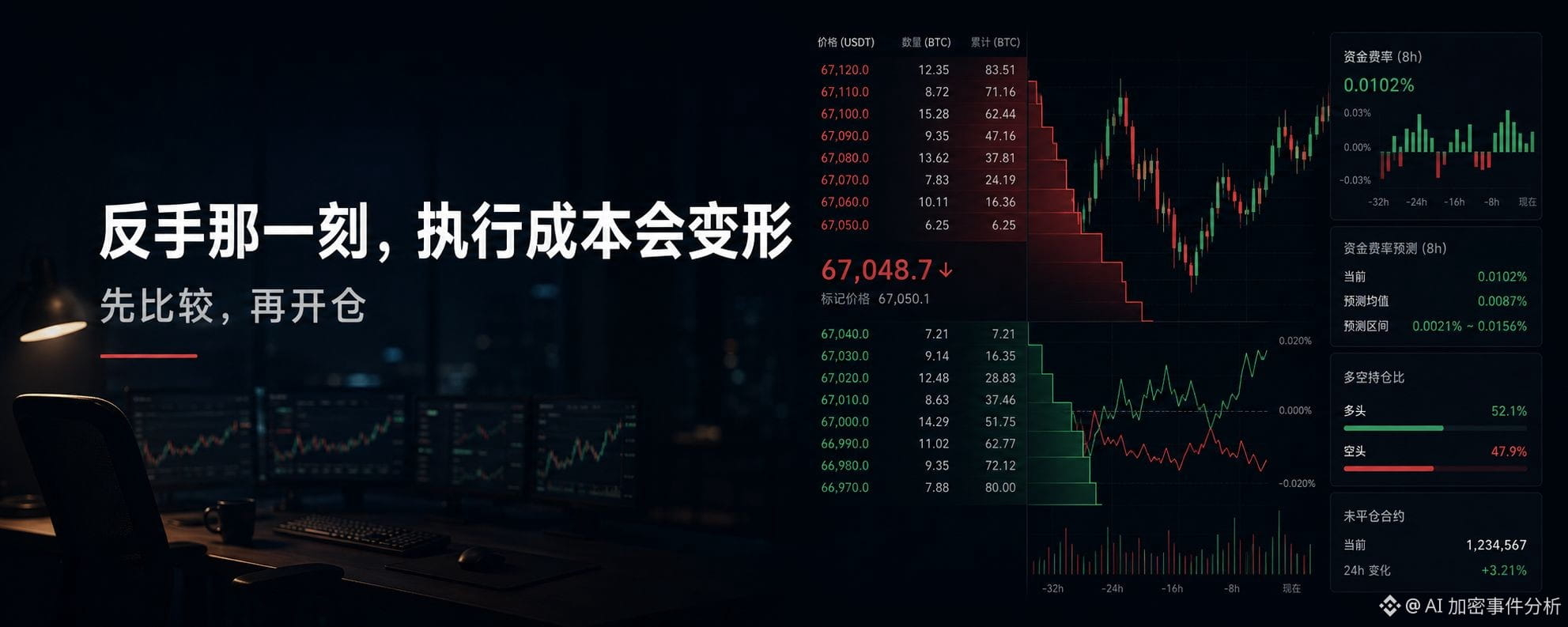

In the afternoon, the price continues to tug between roughly $77,000 and $80,000. Many contract traders naturally focus on a single question: in this move, should you reverse your position or not?
But I think the most dangerous part of reversing a position is often not the direction call. It’s that you believe you’re simply switching long to short, or short to long—yet in reality you end up executing twice in a row.
Close one position in a stroke, open a new one in a stroke. In between are variables like order book depth, slippage, trading fees, funding rates, the mark price, trigger protection, margin usage, and the liquidation buffer. The more frantic the market is, the less these variables behave like static parameters—and the more they act like costs that suddenly morph in the few seconds when you press the button.
Here’s a very realistic scenario: you see BTC bounce back from around 77.5k, and you’re ready to close your original short, then go ahead and chase a quick long. You might be right on direction, but if the order book is thin on the side you’re closing, and the funding rate is more expensive on the side you’re opening, the result reflected in your account won’t be “how much you made because your call was right,” but rather “how much you have left after you were right.”
Many people only review the candlestick chart and pay less attention to the execution path. When they lose money, they say their direction was wrong; when profits are smaller than expected, they say the market was too fast. In Perps, “the market is fast” is just the surface—what really makes people uncomfortable is that the same asset, same direction, and same leverage can turn into different trades across different venues.
Especially with reverse (flip) trading, it’s not as clean as one-way entries. You have to handle closing the old position and opening the new one at the same time, and the liquidity fragmentation issue gets amplified. Just because one place is suitable for closing doesn’t mean it’s suitable for opening immediately. Just because the fee rate looks cheap somewhere doesn’t mean the order book is deep enough to absorb your order right then.
My contrarian take is: derivative traders don’t lack entry opportunities; what they lack is an action—“pause for a moment”—at the time when trading impulse is strongest.
Direction is obviously important, but it’s only the first layer. What really determines whether this trade feels good is where you choose to execute it, and whether this path steals your edge through slippage, fees, and rules.
So I’m more convinced by the value of a Perp aggregator: it’s not to tell you whether BTC should be long or short. Instead, after you’ve already chosen the asset, it lays out and compares the depths, funding rates, trading fees, slippage, and rules across different venues. Pick the asset first, compare the execution conditions next, and then decide which route this trade should take.
This is also the point I care about most when looking at PerpEX-type Perp aggregators. It shouldn’t be only another “open position” button; it should turn the question of “where is it more appropriate to execute before and after the flip” into part of the trading action itself.
#BTC #perpetual contracts trading